
Weekly Solar Geoengineering Updates (03 August - 09 August 2026)
Weekly SRM roundup of research papers, web posts, events, jobs, projects, podcasts, videos and much more.

JUMP TO SECTION
1. This Week’s Top SRM Updates
2. Research Papers
3. Theses
4. Web Posts
5. Reports
5. Job Opportunities
6. Upcoming Events
7. Podcast
7. YouTube Videos

THIS WEEK’S TOP SRM UPDATES
Research Paper: Managing climate overshoot: a risk-based strategy for climate stabilisation (Frontiers)
Monthly SRM News Brief: Monthly Solar Geoengineering Updates (July’2026) (Solar Geoengineering Updates)
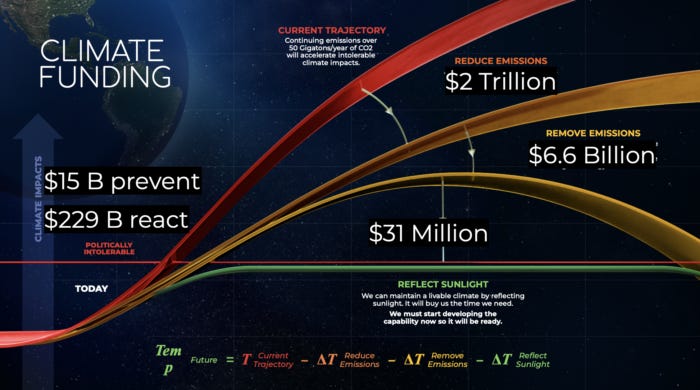
Blog: Planetary Sunshade Institute - Funding Landscape for Reducing, Removing and Reflecting (Planetary Sunshade Institute)
Upcoming Event: Workshop on Solar Radiation Modification (India International Center)
Job Opportunity: Postdoctoral Scholar – Solar Geoengineering Climate Response Evaluation (University of Chicago MS in Environmental Science)
Podcast: Can We Save the Doomsday Glacier? — Marianne Hagen, Seabed Curtain Project (Inevitable & Obvious)
YouTube Video: Climate Moonshot (To Save The World)
Read on to unpack more updates:
Solar geoengineering is one of the most important climate topics of our time.
We monitor hundreds of sources every week and deliver the most important SRM developments in one curated briefing. If these updates save you time each week, please consider becoming a paid subscriber to support the work.
RESEARCH PAPERS
Synchronizing climate intervention: On the infrastructural timing of expert foresight
Authors: J. Daniel Andersson, Anders Hansson, and Mathias Fridahl
Synopsis: The paper examines how computer-based climate models shape anticipatory governance of large-scale interventions such as solar geoengineering. Focusing on the Geoengineering Model Intercomparison Project, it shows how model intercomparison projects synchronize scientific, technical and political timelines through experimental protocols, historical simulations and data organization. The study argues that synchronization depends not only on formal modelling but also on practical expert judgement, revealing how knowledge infrastructures influence expectations about the feasibility and future governance of climate interventions.
Managing climate overshoot: a risk-based strategy for climate stabilisation
Authors: Graeme Taylor, Peter Wadhams, Thomas Goreau, Suzanne Reed, Heri Kuswanto, Daniele Visioni, Dennis Garrity
Synopsis: The paper argues that current climate strategies focused on emissions reduction and carbon removal may not act quickly enough to prevent dangerous climate tipping points. It frames climate stabilisation as a risk-management challenge, calling for explicit comparison of the risks of climate interventions with those of continued warming. The authors propose a risk–risk framework integrating mitigation, carbon removal and cooling interventions, suggesting that carefully governed cooling could complement rapid decarbonisation and carbon removal to address near-term warming.
Authors: Shirin Ajabi, Abolfazl Rezaei
Synopsis: New climate modelling finds that SAI could substantially reduce projected disruptions to the global snow cycle under severe warming. Using six climate models under the SSP5-8.5 scenario, the study projects major declines in snow mass, snow cover, snow depth and melt rates by 2070–2099, alongside earlier seasonal melt. The G6sulfur SAI scenario significantly limits these losses and largely preserves seasonal snow timing. However, residual changes remain, highlighting that SAI could only complement—not replace—rapid greenhouse gas emissions reductions.
Authors: Christer Persson, Peder Jonsson, Lars Söderqvist, Henrik Baltscheffsky, Håkan Thorsell
Synopsis: A proposed financing and governance framework called FiGo is applied to the development of Planetary Sunshades at the Sun–Earth L1 point for space-based solar radiation modification. The initiative, termed Sunshades in Space Undertaking (SiSU), aims to develop the capability to reduce up to 1% of incoming solar radiation as part of long-term climate stabilization efforts. The model separates strategic governance, financing and operations while using intellectual-property revenues from the expanding space economy to fund the undertaking over roughly 50 years. Importantly, returns would not depend on deploying the sunshades, reducing incentives for premature deployment before scientific, legal, ethical and multilateral approvals.
THESES
Authors: Francesca Giacoma
Synopsis: This thesis explores Deployable Reflective Membrane Arrays as a potential technology for Space-Based Solar Radiation Management (SB-SRM). Focusing on systems positioned near the Sun–Earth L1 point, it reviews membrane and solar-sail technologies and compares alternative space-based geoengineering architectures. The study develops a preliminary mission concept covering membrane sizing, spacecraft configuration, deployment, mass and power requirements, and station-keeping, while identifying challenges in scalability, structural stability, formation control, manufacturing and long-term operation.
WEB POSTS
Solar Geoengineering Updates - Monthly Solar Geoengineering Updates (July’2026)
Planetary Sunshade Institute - Funding Landscape for Reducing, Removing and Reflecting
News Scientist - Could geoengineering ‘ice arches’ help preserve Arctic sea ice?
Green European Journal - A Feminist Approach to Solar Geoengineering
Mahabahu - India Climate Cooling Summit to Advance National Strategies
DSG - Community Engagement in Solar Radiation Modification: Lessons from Two Models
SRM360 - What Is El Niño and How Would SRM Affect It?
SRM360 - Cooling, Drying, and the Fine Print: Lessons on SRM From Tanzania
Yahoo - Conservative group preps lawsuits against solar geoengineering, reviving ‘chemtrails’ claim
REPORTS
Cambridge University Press - Ethics and Planetary Boundaries
UPCOMING EVENTS
17 August | New Delhi - Workshop on Solar Radiation Modification (SRM) organized by the India International Center (NEW)
19 August | Online - Solar Geoengineering and India – Heat, Pollution, and Politics by SRM360
01 September | Online - Beyond the Headlines: Reporting on Solar Geoengineering by Solution Journalism Network
10-11 September | Washington, DC. - 2026 RFF and Harvard SRM Social Science Research Workshop
12-13 October | Reykjavik, Iceland - Global Risk and Stabilization Summit 2026 by ARC
12-15 October | Malaysia - Global Tipping Points 2026 | Abstract Deadline: 15 May
05 November | Ortega, Stanford - Global Environmental Policy Seminar with David Keith by Stanford University (NEW)
7–11 December 2026 | San Francisco, CA - AGU26 Annual Meeting | Abstract Submission Deadline: 05 August 2026
10-14 January 2027 | Denver, CO & Online | 19th Symposium on Aerosol–Cloud–Climate Interactions
08-09 April 2027 | United States - 2027 Solar Radiation Management Annual Meeting by Simons Foundation
Add our Solar Geoengineering Events Calendar to your default calendar in 2 ways:
Head to this link: https://teamup.com/ks64mmvtit583eitxx
Sync specific event: Click the event → menu (≡) → Share → choose your calendar → Save.
Or sync all events: Menu (≡) → Preferences → iCalendar Feeds → Copy URL → Add to your calendar settings → Subscribe.
JOB OPPORTUNITIES
Postdoctoral Scholar – Solar Geoengineering Climate Response Evaluation at University of Chicago MS in Environmental Science | Scholar Green, England, United Kingdom
PODCASTS
Can We Save the Doomsday Glacier? — Marianne Hagen, Seabed Curtain Project | Inevitable & Obvious
“An underwater curtain 150 meters tall and 80 kilometers wide, anchored to the Antarctic seabed, may be the most direct thing anyone can do about sea level rise this century. Marianne Hagen co-leads the Seabed Curtain Project after serving as Norway’s deputy foreign minister and as an executive vice president at Aker Solutions, so she has spent a career inside the rooms where governments and industry actually decide about energy and risk. We talk about why warm, salty bottom water started creeping over a seabed sill a few decades ago and now flows down a Grand Canyon-sized channel to the soft underbelly of Thwaites Glacier, and why that glacier works like a cork in a champagne bottle holding back the West Antarctic Ice Sheet. Then we get into the fix itself: raising that sill, 200 kilometers from the glacier, back to the height that kept the warm water out. We also cover this year’s expedition, which drilled through a thousand meters of ice and confirmed the warm water before losing its fiber optic cable at 700 meters, and why the next chance at that data is 2028 unless someone finds a ship.”
“My guest on the podcast this week is Prof Sir David King. An incredibly accomplished scientist with over 500 papers to his name, he has also been Chief Scientific Advisor to the UK government, the UK Government’s Special Representative for Climate Change, and in May 2020 he formed and led Independent SAGE amongst other accomplishments.”
YOUTUBE VIDEOS
“Marianne Hagen, Co-Lead of the Seabed Curtain Project, discusses the topic of climate systems engineering and what’s unique about UChicago.”
Could the known cooling by air pollution be safely mimicked to cool the oceans? | Clive Elsworth
“This presentation brought together members of the Healthy Planet Action Coalition (HPAC), including scientists, engineers and policy-focused participants, to discuss the potential use of Marine Cloud Brightening (MCB) as a climate-cooling intervention.
It was chaired by Clive Elsworth and focused on a proposed approach using sulfate aerosol particles to increase the reflectivity of suitable marine clouds, thereby reducing the amount of solar energy absorbed by the ocean.”
“Large Explosive Volcanos Cause Significant Short-Term Cooling, But AlSO Trigger Century Long Cooling
When a large volcano erupts and sends ash and soot and sulfur into the upper atmosphere it causes a short-term cooling, for example it can reduce global average temperatures by 0.5 to 1.0 degrees Celsius for 3 to 5 years.
What most people do not realize, is that there is often a longer term cooling as well, often lasting for a century or a few centuries up to even 1000 years. This long-term cooling is measured by looking at glacial advance both at the poles and at high altitudes. “
NOAC meeting - 3 Aug 2026 | Clive Elsworth
“Agenda
Clive – MCB cooling by Sulfate Aerosol
Glenn – Proposals to fund SRM
Greg S – El-Nino or just underlying warming?
Sev – Invitation to identify using AI countries for cooling experiments
Brian – At Impact Week at Singapore next week. – General update
Ron B – Regeneration of ship tracks – to avoid Iceland Termination Shock”
“As climate change continues to worsen, and fires rage across the planet, it’s time to ask, can we fix this? This video takes you through Stratospheric Aerosol Injection, how it works, the dangers and advantages.”
Climate Moonshot | To Save The World
“Glenn Weinreb discusses his Manhattan2 project, proposing a climate moonshot focused on research, development, and stratospheric aerosol injection to help cool the Earth.”
Follow us on: Twitter | Bluesky | LinkedIn | Google Group | Podcast
Support us here:
While all content on Solar Geoengineering Updates is free for everyone, We urge those who can to become paid subscribers. Your support empowers this important work and helps us spread the message far and wide.