
Monthly Solar Geoengineering Updates (July'2026)
From MCB research on super El Niños to anti-geoengineering campaigns, SRM governance frameworks, global dimming debates & climate intervention taxonomies, here are July 2026's SRM headlines

Solar geoengineering is one of the most important climate topics of our time.
We monitor hundreds of sources every week and deliver the most important SRM developments in one curated briefing. If these updates save you time, please consider becoming a paid subscriber to support the work.
Follow us on: Twitter | Bluesky | LinkedIn | Google Group | Podcast

TOP 10 SRM UPDATES FROM JULY 2026
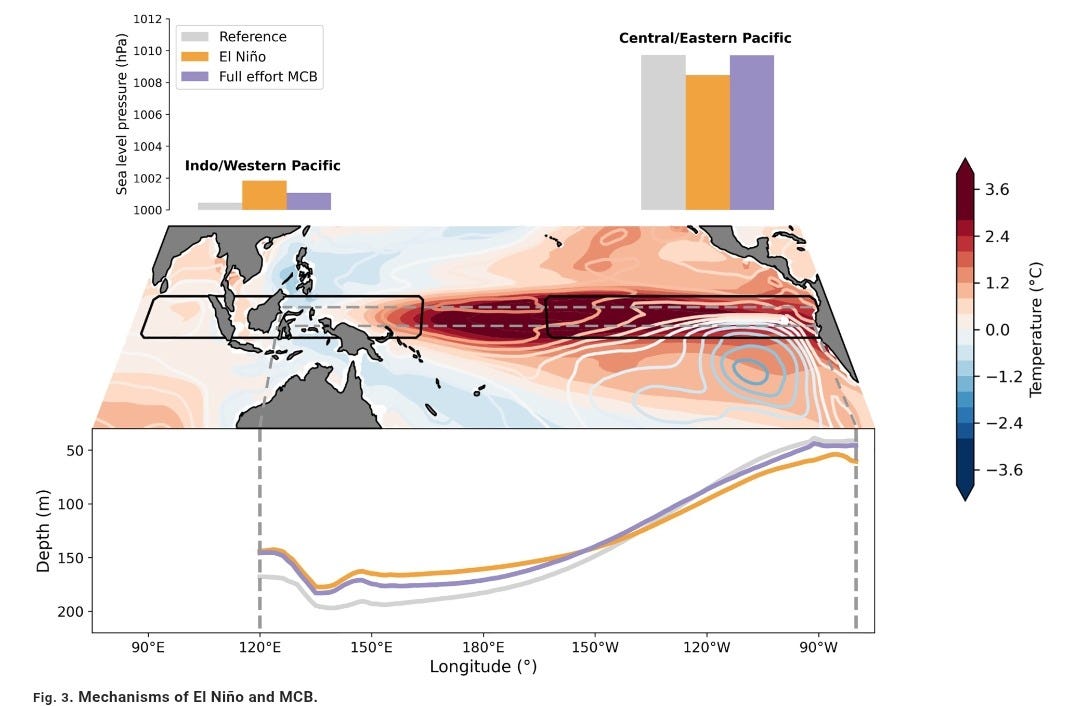
Could Geoengineering Work To Tamp Down Super El Niños?
Building on observations from the 2019-2020 Australian wildfires, researchers found that early, sustained cloud brightening over the southeast Pacific can disrupt the feedbacks that intensify El Niño, potentially restoring neutral ENSO conditions and reducing global climate impacts. However, the intervention could also produce unintended consequences, including an earlier La Niña, underscoring the complexity and risks of using MCB to influence climate variability.
Anti-Geoengineering Group The GeoFight Prepares Legal Campaign Against Two Unnamed SRM Companies
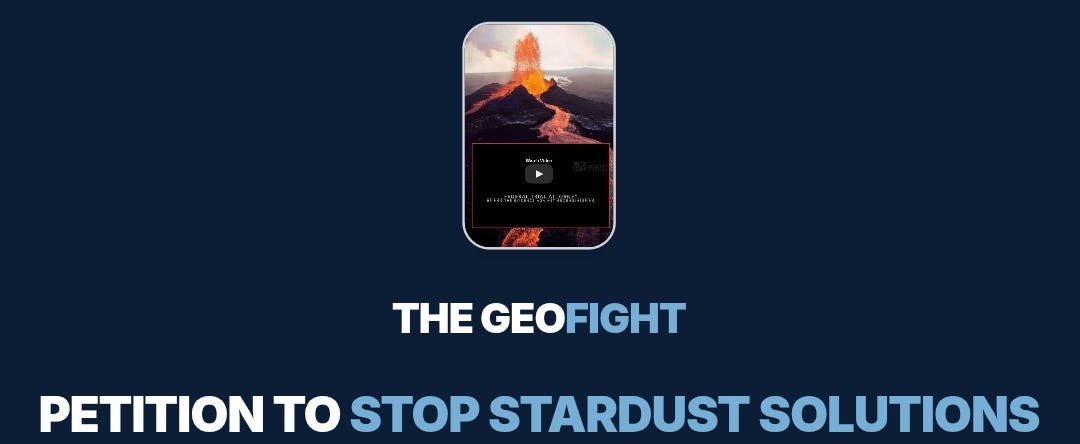
A conservative group called The GeoFight is launching a legal and media campaign against sunlight-reflecting climate technologies, seeking to block solar geoengineering research through lawsuits, petitions and online activism. Founded in February by attorneys Nicole Pearson, Thomas Renz and Blake Horwitz, the group has linked solar radiation management with broader “weather modification” claims, including chemtrail conspiracies.
It is targeting technologies such as Stardust Solutions’ proposed stratospheric particle deployment system and has also criticized cloud-seeding company Rainmaker Technology. Supported by prominent conservative voices, including Tucker Carlson and Marjorie Taylor Greene, the campaign has raised concerns among researchers that misinformation could push Republicans against studying SRM as climate risks intensify.
Former Trump Energy Adviser Makes Counterintuitive Pitch to Sell Republicans on Sun-Blocking Technologies
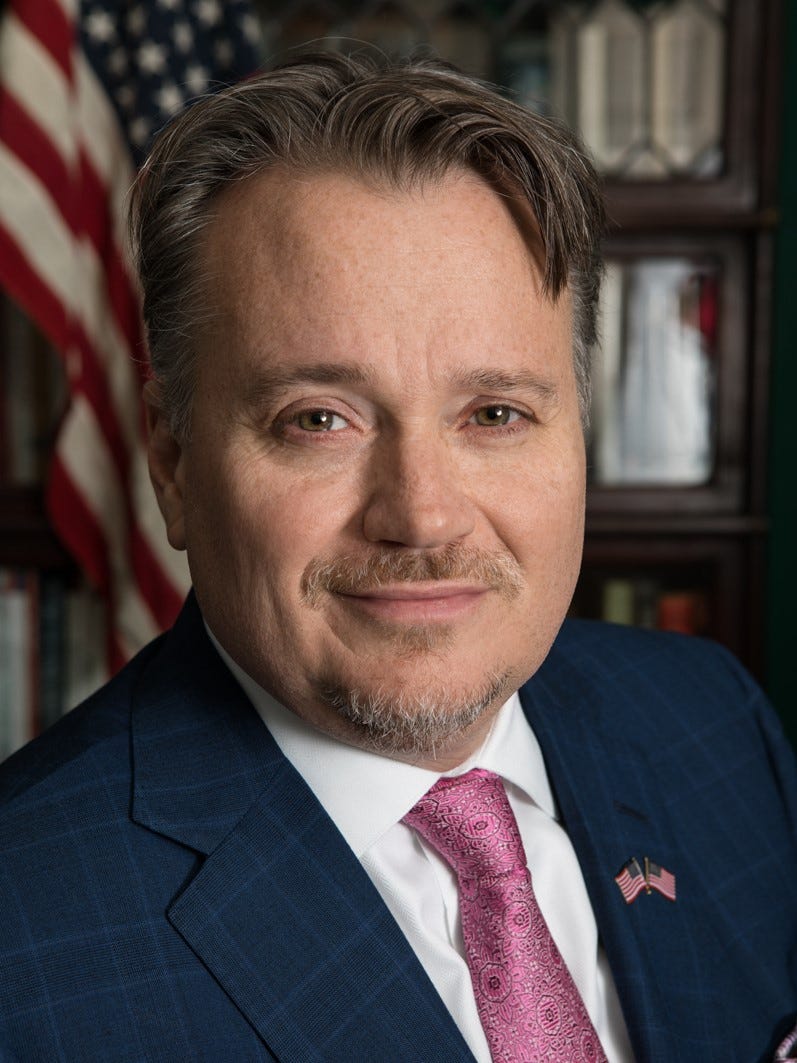
Former Trump international energy adviser George David Banks urged Republicans to support research into solar radiation management, arguing the technology could serve as an “insurance policy” that temporarily allows continued fossil fuel use while limiting global warming.
Speaking at an Aspen Institute conference, Banks said sunlight-reflecting technologies deserve greater federal research support despite political skepticism. His remarks come as conservative opposition to geoengineering grows, highlighting an emerging divide within Republican circles over the role of SRM in climate policy.
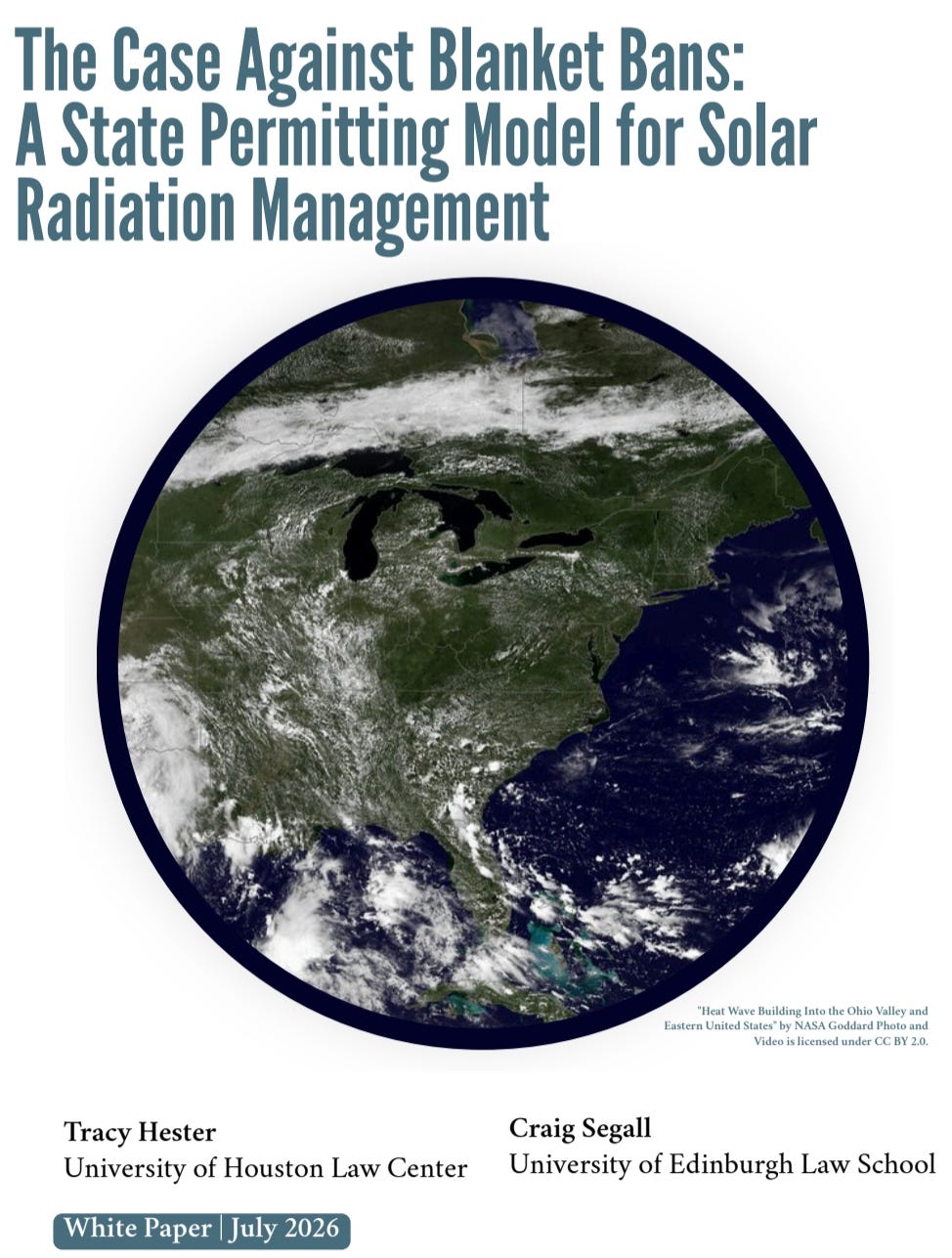
UH Law Report Calls for Permitting System Instead of SRM Research Bans
A new report from the University of Houston Law Center argued that states should regulate solar radiation management research through permitting systems rather than blanket bans. The report, “The Case Against Blanket Bans: A State Permitting Model for Solar Radiation Management,” said prohibitions could hinder scientific research while failing to provide effective oversight.
It noted that 133 bills targeting SRM or weather modification have been introduced across 38 U.S. states since 2023, with three states adopting bans. The authors proposed a framework with monitoring, transparency and public engagement requirements to allow responsible research while preventing deployment without safeguards.
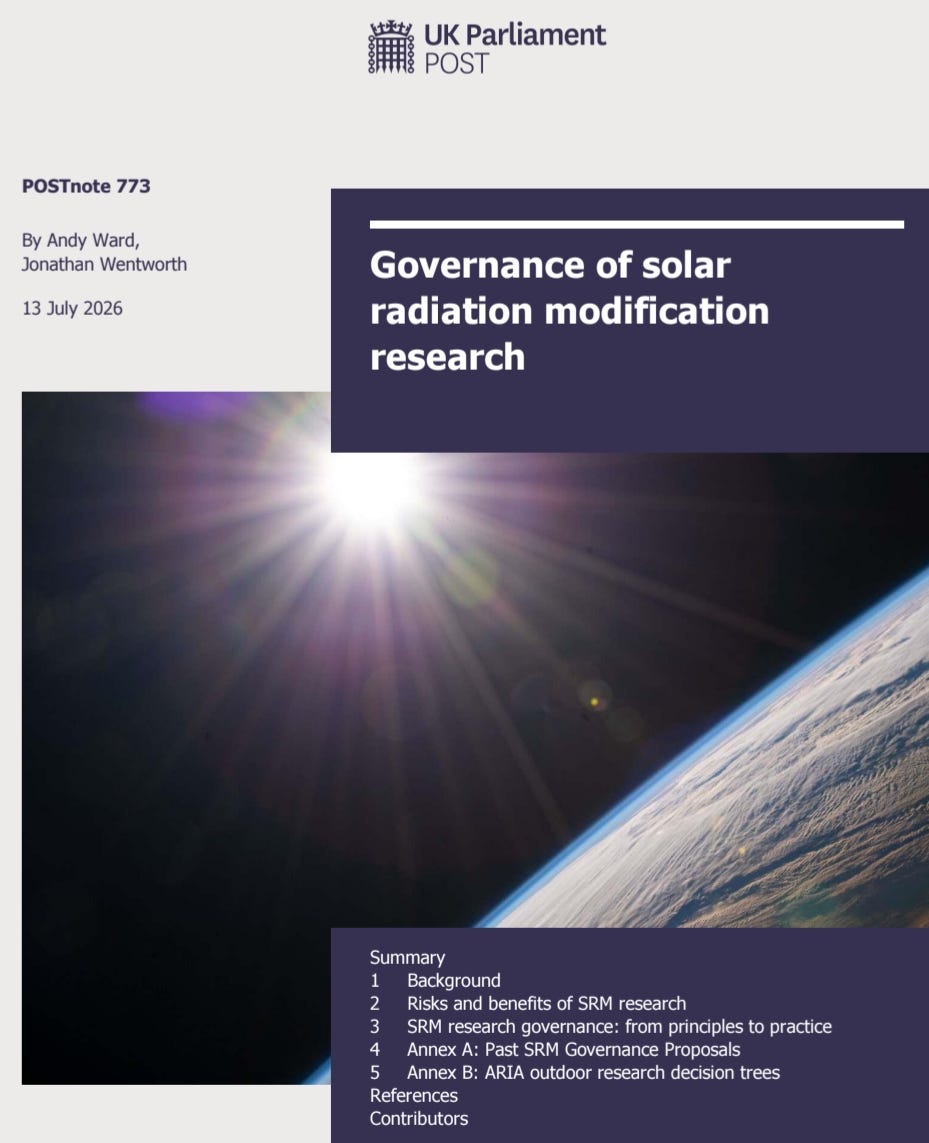
UK Parliament Report Examines Governance Challenges for Solar Radiation Modification Research
The UK Parliament’s Parliamentary Office of Science and Technology (POST) has published a briefing examining how governance for solar radiation modification research could be developed as interest in outdoor experiments increases.
The report reviews SRM approaches, potential benefits and risks, research activities, funding trends, and challenges including geopolitical tensions, ethical concerns, public participation, and legislative challenges involved in developing governance approaches. It highlights that SRM cannot replace emissions cuts and that effective oversight will require transparency, inclusive engagement, and adaptive governance.
The Economist: Global Dimming Decline Is Making Earth Even Hotter
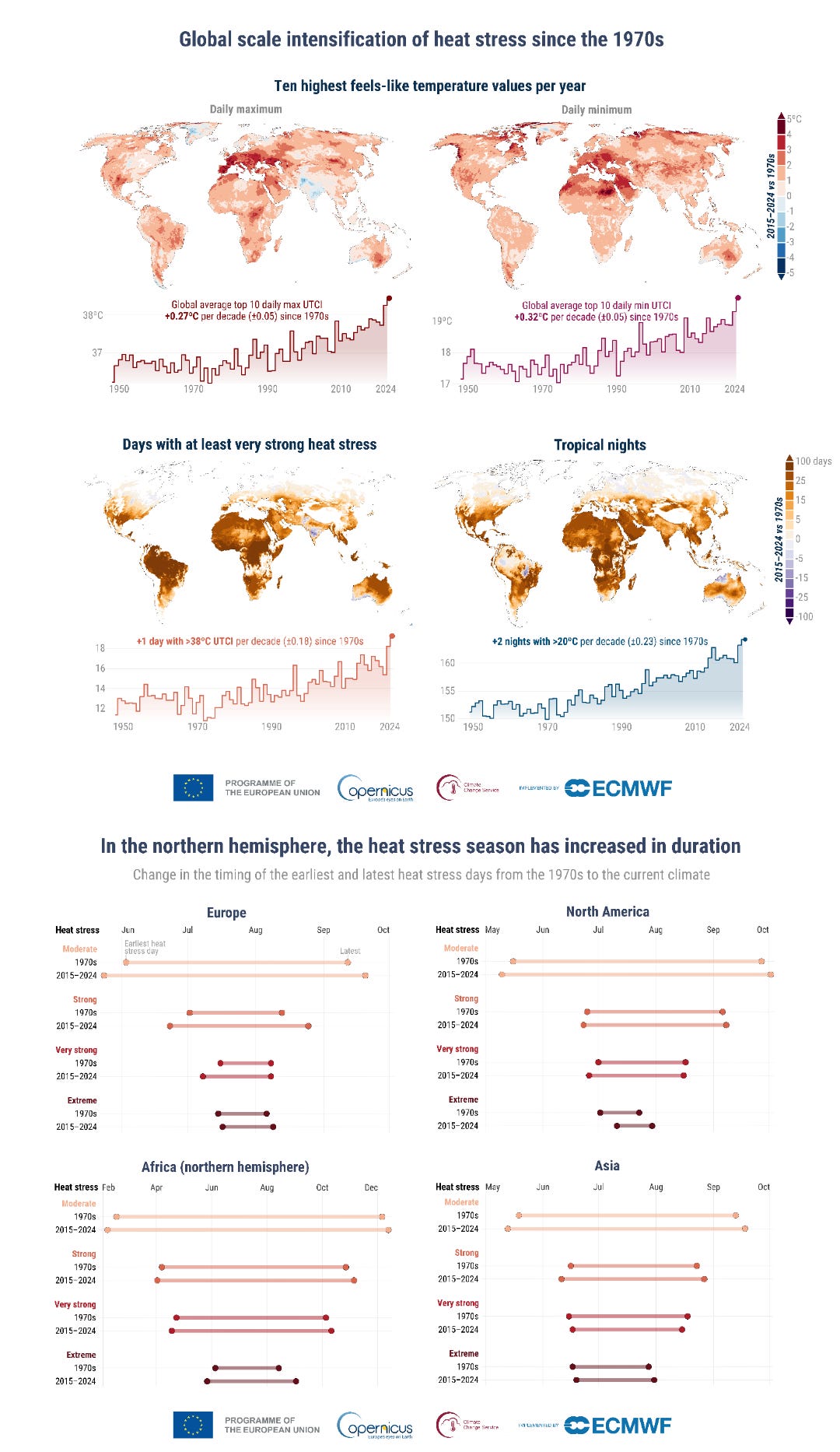
The Economist argued that recent record-breaking heat is being intensified not only by greenhouse gases but also by the weakening of global dimming - the decline in cooling aerosols that once reflected sunlight back into space.
As cleaner air policies reduce pollution, Earth’s albedo declines, allowing more solar energy to be absorbed, increasing the planet’s energy imbalance, accelerating warming and worsening heatwaves. The magazine said this “unmasking” effect makes rapid emissions cuts even more urgent while renewing debate over solar geoengineering despite its scientific, political and ethical risks.

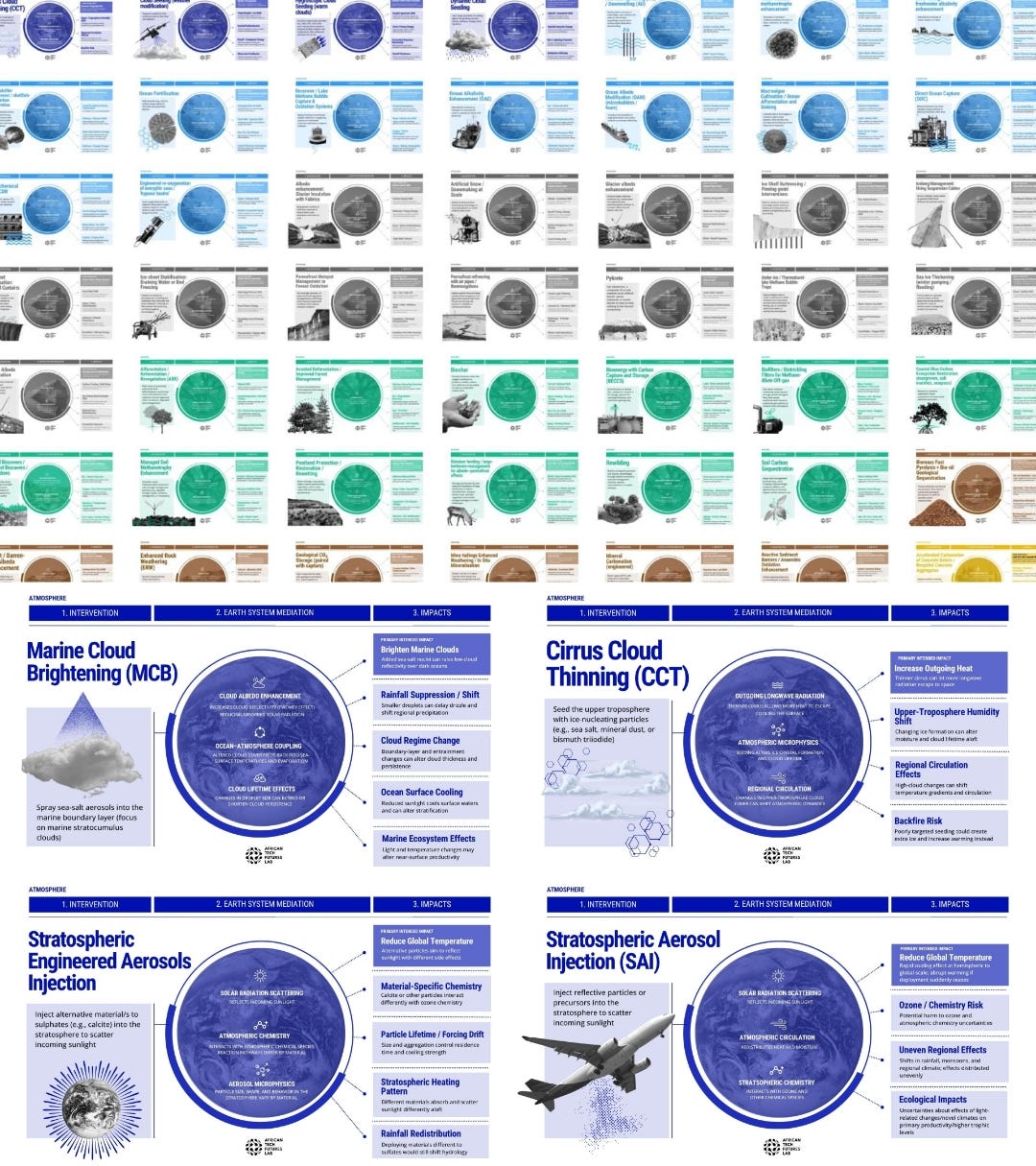
New Climate Intervention Taxonomy Maps 75 Geoengineering Approaches
African Tech Futures Labs introduced a new taxonomy of climate interventions that organizes 75 approaches into standardized “cards” to improve understanding and governance of emerging climate technologies. Each card examines three connected elements: the human action involved, the Earth system processes affected, and the intended or unintended impacts that follow.
Covering approaches from carbon dioxide removal to solar radiation modification, the taxonomy aims to clarify what can be governed, where uncertainties remain, and how different interventions create distinct risks and policy challenges as climate intervention research expands.
Global Risk and Stabilization Summit 2026 to Convene in Reykjavík, Iceland
The Climate Emergencies Forum (CEF) will host the first Global Risk and Stabilization Summit in Reykjavík, Iceland, from October 12-13, 2026, bringing together more than 250 scientists, policymakers, Indigenous leaders, youth representatives, funders and other stakeholders.
The summit aims to advance global efforts to predict, prepare for and prevent catastrophic climate risks by creating shared research priorities and coordinated pathways for Earth systems stabilization. The event will coincide with the release of the first Systemic Risk and Stabilization Report, designed to support a broader global agenda for managing planetary risks.
New Mexico Climate Group Adopts Principles for Solar Radiation Modification
Conservation Voters New Mexico (CVNM) has adopted an internal Statement of Principles to guide its engagement on solar radiation modification. The framework states that SRM should not substitute for emissions reductions or climate adaptation, supports responsible research, transparent and inclusive governance, and emphasizes environmental justice and public participation. CVNM remains outcome-neutral on future SRM deployment while using the principles to guide its ongoing engagement with the issue.

Scottish Government Clarifies Position on Solar Radiation Modification
In response to a Freedom of Information (FOI) request, the Scottish Government stated that it does not support solar radiation modification and is not aware of any SRM projects planned or deployed in Scotland. It said any proposed SRM project would require stringent planning and consenting processes, including full public consultation.
The Government also confirmed that it does not hold information relating to SRM communications, permits, monitoring data, or environmental assessments requested under the Environmental Information (Scotland) Regulations. The response highlights ongoing questions around transparency and governance of emerging climate interventions.
For a full recap of last month’s updates, check out our weekly summaries: WEEK 1 | WEEK 2 | WEEK 3 | WEEK 4 | WEEK 5
And here’s an overview:
RESEARCH PAPERS
Impact of Stratospheric Aerosol Injection on Rangeland Productivity and Animal Production in Africa | Authors: Ashleigh Ho et al.
Study found that SAI could create uneven impacts on African rangelands and livestock by altering rainfall patterns despite reducing warming.
Robust Solar Radiation Modification Strategy for Achieving Temperature Targets | Authors: Guo-Liang Zheng et al.
Researchers developed a decision-making framework showing that a phased SAI deployment strategy could better balance climate targets and the risks of over-deployment under uncertainty.
When are small-scale field experiments in solar geoengineering worth pursuing? | Authors: Ryan O’Loughlin et al.
Researchers proposed a five-part framework to evaluate small-scale solar geoengineering field experiments, emphasizing scientific value, transparency, and strong governance over appeals to urgency.
The Potential Legal Issues, and Challenges of Utilising Geoengineering in Climate Change Mitigation | Authors: Mukhlish Mukhlish et al.
A review concludes that existing international governance is insufficient for geoengineering, calling for stronger global legal frameworks, oversight, and support for developing countries.
Parallel and diverging responses across four Earth system models in response to cirrus cloud thinning climate intervention experiment | Authors: William McFarlane Smith et al.
A GeoMIP study finds cirrus cloud thinning could cool the planet and increase global precipitation, but large model differences highlight significant uncertainties in its climate impacts.
Leveraging transfers to strengthen climate cooperation under the threat of solar geoengineering | Authors: David M. McEvoy et al.
Researchers found that financial transfers in international climate agreements could strengthen emissions cooperation and reduce reliance on solar geoengineering.
Challenges and Opportunities of Solar Geoengineering for Climate Governance | Authors: Furini, Francesco et al.
This review examines the governance challenges of solar geoengineering, highlighting the risks of unilateral deployment and its implications for international climate cooperation.
Cool cities, local contexts: A typology of cooling interventions across the disciplines to address extreme heat and decarbonization in urban areas | Authors: Melissa A Martin et al.
This study proposes a framework for local cooling interventions, highlighting how adaptation, mitigation, and geoengineering can work together to reduce extreme urban heat.
Solar radiation modification in Asia: Current progress, knowledge gaps and future priorities | Authors: Hai-Yuan TANG et al.
Paper finds SRM research in Asia has expanded rapidly since 2023, but major knowledge gaps remain on its regional impacts, governance, and policy needs.
Hydrologic Sensitivity of Snow and Streamflow Dynamics to Climate Forcing With and Without Stratospheric Aerosol Intervention | Authors: Abolfazl Rezaei et al.
Climate model simulations suggest SAI could preserve Northern Hemisphere snowpack and seasonal runoff by preventing the warming-driven shift from snowfall to rainfall.
Responses of streamflow extremes under solar radiation modification in the Muda River Basin, Malaysia | Authors: Puteri Nur Atiqah Bandira et al.
Modeling results suggest SRM could moderate changes in streamflow in Malaysia’s Muda River Basin, but may not consistently reduce flood and drought extremes.
A stratospheric hose for solar radiation management | Authors: Roderick A. Hyde
Engineers proposed a balloon-supported hose system to deliver sulfur into the stratosphere for SAI, outlining its feasibility for small-scale field tests and future larger-scale deployment.
The Impact of Aerosols on Climate Forcing and Cloud Microphysics | Authors: M. G. Abdullaha et al.
Researchers found that aerosols strongly influence climate and clouds, with sulfates producing cooling and black carbon causing warming while increasing cloud reflectivity and suppressing rainfall.
Bubbles, Droplets, Climate: Tellus’s Enduring Influence on Sea Spray Aerosol Research | Authors: Matthew E. Salter
This Perspective reviews advances in sea spray aerosol research, highlighting its growing importance for understanding climate, air–sea interactions, and marine cloud brightening.
Marine cloud brightening of cumulus clouds: from the sprayer to the cloud | Authors: Johannes Kainz et al.
High-resolution simulations show that near-surface aerosol sprayers are more effective for marine cloud brightening than higher-altitude deployment.
Pathway-dependent responses of temperature extremes under Solar Radiation Modification over Northern Africa | Authors: Kenny T.C. Lim Kam Sian et al.
Climate model simulations show that SRM could reduce extreme heat across North Africa, but would not fully restore historical patterns of temperature extremes.
Climate Change Action and Climate Geoengineering Under Neorealism | Authors: Filipe Duarte Santos et al.
Study examines how shifting global power dynamics could influence SRM deployment, warning that geopolitical competition may increase reliance on geoengineering despite governance challenges.
Targeted marine cloud brightening weakens subsequent El Niño | Authors: Jessica S. Wan, et al.
Simulations suggest MCB could weaken El Niño events by altering ocean–atmosphere feedbacks, but may also trigger unintended shifts such as earlier La Niña conditions.
Modeled dependence of climate feedback on CO2 and stratospheric aerosol forcing at different latitudes | Authors: Long Cao et al.
Climate model results show that sulfate aerosol forcing has a different warming response than CO₂ forcing, with effectiveness strongly influenced by feedbacks and forcing location.
PREPRINTS
A high-resolution coupled atmosphere-ocean model of the Great Barrier Reef: ACCESS-EMS-GBR v1.0 | Authors: Rebecca L. Jackson et al.
Researchers developed a high-resolution model of the Great Barrier Reef to improve assessments of MCB impacts on marine aerosols, climate interactions, and coral ecosystems.
Purely light-scattering aerosols could induce positive shortwave radiative forcing over high-albedo surfaces | Authors: Longrui Zhang et al.
Radiative transfer simulations reveal that stratospheric aerosols could cause unexpected warming over bright snow and ice surfaces, potentially increasing localized melting risks.
Exit ramps crucial for outdoor testing of stratospheric aerosol injection | Authors: Gregory Nemet
Analysis finds a major scale gap between SAI experiments and deployment scenarios, suggesting intermediate tests could reduce uncertainties while requiring safeguards against escalation.
Tracing vessel-generated sea spray aerosols to support marine cloud brightening | Authors: Xiaoshen Sun et al.
Scientists developed an airborne tracer method to track MCB aerosol plumes over the Great Barrier Reef, improving monitoring of marine cloud experiments.
“The apex of all climate interventions”? Reducing vulnerability to extreme heat in urban West Africa with direct cooling technology through Mirrors for Earth’s Energy | Authors: Benjamin K Sovacool
A case study of the MEER project in Freetown shows how reflective materials and recycled structures could provide low-cost cooling solutions for heat-vulnerable communities.
A framework for understanding and narrowing uncertainties for Solar Radiation Modification modeling experiments | Authors: Dr. Daniele Visioni et al.
Researchers propose a framework separating SRM uncertainties into scenario and physical factors, finding improved aerosol modeling could significantly reduce uncertainty in climate projections.
Understanding drivers of inter-model uncertainty in the dynamical response to stratospheric heating | Authors: Colleen Marie Golja et al.
SHeatMIP simulations show that SAI-related stratospheric heating could alter atmospheric circulation, with water vapor changes remaining a major source of uncertainty.
THESES
Weather in a Geo-Engineered Climate: Extratropical Cyclones and Monsoon Dynamics | Authors: Nooij, Meike de
High-resolution simulations show that SAI alters storm tracks and monsoon patterns regionally, producing distinct climate responses rather than simply reversing warming effects.
Dynamical Downscaling to Quantify Extreme Precipitation Under Stratospheric Sulfate Aerosol Injection | Authors: Nguyen, Trung
High-resolution modeling shows that SAI could slightly reduce extreme rainfall in the U.S. Midwest, while highlighting the importance of finer-scale climate simulations for regional impacts.
Geoengineering as Defensive War: Why Climate Change Troubles the Waters of Just War Theory | Authors: Milgrim, Jonathan T.
This thesis explores whether geoengineering could be viewed as a defensive response to climate change, challenging traditional ethical frameworks around self-defense and proportionality.
WEB POSTS
Solar Geoengineering Updates - Monthly Solar Geoengineering Updates (June’2026)
The Times - Bright sparks hope drones giving clouds a jolt can cool planet
Kentucky New Era - Legislators urge General Assembly to enforce geoengineering penalties
Peter Dynes - The Red Flags Are Everywhere. Why Are We Still Arguing About Whether Cooling Research Is Necessary?
The Cooler - Much ado about geoengineering
Climate Trunk - Why Earth is reflecting less of the Sun’s energy
GNA - Experts call for African voice in solar geoengineering debate
NASA - Dimming the Sun (DimSun) Using Controllable Dust Cloud to Reduce Solar Insolation
Upon Further Reflections - Sunlight reflection options: a quick primer (and why Reflective prioritizes SAI)
University of Houston Law Center - New UH Law Center Report Offers Safe Permitting Model as States Weigh Counterproductive Legislation on Solar Radiation Management Research
ScienceDirect - Letter to the editor: Rethinking expertise on climate cooling technologies
African Tech Futures Lab - Selling Stability: The Problem with Pitching “Climate Stabilization” as a New Category of Climate Response
Everything and the Carbon Sink - Uncomfortable bedfellows: carbon removal and solar radiation management
Politico - How a conspiracy-fueled campaign could turn Republicans against weather modification
ACIR Hub - What could climate intervention mean for Africa’s renewable energy future?
Peter’s Substack - The Climate Gap - Why cutting emissions alone will not cool a warming planet
The ARC: Thoughts on a Safe Climate Future - Observations from the climate stabilization field
Climate Uncovered - The 3 levers that could stabilise the climate
Inevitable & Obvious - What We Mean by Stabilization
Cape Breton Post - GWYNNE DYER: Climate: What to do now - Solar Radiation Management
WaterLoo Region Record - Heatwaves and wildfires highlight the urgent need for climate intervention
Clare Farrell - Termination Shock: The Faustian Bargain with our Lives
GitHub - Solar Geoengineering Research: India’s Scientific Contribution
SRM360 - Could SRM’s Greatest Risk Be That It Works?
The American Bazaar - Three Indian American researchers earn NASA awards for visionary technology concepts
The Economic Times - In 2011, UK scientists planned to pump water 1 km into the sky to test solar geoengineering equipment, but the balloon never launched
The Telegraph - Heatwaves caused by fall in pollution
Carbon Brief - Factcheck: No, Europe’s heatwaves are not being ‘caused’ by declining air pollution
Scottish Government - Confirmation and Records of Geoengineering and Solar Radiation Modification (SRM) activities over Scotland: EIR release
Nature - Can giant space mirrors boost green energy on Earth? A start-up aims to find out
New Scientist - Cloudy skies have slowed global warming – but that may be changing
E&E News by Politico - Trump ally floats Republican pitch for sun-blocking technologies
Reef Ranch - Reef Digress: Broadening the Boundaries of Human Intervention: Blind Alleys and Groundbreaking Ideas
The Cooler - Is geoengineering going to save us all? - Are we even ready to talk about it?
Issue Wire - Independent Author Explores Solar Geo-engineering, AI and Humanity’s Future in New Adventure Novel
Science News - Can geoengineering blunt El Niño’s fury?
CVNM - Conservation Voters New Mexico Statement of Principles Solar Radiation Modification
SRM360 - Different Takes: Reflections on Paul Crutzen’s SRM Paper, 20 Years On
The Economic Times - Engage in the solar geoengineering debate: Why India must shape the rules before the sun goes dim
Robbie Mallett - Sea ice geoengineering
University of Cambridge - Chasing cloudbows: student builds a drone to measure cloud droplets
New Scientist - Seeding clouds with seawater could prevent a super El Niño
The Economic Times - Not a risk worth taking: Solar Geoengineering could put India’s monsoon at risk
The Telegraph - The British boffins battling to dim the sun
The European Correspondent - Can we refreeze the Arctic?
The ARC: Thoughts on a safe climate future - The drivers of AMOC’s destabilization
DSG - Readiness Is Not a Destination: Lessons from a Cross-Sector Dialogue
The Economist - The rate at which Earth is absorbing energy is alarming scientists
Inevitable & Obvious - Why I Support Stabilization Research
Janos Pasztor - The China Sustainability Tribune interviewed me on a range of Climate Change Issues
The Economist - It’s too darn hot. Blame global dimming: Earth is absorbing a lot more sunshine
African Tech Futures Lab - A New Taxonomy of Climate Interventions
Ocean Visions - What Are Mixed-Phase Clouds, and Could They Help Save Arctic Sea Ice?
University of Cape Town - Geoengineering alone won’t save Africa from deadly heat, UCT study finds
Matthew Henry - What do climate models say about the impact of Stratospheric Aerosol Injection on the monsoons?
Mongabay - In the Canadian Arctic, an experiment aims to stabilize thinning sea ice
REPORTS
University of Houston Law Center - The Case Against Blanket Bans: A State Permitting Model for Solar Radiation Management
Renaissance Philanthropy - Building Permission Space & Narrative Framing for Climate Stabilization
EESA - Satellite and Model Data to Inform Solar Radiation Modification Techniques
UK Parliament - Governance of solar radiation modification research
JOB OPPORTUNITIES
Staff Research Engineer at Climate Systems Engineering Research Initiatives | United States
“The Climate Systems Engineering initiative at the University of Chicago seeks an experienced Research Engineer to help bridge the gaps between academic modeling and factual engineering planning of SAI and open-system CDR.”
“Reflective is a global, non-profit research organization aiming to radically accelerate the pace of sunlight reflection research. We equip the world with the data and tools needed to make informed decisions about sunlight reflection, fast enough to matter.”
Director, Research and Origination, Fund Ecosystem at Renaissance Philanthropy & Senior Manager, Research and Origination, Fund Ecosystem at Renaissance Philanthropy
“Renaissance Philanthropy’s aim is to activate a virtuous loop of increasing ambition and impact between philanthropists and innovators: by identifying frontier experts both in science and in new ways of solving problems; by tapping into the growing number of emerging philanthropists; and by building multi-sector initiatives that can harness the power of philanthropy, markets, and governments.”
“The CVF-V20 seeks a Program Officer to lead delivery of its Climate Emergency and SRM program under the science and health work stream of the Climate Vulnerable Forum. The Program Officer will keep the 74 CVF-V20 member states informed on the evolving science of 1.5°C and the climate emergency, build technical and policy literacy on climate intervention options, including solar radiation management (SRM), marine cloud brightening (MCB), and sea-level-rise interventions, establish institutional mechanisms for informed deliberation on climate intervention governance, and strengthen Global South representation in emerging international discussions. The role provides balanced, evidence-based information and does not advocate for or against any specific intervention.”
UPCOMING EVENTS
19 August | Online - Solar Geoengineering and India – Heat, Pollution, and Politics by SRM360
01 September | Online - Beyond the Headlines: Reporting on Solar Geoengineering by Solution Journalism Network
10-11 September | Washington, DC. - 2026 RFF and Harvard SRM Social Science Research Workshop
12-13 October | Reykjavik, Iceland - Global Risk and Stabilization Summit 2026 by ARC
12-15 October | Malaysia - Global Tipping Points 2026 | Abstract Deadline: 15 May
7–11 December 2026 | San Francisco, CA - AGU26 Anuual Meeting | Abstract Submission Deadline: 05 August 2026
10-14 January 2027 | Denver, CO & Online | 19th Symposium on Aerosol–Cloud–Climate Interactions
08-09 April 2027 | United States - 2027 Solar Radiation Management Annual Meeting by Simons Foundation
Add our Solar Geoengineering Events Calendar to your default calendar in 2 ways:
Head to this link: https://teamup.com/ks64mmvtit583eitxx
Sync specific event: Click the event → menu (≡) → Share → choose your calendar → Save.
Or sync all events: Menu (≡) → Preferences → iCalendar Feeds → Copy URL → Add to your calendar settings → Subscribe.
PODCASTS
Can we engineer ourselves out of a heatwave? | BBC Inside Science
“As the UK and Europe battles with extreme weather warnings, is it time for us to consider some more extreme tactics to tackle the heat? Tom Whipple is joined by Mark Maslin, Professor of Earth System Science at University College London, to explore if solar geoengineering can help.”
Is geoengineering a security threat? | The Land & Climate Podcast
“Geoengineering research is growing, as scientists look for increasingly radical means to protect humanity from the disastrous impacts of global heating.
Less publicly, concerns are also building about the use of these techniques for geopolitical disruption or control.
Technologies such as solar radiation management (SRM) and stratospheric aerosol injection (SAI) are controversial amongst climate scientists: they could buy us time through a temporary cooling effect, but they would not actually stop global heating, and could cause other negative impacts.
Danielle Young tells Alasdair that scientific research on these technologies often lacks alignment with political realities. While scientists plan for multilateral governance regimes to protect global populations from heat, government and military officials are more likely to think about SRM or SAI in terms of weaponisation and international power struggles.”
YOUTUBE VIDEOS
Changing the Climate: Is Solar Geoengineering Hope or Folly? | Plan C: For Civilization
“The PlanCForCivilization team gathered during London Climate Action Week for a private screening and workshop focused on these core questions. In a series of future forward exercises led by Foresight practitioner Tessa Finlev, participants were asked to imagine radical solutions to the climate crisis and the potential paths towards them.
Should solar-geoengineering be one lever we pull? What governance structures need to be in place to decide, collectively, the path forward? “
What Happens to Our Food Supply When We Dim the Sun? with Brendan Clark | Climate Chat
“In this Climate Chat episode, host Dan Miller interviews Cornell atmospheric climate scientist Brendan Clark about his research on how Sunlight Reflection Methods (SRM, a.k.a., solar geoengineering) will impact vegetation growth and agriculture. We will also discuss Brendan’s recent paper on how global warming induced changes to vapor pressure deficit (VPD) is slowing the growth of trees and reducing an important carbon sink.
Dr. Brendan Clark is an atmospheric scientist and Postdoctoral Research Associate at Cornell University who specializes in modeling climate intervention scenarios, specifically Stratospheric Aerosol Intervention (SAI). His research focuses on evaluating the regional trade-offs and agricultural impacts of solar geoengineering, simulating how altered temperature and sunlight patterns would affect global crop production, food security, and terrestrial ecosystems. A former graduate researcher at Rutgers University, he has authored prominent papers on these climate engineering variables, including a lead-author study in Nature Food examining how optimal climate intervention strategies vary by nation.”
IfM Buns Talk - Climate Repair: Can We Refreeze the Arctic? | Centre for Climate Repair
“Global warming is on target to exceed 2C by 2050. Arctic sea ice will almost certainly have vanished by then. The AMOC is weakening. Storms, floods and droughts are increasing in severity and frequency. What can we do? Emissions reductions alone are not sufficient, even when supplemented by carbon offsetting (Net Zero). We’re left with options to reflect sunlight, by emulating volcanic eruptions with stratospheric aerosols or increasing the reflectivity of clouds. There are even people talking about space reflectors. This talk will outline the activities of the Centre for Climate Repair and the options available to us. Time is running out!”
George Monbiot | The Most Important Technology You’ve Never Heard Of | Novara Media
“With Michael Walker and Guardian Columnist George Monbiot.
00:00 Intro
02:23 Farage Vs Binface
09:20 The Cost & Politics Of The Climate Crises
24:22 Blair Vs Humanity
29:13 Carbon Capture
39:22 Geo-Engineering
48:37 “Impossible” Begets “Inevitable”
55:55 Rewilding
1:00:04 “The most important environmental technologies ever developed!”
1:05:34 Will China Save Us?”
Live Discussion: The History of Solar Geoengineering | SRM360
“SRM360 hosted a live discussion on how the field of solar geoengineering originated and developed, and how it may evolve in the future.
Watch the recording to explore this topic with expert panellists David Keith, Sikina Jinnah, and Oliver Morton.”
“Dr Gene Fry presents his analysis of the growing role of albedo loss in global warming at a meeting of the Healthy Planet Action Coalition held on 20 February 2026.
Drawing on temperature records, Earth energy imbalance measurements, paleoclimate evidence and changes in clouds, aerosols, snow and sea ice, Dr Fry argues that greenhouse gases initiate warming while declining planetary reflectivity increasingly amplifies it.”
Offset Half the Warming: What Models Say | Climate Emergency Forum
“Herb Simmens of the Climate Emergency Forum speaks with climate scientist Dr. Ken Caldeira at the first Climate Systems Engineering Conference at the University of Chicago. Caldeira reflects on his pioneering role in solar geoengineering and recounts the unlikely bureaucratic origins of the now‑dominant term “solar radiation management.””
Laurie Laybourn - The Security Blind Spot: Climate Tipping Points | Healthy Planet Action Coalition
The Albedo Imperative | ToSaveTheWorld
“Robbie Tulip and Gene Fry discuss how declining planetary albedo, primarily due to cloud loss, accelerates climate warming, necessitating urgent albedo restoration alongside carbon removal efforts.”
Have we entered a New Normal? Tom Harris | Cybernetics Society
“Have we entered a New Normal? The physics, the feedbacks, the implications and the responses to our changing climate
The talk walks through the physics of climate change using the very latest satellite data to show how the planet is out of energy balance, is accumulating energy at an accelerating rate, and how this energy is taken up as heat in different Earth systems.
The up-coming ‘Goliath’ El Niño effects will be looked at with reference to past events and the phenomenon of temperature ratcheting uncovered, leading to predictions for the second half of this decade. Tipping points are the next topic, focussing on the ocean currents and Amazon rainforest, as well as the economic consequences of the continued warming.
The talk then looks at the triad of measures we still have available to combat the predicament — decarbonising the economy, removing greenhouse gases from the atmosphere, and deploying solar geoengineering.
Finally we try and answer the question of whether this is a new normal.”
Climate Intervention: Funding Impact Assessments | Climate Emergency Forum
“In this episode we introduce the Climate Intervention Environmental Impact Fund (CIEIF), a unique family-funded initiative that supports climate intervention field tests by financing rigorous environmental impact assessment and stakeholder outreach. Fund manager and environmental attorney Peter Jenkins and science advisor Dr. Renaud de Richter explain how the fund focuses on projects with real-world field trials that can scale to meaningful climate benefits, rather than basic research or conventional adaptation and clean energy efforts.”
SRM Governance, Ethics & Africa’s Role in Global Decision-Making | Emerging Climate Frontiers
“Join us for an insightful webinar on the governance, ethics, and global policy considerations surrounding Solar Radiation Modification (SRM), with a special focus on Africa’s voice in shaping international climate decisions. The session will be led by Prof. Samuel Essien Baidoo, Associate Professor of Laboratory Medicine and Fellow of the West African Postgraduate College of Medical Laboratory Science, who will share expert perspectives on the opportunities, challenges, and ethical questions surrounding emerging climate intervention technologies.”
“In part 1, Tom will discuss climate change acceleration using the latest CERES data, looking in particular at the role of El Niños as ratchet moments creating jumps in global warming. The predictions for the ‘Goliath’ 2026 event have some worrying prognoses. He’ll discuss the fact that 90% of the accumulating energy goes into the oceans, but is not evenly distributed by depth. Ocean stratification in increasing with a number of impacts.
After this introductory Part 1, in Part 2, Jan Umsonst will dive deeper into some of the main signals inside the system that indicate that we are in the unquantifiable worst case scenario now. The presentation will be based on a sheet where he assembled the main aspects of the vicious feedback cycle between the upper oceans and atmosphere which we are in the process of triggering now.”
The Plan to Dim the Sun Is Already Being Tested | Nick Jackson
“An American startup called Make Sunsets is launching balloons filled with sulfur dioxide and selling cooling credits tied to those releases. The goal is solar geoengineering: place reflective particles in the stratosphere so less sunlight reaches Earth. The company has released far too little to change the global climate, but the physics behind the idea is real.
Mount Pinatubo showed why. After the volcano pushed millions of tons of sulfur dioxide into the stratosphere in 1991, reflective aerosols spread around the planet and global average temperatures fell by roughly half a degree Celsius for about a year or two. That makes stratospheric aerosol injection look like a fast, surprisingly cheap emergency brake.
It is also a mask, not a cure. It would not remove carbon dioxide, and models point to risks involving ozone, rainfall, and rapid rebound warming if a long-running program suddenly stopped. This documentary follows the science from Pinatubo to Make Sunsets, then asks the hardest question: if a company, wealthy individual, or country can alter the climate for everyone, who gets to decide?”
Aspen Ideas: Climate | Ground Rules for Geo-engineering | The Aspen Institute
“As the impacts of climate change grow more severe and global decarbonization goals seem increasingly out of reach, conversations about whether and how to directly intervene in the global atmosphere are growing more serious. As geoengineering moves from science fiction to potential reality, policymakers and the public will need to answer a series of increasingly urgent questions: who gets to decide whether, when, and how much to alter the Earth’s atmosphere?”
“As climate change continues to worsen, and fires rage across the planet, it’s time to ask, can we fix this? This video takes you through Stratospheric Aerosol Injection, how it works, the dangers and advantages.”
Follow us on:
Twitter | Bluesky | LinkedIn | Substack | Google Group | Podcast 1 | Podcast 2
Support us here:
We put significant time and effort into compiling this resource for you. If you can, please consider becoming a paid subscriber. Your support sustains this work and helps us reach a wider audience.
These great monthly summaries are growing and evolving quickly. Saves hours of querying and also gives you info you didn't realize you would need.
Thank you for the compilation of news. Always interesting to see an assumed institutional capture with various publications.