
Monthly Solar Geoengineering Updates (April'2026)
From EU calls for an SRM deployment moratorium & WHO-linked health-centered governance report, to Stardust publishing its own SRM rules, key solar geoengineering headlines you need to know from April

Subscribe to stay informed on solar geoengineering tech and support our independent reporting through a paid subscription.
Follow us on: Twitter | Bluesky | LinkedIn | Google Group | Podcast

TOP 10 SRM UPDATES FROM APRIL 2026
Stardust Releases Its Own Rules and Guidelines for SRM R&D
Stardust Solutions, a U.S.-Israeli private solar radiation modification (SRM) company, has publicly released a set of self-authored “Guiding Principles,” described as a voluntary code of conduct governing the company’s research and activities, alongside a white paper outlining proposed safety and controllability requirements for sunlight reflection systems. However, a feature in The Atlantic highlighted criticism from researchers and experts over unresolved questions surrounding the company’s undisclosed aerosol particles, limited transparency, and the broader implications of allowing private firms to influence potential planetary-scale climate interventions.
WHO-Backed Report Calls for Health-Centered Global Governance of Solar Geoengineering
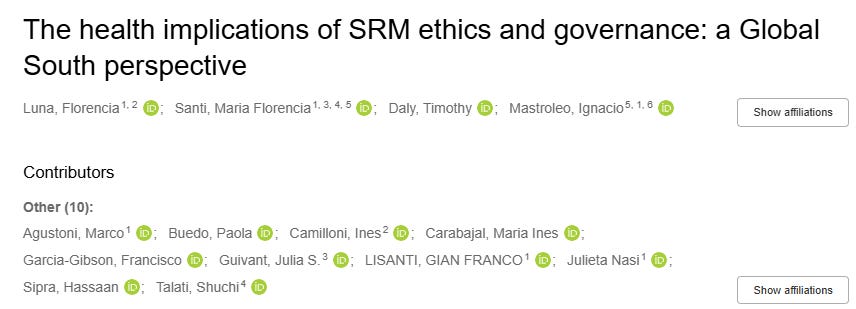
A WHO-funded report [pre-print] released by the Bioethics Program at FLACSO Argentina, with international collaborators, calls for a health-centered governance framework for solar radiation modification. It stresses that mitigation and adaptation must remain the primary climate responses, recommending a “non-substitution” safeguard to prevent SRM replacing emissions cuts. The report urges a “health-first” governance mandate, integrating physical and mental health impacts into risk assessments, and establishing an international anticipatory governance system. It also highlights equity, justice, and co-stewardship, emphasizing stronger inclusion of Global South voices and regional contexts in SRM decision-making.
EU Calls for SRM Deployment Moratorium
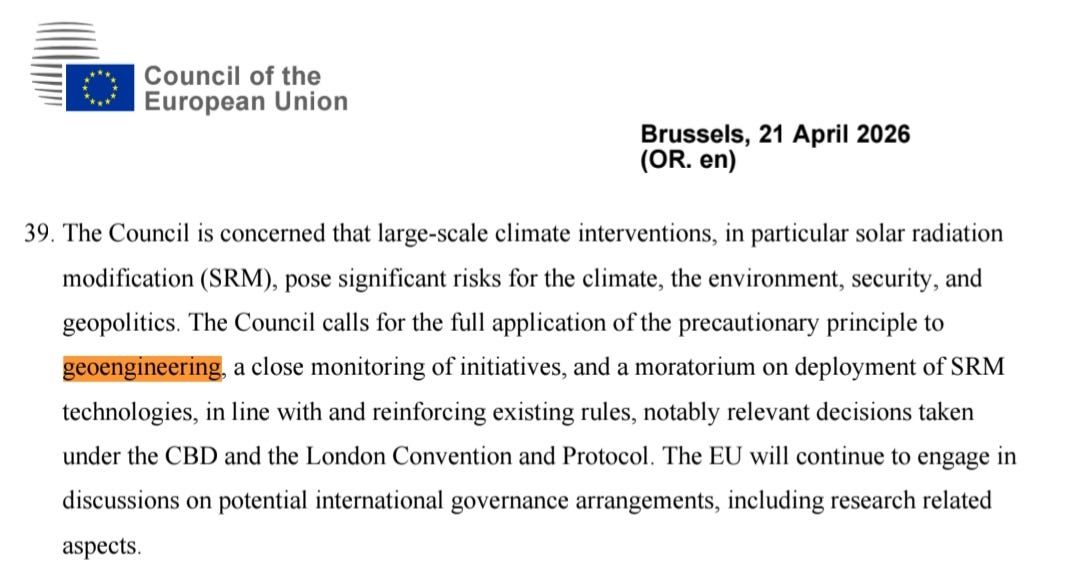
Council of the European Union has called for a moratorium on the deployment of SRM technologies, citing potential risks to climate, environment, security, and geopolitics. While the move does not extend to SRM research, the Council urged application of the precautionary principle and closer monitoring of geoengineering initiatives. Read Operaatio Arktis’ constructive response to this news.
Arctic Stabilization Initiative Launched to Mitigate Climate Risks
The Arctic Stabilization Initiative (ASI), a new stage-gated research program supported by Renaissance Philanthropy’s Advanced Research for Climate Emergencies (ARC), has raised $6.5 million to advance the research needed to assess the safety, efficacy, and feasibility of Arctic-targeted climate interventions.
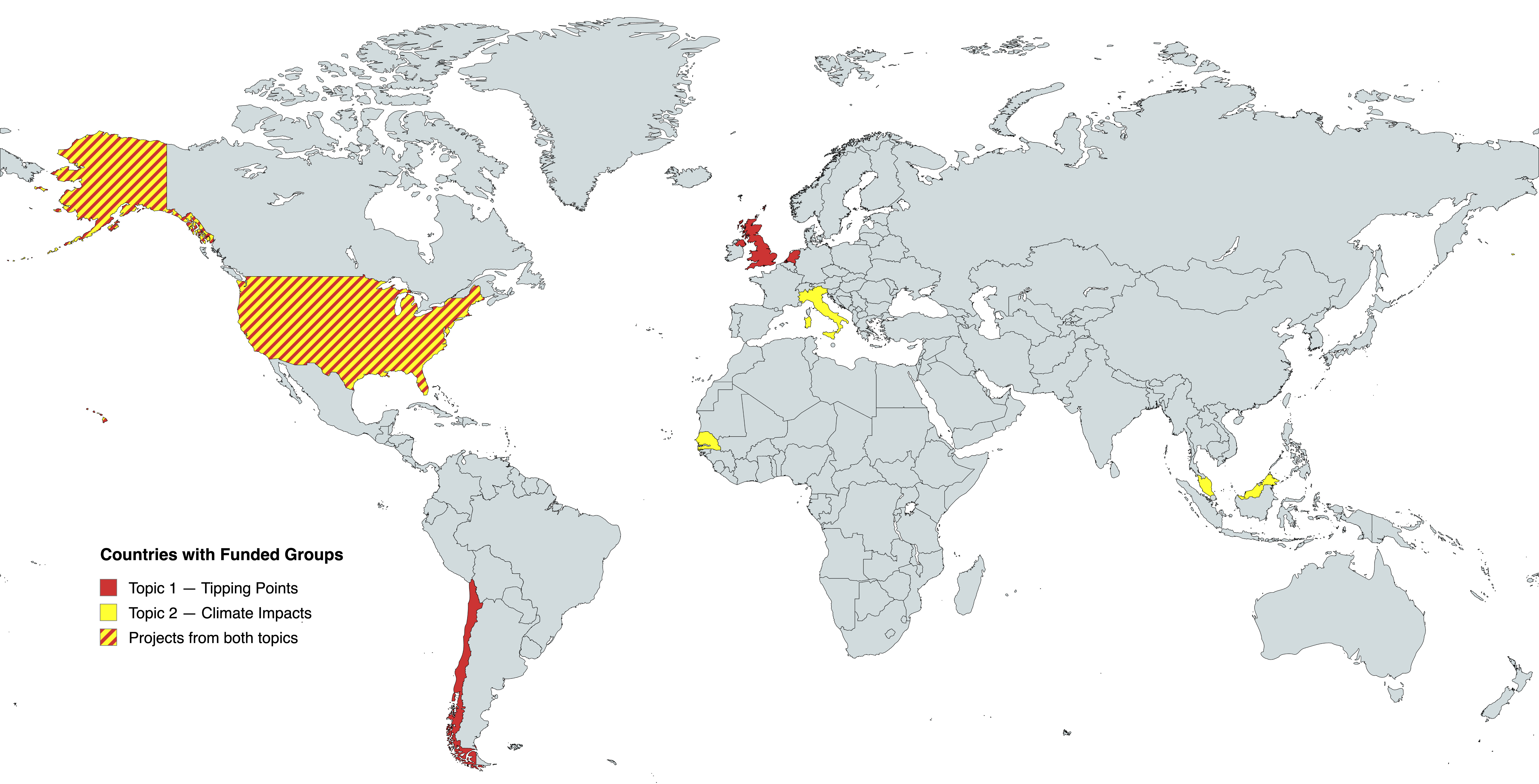
Reflective Funds 13 Teams to Study SAI Impacts and Climate Tipping Risks
Reflective has awarded grants to thirteen research teams under its “Effects of SAI on Tipping Points & Climate Impacts” programme to advance understanding of SAI risks and interactions with the Earth system. The initiative aims to strengthen the evidence base ahead of the IPCC Seventh Assessment Report (AR7), which will shape global understanding of SAI for years to come. The funded projects will examine two core areas: potential interactions between SAI and critical tipping points such as ice sheet loss and ocean circulation shifts, and its wider effects on food systems, health, ecosystems, infrastructure, and economies.
2026 RFF and Harvard SRM Social Science Research Workshop
Resources for the Future (RFF) and Harvard’s Solar Geoengineering Research Program have announced a call for papers for the 4th annual Social Science Workshop on SRM, to be held in Washington, DC on September 10-11, 2026. The workshop will present new and ongoing research on SRM’s risks, benefits, governance, political economy, ethics, and public perception. Submissions are invited from diverse social science fields, including contributions from Global South researchers, with proposals due May 15 and decisions expected by June 15.
Geoengineering Could Protect Amazon Rainforest from climate Change
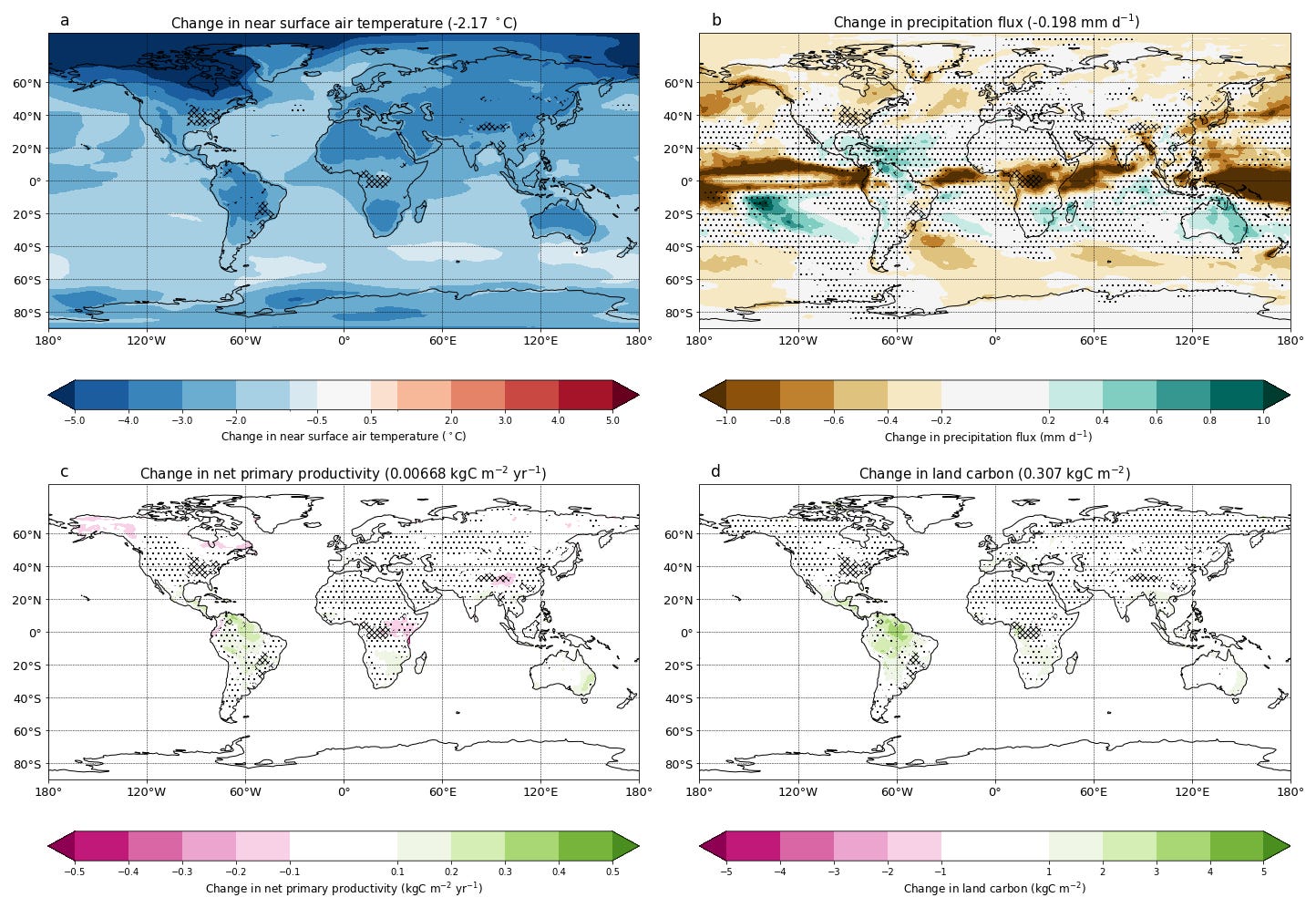
Earth System Dynamics published a new study that suggests geoengineering via stratospheric aerosol injection (SAI) could help shield the Amazon rainforest from climate-driven stress. Contrary to concerns that reduced sunlight and rainfall might harm forests, climate model simulations show SAI may increase Amazon carbon storage by about 10.8% compared to high-emissions scenarios and 8.6% relative to mid-emissions pathways by reducing heat and drought impacts, thereby limiting forest carbon losses. But researchers note benefits are uneven across regions and stress mitigation and emissions cuts remain essential.
Workshop to Advance Engineering Dialogue on SRM
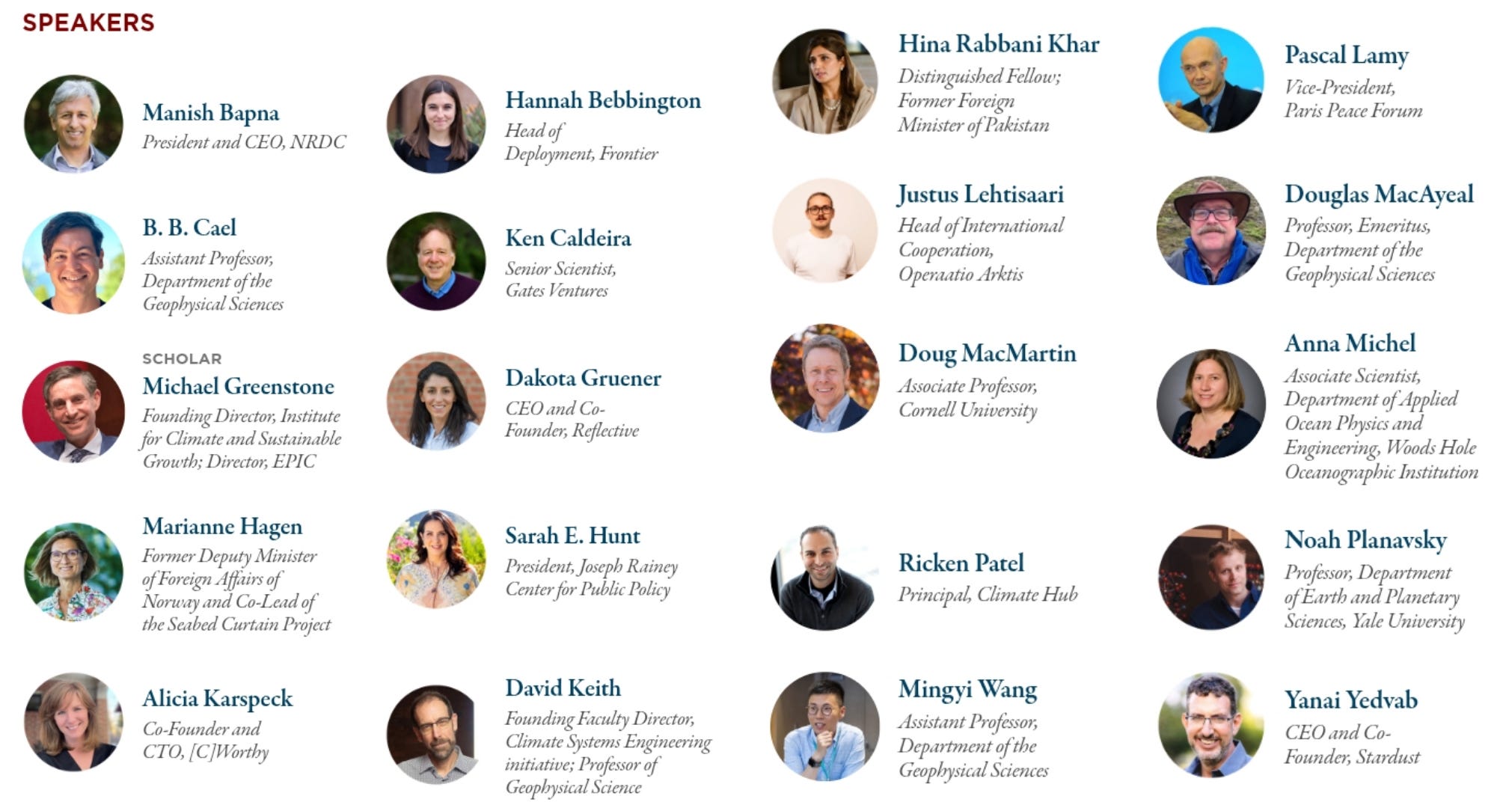
Dakota Gruener from Reflective will convene a workshop in Chicago on May 19 titled “Frontiers in Engineering for Sunlight Reflection,” bringing together engineers and researchers to explore how sunlight reflection technologies could be practically designed and implemented. The initiative highlights a gap in relevant engineering expertise, noting that few specialists are currently working on the problem. The discussion aims to advance early-stage technical thinking on feasibility, even as broader debate continues over whether such approaches should ever be deployed. A similar workshop also took place in San Francisco on May 4.

University of Chicago to Host Climate Systems Engineering Event on May 18-19
The University of Chicago Institute for Climate and Sustainable Growth and the Climate Systems Engineering initiative (CSEi) announced a “Frontiers in Climate Systems Engineering” event to be held on May 18-19 at the David Rubenstein Forum, bringing together researchers, policymakers, and stakeholders to discuss climate systems engineering approaches, including carbon removal and sunlight reflection. The event focuses on assessing the risks, benefits, and governance challenges of emerging climate interventions alongside emissions reduction efforts.
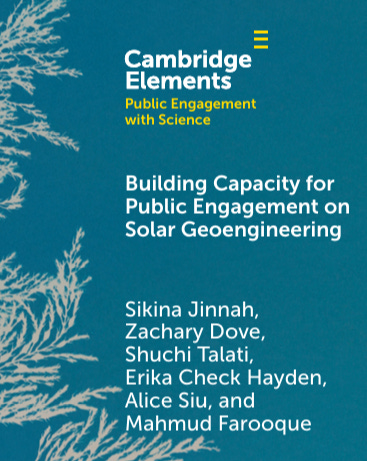
Building Capacity for Public Engagement on Solar Geoengineering - Book
A new book published by Cambridge University Press highlights the importance of capacity-building and public engagement in SRM. It examines three main approaches to achieve this: capacity-building workshops, participatory technology assessment, and deliberative polling, aimed at supporting informed, inclusive decision-making on SRM governance.
For a full recap of last month’s updates, check out our weekly summaries: WEEK 1 | WEEK 2 | WEEK 3 | WEEK 4 | WEEK 5
And here’s an overview:
RESEARCH PAPERS
Solar Geoengineering Effects on Malaria Transmission Risk in South Asia Under G6sulfur Scenario | Authors: Athar Hussain, Muhammad Ali Khan, Muhammad Shoaib
Study suggests SAI could lower malaria risk across South Asia, especially in Bangladesh, India, and Pakistan.
Who Controls the Climate? Negotiating the Global Governance of Geo-engineering: A non-scorable real-world negotiation Simulation | Authors: Peter Kesting, Remigiusz Smolinski
Simulation-based study of geoengineering governance reveals tensions between innovation and precaution, highlighting risks around harm, inequality, and weaponization in the absence of global rules.
Impacts of Solar Geoengineering through Stratospheric Aerosol Injection on Terrestrial Ecosystems and Ecosystem Services | Authors: Anna Harper, Christophe Francois, Lili Xia, et al.
Study finds that while SAI could cool the planet, major uncertainties remain over its impacts on ecosystems, crops, and carbon cycles, underscoring the need for better Earth system modelling.
An unrecognized mode of small particles in the lower stratosphere | Authors: Ming Lyu, Adam T. Ahern et al.
Aircraft observations show that previously underrepresented fine particles dominate stratospheric aerosol surface area, affecting ozone chemistry and adding key uncertainties for climate models and SAI effectiveness.
Why we need to explore conflict and competition around solar geoengineering | Authors: Ina Möller, Danielle N. Young
Study reframes solar geoengineering as a potential geopolitical power tool, urging more research on conflict, competition, and governance risks beyond cooperative climate scenarios.
Not yet partisan: Cultural Theory explains attitudes about solar radiation management in the US | Authors: Chris Koski and Paul Manson
Findings suggest cultural values, such as egalitarianism and views on hierarchy, play a stronger role than political partisanship in shaping US public attitudes toward SRM.
Could geoengineering ever start? Could it ever stop? Grist for “Destiny Studies” and “Continuity Ethics” | Authors: Robert Socolow
Paper explores geoengineering through the lens of long-term human governance and ethics, warning that reliance on such technologies could become difficult to reverse or even “addictive.”
Cloud-Top Relative Humidity Modulates Aerosol Effects Across Marine Cloud Regimes | Authors: Fan Liu, Feiyue Mao, Zengxin Pan, et al.
Study finds that fine aerosols drive much stronger cloud-cooling effects than coarse sea-salt aerosols, with impacts varying by cloud-top humidity and cloud regime.
Climate Engineering: Can Humans Reverse Global Warming? | Authors: Xojabekova Ramzida Uktam qizi
Article reviews Carbon Dioxide Removal (CDR) and SRM, emphasizing that climate engineering can complement, but not replace, emissions reductions and requires strong global governance.
Projected temperature and precipitation extremes over Tanzania under stratospheric SO2 injection | Authors: Trisha D Patel, Mariam Nguvava and Romaric C Odoulami
Findings revealed that SAI could reduce extreme warming in Tanzania but may also decrease rainfall and worsen drought risks, highlighting major climate trade-offs.
Learning From Public Health Emergencies For Solar Geoengineering Governance: The Filter And The Countermeasure | Authors: Guillermo Marín Penella, Timothy Daly, Ignacio Mastroleo
Study proposes a dual governance framework for climate engineering, combining long-term research oversight with emergency-use pathways for temporary deployment during severe climate crises.
Simulated response of the climate of eastern Africa to stratospheric aerosol intervention | Authors: Herbert O. Misiani, Hussen S. Endris, Franklin J. Opijah, et al.
Research finds that SAI could reduce future warming in Eastern Africa, though rainfall impacts remain uneven and uncertain across regions and seasons.
Field Observations of Sea Ice Thickening by Artificial Flooding | Authors: T. C. Hammer, L. L. van Dijke, A. Shestov, C. Haas, H. Hendrikse
Analysis shows that artificial seawater flooding can temporarily thicken Arctic sea ice and delay melting, but may not significantly extend summer ice survival under current conditions.
Organic Solar Radiation Modification | Authors: Markku Kulmala, Anton Laakso, Mikael Ehn, et al.
Study proposes Organic Stratospheric Aerosol Injection (OSAI) as a possible alternative to sulfate-based SRM, potentially reducing acid deposition and ozone risks while introducing new uncertainties.
Uncovering a Missing Factor in Marine Low Cloud Formation | Authors: Ehsan Erfani
Simulation shows that El Niño affects Pacific marine low clouds differently by region, reducing cloud cooling in the Northeast Pacific while enhancing it in the Southeast Pacific.
Dynamical and Radiative Influence on the Hadley Circulation by Aerosol-Cloud Interactions | Authors: Takanobu Yamaguchi, Ryuji Yoshida, Yao-Sheng Chen, et al.
Research finds that aerosols can strengthen atmospheric circulation and enhance cloud brightening effects, though ocean–atmosphere coupling reduces the overall climate response.
Which worlds? With whom?: Geoengineering through a relational multispecies lens | Authors: Julia D. Gibson
Essay argues that geoengineering should be viewed through justice, colonial, and multispecies perspectives, emphasizing its deeper ethical and ecological implications beyond technical climate intervention.
A call for strategic assessments of regional applications of solar radiation management: Exploring the challenges and opportunities from marine cloud brightening and albedo surface modification | Authors: U Baresi, CM Baum, TB Fischer, S Lockie, et al.
Paper examines Marine Cloud Brightening and surface albedo modification as potential SRM tools, highlighting both their climate benefits and the need for more inclusive governance and environmental assessment.
The global climate response to High-Latitude Low-Altitude Stratospheric Aerosol Injection (HiLLA-SAI) | Authors: Alistair Duffey, Walker Lee, Lauren Wheeler, et al.
Study finds that high-latitude low-altitude (HiLLA) Stratospheric Aerosol Injection could provide a more practical early-stage SRM approach, delivering partial global cooling using existing aircraft technology.
Stratospheric aerosol injection geoengineering has the potential to increase land carbon storage and to protect the Amazon rainforest | Authors: Isobel M. Parry, Paul D. L. Ritchie, Olivier Boucher, et al.
Study finds SAI could boost global vegetation productivity and land carbon storage, but with uneven regional impacts and potential declines in some tropical and high-latitude regions.
The Solar radiation management and evaporative heat flux over West Africa: Insights from ERA5 Reanalysis, CMIP6 Models, and Stratospheric Aerosol Injection | Authors: Adenuga, K., Adenuga, K. P., et al.
Analysis shows that SAI could moderate evaporative stress and drought risk in West Africa, partially restoring latent heat flux toward pre-industrial conditions with strongest effects in coastal regions.
Projected Future of African Marine Ecosystems Under Climate Change and Stratospheric Aerosol Injection | Authors: Founi M. Awo, Babatunde J. Abiodun, Isabelle Ansorge, et al.
Study finds that SAI could limit warming to 1.5°C but only partially mitigates marine ecosystem impacts in African coastal waters, with continued acidification and oxygen loss still occurring.
Energetic constraints on tropical precipitation changes under stratospheric aerosol geoengineering: a topical review | Authors: Anu Xavier, Govindasamy Bala and Thejas Kallihosur
Review shows that Stratospheric Aerosol Geoengineering alters tropical rainfall patterns through large-scale energy balance changes, particularly affecting the Intertropical Convergence Zone, with design choices potentially reducing adverse impacts.
Calcite plumes for the mitigation of extreme heat events | Authors: Alan Hoback
Study finds that airborne calcite plumes for urban cooling could reduce solar radiation and temperatures significantly, lowering energy demand and providing additional health and economic benefits in cities like Las Vegas.
Quantifying the effectiveness of multiple SAI strategies across different dimensions - Preprint | Authors: Dr. Cindy Wang, Dr. Daniele Visioni, Dr. Walker Raymond Lee, et al.
Analysis revealed that while SAI can meet global temperature targets, it may still fail to restore regional and seasonal climate patterns, highlighting mismatches between global and local climate recovery.
Managing climate overshoot: A risk-based strategy for climate stabilisation - Preprint | Authors: Graeme Taylor, Peter Wadhams, Tom Goreau, et al.
Study argues that current mitigation and carbon removal efforts are too slow to match accelerating warming, calling for a risk-based approach combining rapid decarbonization, carbon removal, and potentially governed climate cooling interventions.
Spatial and temporal distribution of stratospheric turbulence from global high-resolution radiosonde data - Preprint | Authors: Han-Chang Ko, Hongwei Sun
Observational analysis of stratospheric turbulence suggests key hotspots and shear-driven regions that could significantly affect aerosol dispersion and plume behavior in Stratospheric Aerosol Injection.
Drivers of reduced permafrost cooling efficacy of equatorial stratospheric aerosol injection in the Eastern Arctic compared to a moderate emission pathway - Preprint | Authors: Isaline Businger, Rhonda Müller, Raleigh Grysko, et al.
Under the G6sulfur scenario, Stratospheric Aerosol Injection can slow overall Arctic permafrost loss by reducing warming, but it also creates uneven regional thaw patterns due to circulation changes.
Assessing Future Temperature and Precipitation Responses to Solar Radiation Management in Bangladesh: A Comparative Analysis with SSP Scenarios - Preprint | Authors: Afifa Talukder, Mohammad Kamruzzaman, Syed Hafizur Rahman
Climate modeling for Bangladesh finds that SRM can reduce future warming but may also slightly decrease rainfall, raising potential drought risks despite temperature benefits.
The enhanced capabilities of mid-infrared limb emission sounding to observe stratospheric aerosol injection geoengineering interventions - Preprint | Authors: Pasquale Sellitto, Mona Kosary, Michael Höpfner, et al.
Study finds that proposed satellite-based monitoring systems could rapidly detect and track even small Stratospheric Aerosol Injection deployments, highlighting current gaps in SRM observation capabilities.
High-latitude, low-altitude stratospheric aerosol injection reshapes West African monsoon rainfall and associated dynamics - Preprint | Authors: Kwesi Twentwewa Quagraine, Kwesi Akumenyi Quagraine, et al.
Model simulations of HiLLA-SAI suggest highly uncertain, regionally mixed impacts on the West African Monsoon, with potential shifts in rainfall patterns that may shorten coastal wet periods and intensify Sahel drought conditions.
Regional Economic Impacts and Emission Responses under Solar Radiation Modification - Preprint | Authors: Jenny Bjordal , Evelien van Dijk, Henri Cornec, et al.
Study finds that SRM-induced cooling could raise GDP per capita and reduce global inequality, especially in low-income countries, but may also incentivize higher emissions and create long-term climate trade-offs.
WEB POSTS & REPORTS
Solar Geoengineering Updates - Monthly Solar Geoengineering Updates (March’2026)
Stardust Solution - Guiding Principles for Stardust’s Solar Radiation Modification Research
SRM360 - The Case for a Solar Geoengineering Research Governance Platform
CSEi - Dan Cziczo, Leading Atmospheric Scientist, Joins UChicago
Europe Scientist - Shading the Planet: The Case for Climate Intervention with High-Altitude Balloons
Nancy Mace - Rep. Nancy Mace Backs Legislation Banning Atmospheric Geoengineering Experiments Over South Carolina
Atlantic - A Private Company Wants to Block the Sun, Responsibly
LinkedIn - A trio of conservative US thinktanks have issued briefs on SRM
DSG - First Comes the Science: What Gene Editing’s Legitimacy Gap Reveals for SRM
E&E News by Politico - Solar geoengineering startup sets its own rules
Reflective Climate - SAI Simulator v1.3 Update: Sea Ice, Model Variability, and Data Export
Columbia Missourian - Clear skies legislation gets House hearing
Climate Court - State Climate Liability Shields in 2026: A Comparative Analysis of Utah, Iowa, Oklahoma, Tennessee, and Louisiana
SRM360 - Do New Reports Signal a Shift in US Conservatives’ Approach to SRM?
DSG - The Danger of Performed Governance in SRM
SilverLining - Why Sustained Marine Observations Matter for Atmospheric Research
The Telegraph - The climate change scientists racing to dim the sun
Degrees Initiative - From curiosity to climate leadership: Dr Romaric C. Odoulami’s journey in African SRM research
Woodwell Climate Research Centre - The only thing crazier than talking about solar radiation management is not talking about it
Climate Uncovered - Solar Radiation Modification: A last resort, but for how much longer?
The Innovation Geoscience - Positive feedback of Gulf Stream latent heat flux in sustaining AMOC evolution under stratospheric aerosol injection
Carbon Brief - Guest post: How declining cloudiness is accelerating global warming
DSG - From Taboo to Assumed: How Carbon Dioxide Removal Advanced Before Governance Could Keep Up and What It Means for SRM
ACIRhub - How could SRM affect West Africa?
SRM360 - Stardust Publishes New Details on Its Climate Cooling Plans
ACIRH Hub - The ACIRH Story: 12 Years in the Making
Upon Further Reflection - Reflective at GeoMIP
Engineering & Technology – Is geoengineering our ‘escape hatch’ from climate change?
Ghana Web – Ghana advancing despite ‘deeply concerning’ global climate trends - Minister
The Conversation – Searching for a ‘technofix’ to climate change has many dangers. Could radical humility save the planet?
Rio Grande Guardian – Wolfe: Bans on cloud seeding and sunlight reflection would criminalize innovation
Reflective – Why field experiments will be necessary to understand stratospheric aerosol injection
The Guardian – Critical Atlantic current significantly more likely to collapse than thought
The Times - A new way to cool the Earth: give clouds a silver lining
Inevitable & Obvious - On the Ground at Stabilize Earth
The Energy Mix - Geoengineering On the Table, and Under Fire, As Scientists Race to Save Melting Thwaites Glacier
Renaissance Philanthropy - Arctic Stabilization Initiative - Advancing Arctic-targeted climate interventions to slow or reverse our trajectory toward planetary thresholds
Heatmap - Scoop: New Nonprofit Backs Unique Approach to Geoengineering the Arctic
CBN - British scientists firing salt water into clouds in bold attempt to cool Earth
New American - States Push Back Against Geoengineering and Cloud Seeding
MIT Technology Review - There is no nature anymore - No part of the globe is free of human fingerprints. Should we deploy technology to change it back?
Phys.Org - Geoengineering could protect Amazon rainforest from climate change
The ARC: Thoughts on a safe climate future - A bold research initiative to stabilize the Arctic
Cambridge in America - Earth Month 2026: Leading Cambridge Climate Scientist Shaun Fitzgerald on the State of the Planet
Earth.com - Reducing air pollution has triggered something worse that scientists didn’t predict
Environmental Defense Fund - EDF Submits Response to UN Special Rapporteur on Climate Technologies and Human Rights
Bulletin of the Atomic Scientists - Emergency brakes: How to limit temperatures long before the last resort of geoengineering
Lawfare - Reframing the Conversation on Climate Intervention and Security
Science.Orf - Tiny aerosols could influence the climate
Manchester Evening News - Government issues statement on ‘weather modification’ in UK after calls for ban
The Degrees Initiative - ‘A beautiful chance to better understand how the field is built and evolving’ – reflections from GeoMIP
Eos - Toward Marine Cloud Brightening at Scale: A Science Agenda
Upon Further Reflection - Award Announcement: Effects of SAI on Tipping Points & Climate Impacts
ARIA - Unearthing the known unknowns - A joint workshop on climate cooling and tipping points
Stardust is tackling the wrong problem with the wrong structure (David Keith)
Taylor & Francis Online - The long heat: climate politics when it’s too late (Book Review)
JOB OPPORTUNITIES
Operations Specialist, Arctic Stabilization Initiative at Renaissance Philanthropy
“ASI is a 5-year research initiative focused on reducing the risk of catastrophic Arctic climate tipping points — specifically Greenland Ice Sheet melt, Arctic sea-ice loss, and permafrost thaw — systems that are already showing signs of destabilization, with potential cascading impacts on sea levels, weather patterns, and geopolitical stability. Through a stage-gated research process, ASI evaluates potential Arctic-targeted interventions, with an initial focus on Mixed-Phase Cloud Thinning (MCT), to determine whether such approaches could credibly reduce catastrophic risk while building the scientific and governance foundations needed to assess their safety and feasibility.”
Communications Specialist, Science and Technology at The University of Chicago
“The University of Chicago Institute for Climate and Sustainable Growth (ICSG) is a groundbreaking effort uniting faculty from across the university to advance society’s understanding of our energy and climate future. The Institute combines faculty insights in energy markets and policy, climate systems engineering, and energy technology to produce world-changing ideas while also investing in the next generation of energy and climate thinkers, leaders, and innovators through novel educational programs.”
“University of Edinburgh seek a postdoctoral research associate (PDRA) for a 24-month position to work on the UK NERC-funded grant “Quantifying Efficacy and risks of solar radiation management (SRM) approaches using natural analogues”. The project will use novel machine learning-based methods to determine the climate response to a range of natural event (e.g. wildfires, volcanic eruptions) which can be used as analogues of SRM to provide evidence for informing model improvement without worry about the risks of field experiments. The derived large-scale observational constraints will be used to constrain and advance climate models, and to attribute climate response to SRM.”
Research Associate in Climate Dynamics at Imperial College London | Deadline: 13 May 2026
“Applications are invited for a fully funded fixed-term position at the Research Associate (postdoc) level in understanding the global climate response to stratospheric perturbations from solar radiation management (SRM).
The position will be co-supervised by Dr Paulo Ceppi and Dr Colleen Golja and will be based in the Department of Physics.”
“The Department of Meteorology at Stockholm University (MISU) conducts research and education spanning the atmosphere, ocean and physical climate sciences.”
DEADLINES
08-09 May | Pwani University, Kenya - Short Course on Carbon Dioxide Removal (CDR) and Solar Radiation Modification (SRM)
21 & 22 May | University of Cape Coast - SRM & CDR Short Course 2026
UPCOMING EVENTS
12 May | University of Cambridge - Climate Repair Symposium by Center for Climate Repair
13-15 May | University of Nottingham - IAA Planetary Sunshade Workshop by Planetary Sunshade Foundation
15 May | London, United Kingdom - AI x Weather x Climate Demo Night by Encode: AI for Science Fellowship - Pillar VC x ARIA
18-19 May | University of Chicago - Frontiers in Climate Systems Engineering by CSEi
25 May | Online - Exploring climate interventions and the science-policy interface by WCRP
28 May | Arena 2 Plenum - Building and Sharing Knowledge of Climate Interventions by UArctic Congress
28-29 May | Belgium - International Forum on Solar Radiation Modification Research Governance by Co-Create
01 June | Online - CSAR lecture: Beyond Net Zero: Can We Repair The Climate? by University of Cambridge
02-04 June | Rwanda - The IAF Global Space Conference on Climate Change 2026 - Uniting Space and Earth for Climate Resilience
20-21 June | United States - Bridging the Knowledge Gaps in Climate Engineering with Experiments, Models, and Observations by Gordon Research Seminar
21-26 June 2026 | United States - Gordon Research Conference - Bridging Observations, Models, and Impacts in Solar Radiation Modification Research
10-11 September | Washington, DC. - 2026 RFF and Harvard SRM Social Science Research Workshop
12-15 October | Malaysia - Global Tipping Points 2026 | Abstract Deadline: 15 May
Add our Solar Geoengineering Events Calendar to your default calendar in 2 ways:
Head to this link: https://teamup.com/ks64mmvtit583eitxx
Sync specific event: Click the event → menu (≡) → Share → choose your calendar → Save.
Or sync all events: Menu (≡) → Preferences → iCalendar Feeds → Copy URL → Add to your calendar settings → Subscribe.

PODCASTS
“A former UN Assistant Secretary-General spent seven years trying to get world leaders to talk about planetary cooling. Most of them told him the same thing: “We can’t talk about this publicly.” Janos Pasztor led the Carnegie Climate Governance Initiative (C2G), the first organization to systematically bring solar radiation modification governance to governments, diplomats, and the UN system.
In this conversation, he walks through what those private meetings actually sounded like, why a landmark UN event was killed by COVID days before launch, how a Pakistani minister’s first question revealed what actually drives national policy, and why the biggest gap right now isn’t research or technology but the societal conversations that still aren’t happening.”
MCB: Can Brighter Clouds Cool the Planet? with Dr. Jessica Wan | CSEi
“Climate scientist and CSEi Research Fellow Jessica Wan joined the Oceanography podcast to explain how marine cloud brightening (MCB) works, and what climate models reveal about MCB’s unintended effects.”
A Natural Experiment in the Sky: Shipping, Clouds, and Climate | Oceanography
”Shipping pollution changed clouds. What can scientists learn? What happens when cleaner shipping fuel suddenly changes the atmosphere above the ocean? In this episode of Oceanography, meteorologist Dr. Michael Diamond explains how shipping pollution, cloud formation, and climate are connected, and how a major fuel regulation and disrupted global shipping routes created a rare natural experiment for scientists. The conversation explores aerosols, sulfur pollution, cloud brightening, and what these real-world changes can teach us about marine climate intervention, including marine cloud brightening and solar geoengineering. If you want to understand how human activity is already shaping clouds, warming, and climate policy, this episode offers a grounded, fascinating look at one of the most complex questions in climate science.”
SAI: Should We Reflect More Sunlight to Cool the Earth? with Dr. Kelsey Roberts | Oceanography
“Could reflecting sunlight help cool the Earth? Stratospheric aerosol injection, or SAI, is a proposed climate intervention that aims to reduce global temperatures by reflecting a small portion of incoming sunlight. Inspired by volcanic eruptions, this approach is being studied through climate and ecosystem models to better understand its potential effects. This episode explores how SAI could influence sea surface temperature, net primary production, ocean chemistry, and marine food webs. It also looks at how scientists use models to evaluate different deployment scenarios, including long-term use and phase-out strategies. Along the way, the conversation considers uncertainty, regional variability, and the role SAI might play within a broader portfolio of climate responses.”
MCB: Can Brighter Clouds Cool the Planet? with Dr. Jessica Wan | Oceanography
“Can brighter clouds cool Earth? Marine cloud brightening (MCB) is a proposed solar radiation modification strategy that could reflect sunlight, cool ocean regions, and potentially reduce dangerous heat. But can it actually work at scale, and what risks might come with it? In this episode, climate scientist Dr. Jessica Wan explains how MCB works, why researchers are studying sea salt aerosols and marine stratocumulus clouds, and what climate models reveal about unintended effects on weather, heatwaves, rainfall, and global circulation. The conversation explores geoengineering, climate intervention, El Niño, regional cooling, governance, and the major uncertainties surrounding marine cloud brightening as a response to climate change.”
As Temperatures Rise, Could Dimming the Sun Be a Solution? | Aspen Ideas
“What are the solutions to slowing the harmful effects of climate change? Could a plausible one be to block some sun to cool the planet? It may sound far-fetched but scientists are studying solar radiation management as one potential tool in the toolbox. But–it’s a controversial one. Could it be our emergency escape hatch, or a devastating Pandora’s Box? Two environmental pioneers discuss dimming the sun and other tactics to manage climate risk. Energy and Climate Editor for The Economist Vijay Vaitheeswaran speaks with Fred Krupp, president of Environmental Defense Fund, and David Keith, director of the Climate Systems Engineering Initiative at the University of Chicago.”
Solar Geoengineering: Who Gets to Decide? with Hassaan Sipra | Oceanography
“Solar geoengineering is a justice question. As sunlight reflection methods move from theory toward real-world research, who gets to decide what happens next? This episode explores the justice and governance questions surrounding solar geoengineering, also called solar radiation modification or SRM. Hassaan Sipra of the Alliance for Just Deliberation on Solar Geoengineering explains why the risks of climate intervention cannot be separated from existing inequalities in climate change, especially for climate-vulnerable communities in the Global South. The conversation covers environmental justice, public participation, free, prior and informed consent, governance gaps, research transparency, and why climate intervention must never replace emissions cuts, adaptation, climate finance, or loss and damage. A grounded, accessible finale to Oceanography’s marine climate intervention arc.”
“In November 2025, Iceland became the first nation to formally declare a potential collapse of the Atlantic Meridional Overturning Circulation a threat to national security. The decision moved through the Ministry for Environment, Energy and Climate, escalated to the National Security Council, and produced an op-ed signed jointly by the Icelandic minister and Johan Rockström. None of the larger Atlantic-rim countries that would be devastated by an AMOC collapse have done anything comparable yet. Páll Gunnarsson, founder of the Reykjavík Institute, has been close to that political process and to the global advocacy effort Iceland has launched off the back of it. This conversation is about why a country of 400,000 people moved faster than the rest of the world, what made the declaration possible at all, and what Páll is now trying to organize at the EU level by September.
Páll Gunnarsson is the founder of the Reykjavík Institute, an Icelandic policy organization focused on climate tipping point response. Before founding the institute, he spent over a year working on AMOC advocacy as an independent activist, a track that began when he realized no one in the Icelandic governance system was actually focused on the threat. He came to climate work after a career in software engineering.”
YOUTUBE VIDEOS
Dan Miller 20 Point Blueprint to Actually Fight Climate Change | Healthy Planet Action Coalition
“Climate Chat Host Dan Miller discusses his 20-Point Climate Action Plan of feasible and rational policies that eliminate fossil fuel emissions, remove CO2 from the atmosphere, temporarily cool the Earth, protect biodiversity, and address social and environmental justice. An open discussion follows Dan’s presentation.”
Can We Cool The Planet, And Should We Try? | Ep251: Ricken Patel | Cleaning Up Podcast
“What happens if we’re underestimating the speed and scale of climate risk? This week on Cleaning Up, Bryony Worthington sits down with Ricken Patel, Principal at Climate Hub & Founder of activist network Avaaz, to explore how to build successful climate movements, and the case for research into geoengineering.
Ricken argues that companies have been accidentally geoengineering since the turn of the Industrial Revolution, as a byproduct of their pollution, and says ‘it’s crazy’ that research into deliberate forms of geoengineering isn’t being allowed.”
Climate Repair: Hope or Hype? at Cambridge Festival | Centre for Climate Repair
“As global temperatures continue to rise, the idea of “repairing” the climate is capturing public imagination — and stirring controversy. From ocean-based carbon removal to solar radiation management, a host of interventions are being proposed as essential tools to combat climate change, while others warn they are risky distractions from cutting emissions and transforming our energy systems.
This engaging panel discussion will explore the growing field of climate repair and ask whether it represents genuine hope for a cooler planet, or simply the latest hype. Our expert speakers will examine the science behind these technologies, their potential benefits and risks, and the ethical and political questions surrounding their deployment.
With time for audience questions, this session promises an open and lively discussion about one of the most debated topics in climate science today. Whether you are an optimist, a sceptic, or simply curious, Climate Repair: Hope or Hype? invites you to join the conversation and form your own view on repairing our planet.”
“New investigations have revealed the extent to which billionaire philanthropists and governments of wealthy countries are driving research into a range of solar geoengineering technologies.
Watch this webinar as our experts look at key geoengineering companies and research funds, such as US-Israeli start-up Stardust Solutions, and the UK government’s Advanced Research and Invention Agency (ARIA), as they unpack the solar geoengineering funding flows.”
“Public and private research on solar geoengineering is on the rise. Nearly all proposals for large-scale research or deployment envision that, given the scale and scope of interventions like stratospheric aerosol injection, some level of international cooperation or coordination is necessary for both success and moral license. Geoengineering more broadly faces the challenge by many opponents that even research, particularly large-scale outdoor experiments, risk “mitigation deterrence” — a moral hazard slowing the commitment to reduce anthropogenic greenhouse gases both by particular countries and under accepted international regimes. Along with the rise in research on geoengineering, there has been a flurry of proposed resolutions and well-organized campaigns in multilateral forums to limit all deployment and some research on solar geoengineering, most prominently advocacy for a global Non-Use Agreement. In this talk, Andrew Light will explore the current landscape of international debates on climate engineering and then try to address the question of whether it is feasible to get sufficient international coordination to attempt some form of climate engineering, and the conditions that would be necessary for some measure of international acceptance of it, as well as the broader problem of how to address the ethical, even existential, challenges to large-scale research or deployment.”
Can We Reflect the Sun & Cool the Earth? with SRM Scientist Doug MacMartin | Climate Chat
“In this Climate Chat episode, Cornell climate scientist -- and returning guest -- Douglas MacMartin discusses the latest research in Sunlight Reflection Methods (a.k.a, solar radiation management (SRM) and Solar Geoengineering) and the practicality of implementing SRM in the coming decade, if needed.”
Joe Rogan Experience - Kurt Metzger | PowerfulJRE
Kurt Metzger on Joe Rogan discusses cloud seeding, geoengineering, chemtrails, and the SATAN experiment for around 5m starting at around 55m.
“Unveiling micro-signals of social tipping mechanisms in the climate discourse: Mechanistic insights using computational social sciences
This talk investigates how computational social sciences can identify “micro-signals,” subtle shifts in discourse, that signal social tipping points critical to climate action.”
“The Degrees Initiative is changing how the world evaluates solar radiation modification (SRM), also known as solar geoengineering.
If the world reaches a point where leaders must decide whether to use SRM to reduce climate impacts, they will need trusted experts to advise on risks, benefits, trade-offs and governance.
For over a decade, Degrees has led the world in building the capacity of developing countries to ask their own questions and do their own research, ensuring informed and confident representation in global discussions. We fund research, run engagement workshops and build communities, creating networks of independent experts.”
“The second of the two-part event convened Geoengineering Policy, Research, and Engagement leaders and producers to facilitate conversations with the science and technology policy research, design, and engagement communities in Washington, DC, and online.”
Solar Geoengineering Is Just the Beginning | Stardust CEO Yanai Yedvab | Forecast 2050
“Yanai Yedvab thinks we need to completely overhaul the infrastructure of humanity to avoid a climate disaster, and we can’t afford to wait the 70 years it’ll take to wean off fossil fuels. Before founding Stardust, Yanai spent nearly three decades in Israeli nuclear research, ending up as deputy chief scientist at the Israel Atomic Energy Commission.
Stardust is developing reflective particles to disperse into the upper atmosphere that will buy us the several decades we need to transition into a low-carbon economy. We sat down in New York to talk about how the technology works, the dangers at stake if we do nothing, and Yanai’s radical optimism in spite of everything.”
The Albedo Accord | Alinka Rutkowska
“Join host Andrew Dupy for a fascinating deep dive into the future of our planet with guest Robbie Tulip. Robbie is an author and climate expert who is challenging the traditional “doom and gloom” narrative of climate change.
In this episode, Robbie discusses how we can move beyond the polarization of emissions debates to find practical, technology-driven solutions for global stabilization.”
“In this Climate Chat episode, we interview returning guest René van Westen on his latest Atlantic Meridional Overturning Circulation (AMOC) research, including his research that shows the recent sudden shift of the Gulf Stream is an indication of pending AMOC collapse.”
HPAC Town Hall and Bruce Melton - The History of Geoengineering | Healthy Planet Action Coalition
“Bruce Melton presents and leads discussion on: The History of Geoengineering”
Live Discussion: Would Solar Geoengineering Transform or Preserve Nature? | SRM360
“On 22 April 2026, SRM360 hosted a live discussion on human interactions with nature and what solar geoengineering could mean for the natural world. Watch the recording to explore this topic with expert panellists Mike Tidwell, Mark Lynas, and Arthur Obst.”
“A discussion and Q&A with film producer/director Ben Kalina, and Professors David Keith and Elisabeth Moyer of the University of Chicago. Conversation moderated by Geneva Kirk Drayson (College, ‘26)”
“Host Mark McNees interviews award-winning filmmaker Ben Kalina on the InNOLEvation® Mindset podcast, powered by the Jim Moran College of Entrepreneurship, about his climate-focused documentary work and his new film, “Plan C for Civilization.” Kalina traces his upbringing in rural Vermont and his early concern about global warming, then discusses past projects on sea-level rise and other environmental issues. The conversation explores plastic pollution, microplastics, corporate responsibility, limits to recycling, and the need for regulation and open dialogue. Kalina previews his film, which follows researcher David Keith and others in the contentious field of solar geoengineering (sunlight reflection), highlighting governance, trust, unintended consequences, and moral hazard. He also explains the economics of independent documentary filmmaking, including crowdfunding, grants, creative control, distribution challenges, and plans for screenings and eventual wider release via the film’s website.”
Reflect the sun to slow down climate change? | The Royal Society
“Solar Radiation Modification describes several possibly interventions designed to increase the Earth’s albedo (reflectivity) reducing the amount of heat absorbed from the Sun. From ships spraying particles into the lower atmosphere to brighten clouds to high flying aircraft injecting reflective aerosols into the stratosphere, find out about the techniques some scientists say might just work.”
Janos Pasztor: Solar Radiation Modification and Our Future | Climate Emergency Forum
“This episode of Climate Emergency Forum features a wide‑ranging conversation with Janos Pasztor, former UN Assistant Secretary‑General for Climate Change and founding director of the Carnegie Climate Governance Initiative (C2G). We explore how decades of climate diplomacy led him into the controversial world of solar radiation modification (SRM) and his recent work engaging directly with private actors like Stardust that are developing stratospheric aerosol injection technologies.”
Stratospheric Aerosol Injection and Global Land Carbon Storage | Remove and Reflect Podcast
“This episode covers a research article that investigates the potential impacts of stratospheric aerosol injection (SAI) on global vegetation and land carbon storage using five advanced Earth System Models. The study concludes that this form of geoengineering could significantly enhance net primary productivity (NPP) and terrestrial carbon sequestration, largely due to the benefits of CO2 fertilization occurring under cooler temperatures. A primary focus is the Amazon rainforest, which appears to gain protection from climate-driven dieback and carbon loss when SAI is applied to mitigate extreme warming. However, the authors note that these positive effects are not universal, as some regions like Indonesia and eastern Africa may experience declines in productivity due to shifting rainfall patterns. Ultimately, while SAI may offer a temporary defense for vulnerable ecosystems, the researchers emphasize that it does not replace the fundamental need for greenhouse gas mitigation.”
Follow us on:
Twitter | Bluesky | LinkedIn | Substack | Google Group | Podcast 1 | Podcast 2
Support us here:
We put significant time and effort into compiling this resource for you. If you can, please consider becoming a paid subscriber. Your support sustains this work and helps us reach a wider audience.