
Weekly Solar Geoengineering Updates (27 April - 03 May 2026)
Weekly SRM roundup of research papers, web posts, events, jobs, projects, podcasts, videos and much more.

JUMP TO SECTION
1. This Week’s Top SRM Updates
2. Research Papers
3. Web Posts
4. Upcoming Events
5. Podcasts
6. YouTube Videos
7. Short Course

THIS WEEK’S TOP SRM HIGHLIGHTS
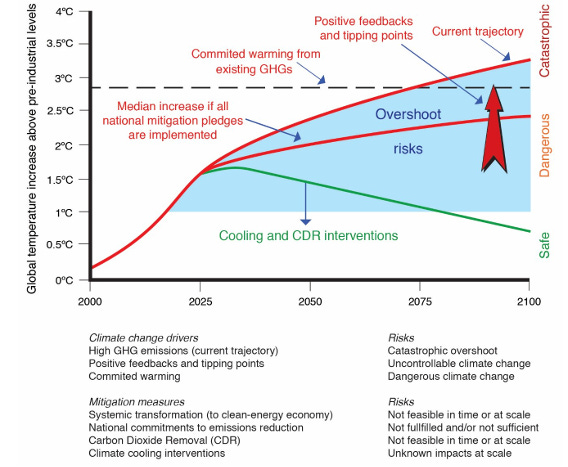
Research Paper: Managing climate overshoot: A risk-based strategy for climate stabilisation (ESS Open Archive)
Research Paper: Quantifying the effectiveness of multiple SAI strategies across different dimensions (ESS Open Archive)
Award Announcement: Effects of SAI on Tipping Points & Climate Impacts (Upon Further Reflection)
Opinion Piece: Reframing the Conversation on Climate Intervention and Security (Lawfree)
Short Course: Short Course on Carbon Dioxide Removal (CDR) and Solar Radiation Modification (SRM) at Pwani University, Kenya (Emerging Climate Frontiers)
Podcast: Solar Geoengineering: Who Gets to Decide? with Hassaan Sipra (Oceanography)
YouTube Videos: Janos Pasztor: Solar Radiation Modification and Our Future (Climate Emergency Forum)
Read on to unpack more updates:
This newsletter is free to read, but not free to produce. Please consider a paid subscription to support our independent reporting.
RESEARCH PAPERS
Authors: Founi M. Awo, Babatunde J. Abiodun, Isabelle Ansorge, et al.
Synopsis: According to this study, stratospheric Aerosol Injection under ARISE-SAI-1.5 may limit warming to 1.5°C but offers mixed outcomes for African coastal ecosystems. While it can stabilize sea surface temperature, salinity, and chlorophyll declines, it does not fully prevent acidification or subsurface oxygen loss. Climate change alone reduces productivity and alters marine chemistry, with SAI only partially mitigating these impacts.
Authors: Anu Xavier, Govindasamy Bala and Thejas Kallihosur
Synopsis: Since Paul Crutzen highlighted Stratospheric Aerosol Geoengineering (SAG), research has expanded on its impacts on tropical precipitation. This review shows changes are largely governed by global and interhemispheric energy budget constraints, influencing rainfall and the Intertropical Convergence Zone. It outlines how SAG design may reduce harmful precipitation shifts.
Calcite plumes for the mitigation of extreme heat events
Authors: Alan Hoback
Synopsis: This study revealed that urban cooling using airborne Calcite plumes could significantly reduce heat and energy use. In Las Vegas, a ring of towers dispersing calcite aerosols may cut solar radiation by ~50%, lowering peak temperatures by 5–6°C. Modeling suggests 38% savings in air-conditioning energy and 15% annual energy reduction, with 4–6 year payback and added benefits from improved health, tourism, and reduced emissions.
Quantifying the effectiveness of multiple SAI strategies across different dimensions
Authors: Dr. Cindy Wang, Dr. Daniele Visioni, Dr. Walker Raymond Lee, et al.
Synopsis: Stratospheric Aerosol Injection can cool the planet by reflecting sunlight, but matching global temperature targets doesn’t ensure regional or seasonal climate recovery. This study introduces a variability-scaled “distance-to-target” metric to assess how well SAI restores climate patterns. Applied across models like CESM2-WACCM6 and UKESM1, it reveals gaps between global success and local climate outcomes.
Managing climate overshoot: A risk-based strategy for climate stabilisation
Authors: Graeme Taylor, Peter Wadhams, Tom Goreau, Suzanne Reed, Heri Kuswanto, Daniele Visioni, and Dennis Garrity
Synopsis: This study entails that global warming is accelerating, while emissions cuts and carbon removal alone are too slow to prevent near-term climate risks. This mismatch stems from underestimated nonlinear impacts and delays in action. A risk-based strategy is needed, combining rapid decarbonization, scaled carbon removal, and carefully governed cooling interventions, while weighing intervention risks against inaction to avoid irreversible Earth-system disruption.
NOTE: If you’d like to submit SRM-related news for our next newsletter, please send it here:
WEB POSTS
Earth.com - Reducing air pollution has triggered something worse that scientists didn’t predict
Environmental Defense Fund - EDF Submits Response to UN Special Rapporteur on Climate Technologies and Human Rights
Bulletin of the Atomic Scientists - Emergency brakes: How to limit temperatures long before the last resort of geoengineering
Lawfree - Reframing the Conversation on Climate Intervention and Security
Science.Orf - Tiny aerosols could influence the climate
Manchester Evening News - Government issues statement on ‘weather modification’ in UK after calls for ban
The Degrees Initiative - ‘A beautiful chance to better understand how the field is built and evolving’ – reflections from GeoMIP
Eos - Toward Marine Cloud Brightening at Scale: A Science Agenda
Upon Further Reflection - Award Announcement: Effects of SAI on Tipping Points & Climate Impacts
ARIA - Unearthing the known unknowns - A joint workshop on climate cooling and tipping points
Stardust is tackling the wrong problem with the wrong structure (David Keith)
Taylor & Francis Online - The long heat: climate politics when it’s too late (Book Review)
UPCOMING EVENTS
06 May | Oxford St., Cambridge - Thinking Well About Solar Geoengineering by Harvard Solar Geoengineering Research Program
06 May | University of Cambridge & Online - A Polarised Debate: Is There a Middle Ground on Geoengineering? by Center for Climate Repair
12 May | University of Cambridge - Climate Repair Symposium by Center for Climate Repair
13-15 May | University of Nottingham - IAA Planetary Sunshade Workshop by Planetary Sunshade Foundation
15 May | London, United Kingdom - AI x Weather x Climate Demo Night by Encode: AI for Science Fellowship - Pillar VC x ARIA (NEW)
18-19 May | University of Chicago - Frontiers in Climate Systems Engineering by CSEi
25 May | Online - Exploring climate interventions and the science-policy interface by WCRP
28 May | Arena 2 Plenum - Building and Sharing Knowledge of Climate Interventions by UArctic Congress
28-29 May | Belgium - International Forum on Solar Radiation Modification Research Governance by Co-Create
01 June | Online - CSAR lecture: Beyond Net Zero: Can We Repair The Climate? by University of Cambridge
02-04 June | Rwanda - The IAF Global Space Conference on Climate Change 2026 - Uniting Space and Earth for Climate Resilience
20-21 June | United States - Bridging the Knowledge Gaps in Climate Engineering with Experiments, Models, and Observations by Gordon Research Seminar
21-26 June 2026 | United States - Gordon Research Conference - Bridging Observations, Models, and Impacts in Solar Radiation Modification Research
10-11 September | Washington, DC. - 2026 RFF and Harvard SRM Social Science Research Workshop
12-15 October | Malaysia - Global Tipping Points 2026 | Abstract Deadline: 15 May
Add our Solar Geoengineering Events Calendar to your default calendar in 2 ways:
Head to this link: https://teamup.com/ks64mmvtit583eitxx
Sync specific event: Click the event → menu (≡) → Share → choose your calendar → Save.
Or sync all events: Menu (≡) → Preferences → iCalendar Feeds → Copy URL → Add to your calendar settings → Subscribe.
PODCASTS
Solar Geoengineering: Who Gets to Decide? with Hassaan Sipra | Oceanography
“Solar geoengineering is a justice question. As sunlight reflection methods move from theory toward real-world research, who gets to decide what happens next? This episode explores the justice and governance questions surrounding solar geoengineering, also called solar radiation modification or SRM. Hassaan Sipra of the Alliance for Just Deliberation on Solar Geoengineering explains why the risks of climate intervention cannot be separated from existing inequalities in climate change, especially for climate-vulnerable communities in the Global South. The conversation covers environmental justice, public participation, free, prior and informed consent, governance gaps, research transparency, and why climate intervention must never replace emissions cuts, adaptation, climate finance, or loss and damage. A grounded, accessible finale to Oceanography’s marine climate intervention arc.”
“In November 2025, Iceland became the first nation to formally declare a potential collapse of the Atlantic Meridional Overturning Circulation a threat to national security. The decision moved through the Ministry for Environment, Energy and Climate, escalated to the National Security Council, and produced an op-ed signed jointly by the Icelandic minister and Johan Rockström. None of the larger Atlantic-rim countries that would be devastated by an AMOC collapse have done anything comparable yet. Páll Gunnarsson, founder of the Reykjavík Institute, has been close to that political process and to the global advocacy effort Iceland has launched off the back of it. This conversation is about why a country of 400,000 people moved faster than the rest of the world, what made the declaration possible at all, and what Páll is now trying to organize at the EU level by September.
Páll Gunnarsson is the founder of the Reykjavík Institute, an Icelandic policy organization focused on climate tipping point response. Before founding the institute, he spent over a year working on AMOC advocacy as an independent activist, a track that began when he realized no one in the Icelandic governance system was actually focused on the threat. He came to climate work after a career in software engineering.”
YOUTUBE VIDEOS
Reflect the sun to slow down climate change? | The Royal Society
“Solar Radiation Modification describes several possibly interventions designed to increase the Earth’s albedo (reflectivity) reducing the amount of heat absorbed from the Sun. From ships spraying particles into the lower atmosphere to brighten clouds to high flying aircraft injecting reflective aerosols into the stratosphere, find out about the techniques some scientists say might just work.”
Janos Pasztor: Solar Radiation Modification and Our Future | Climate Emergency Forum
“This episode of Climate Emergency Forum features a wide‑ranging conversation with Janos Pasztor, former UN Assistant Secretary‑General for Climate Change and founding director of the Carnegie Climate Governance Initiative (C2G). We explore how decades of climate diplomacy led him into the controversial world of solar radiation modification (SRM) and his recent work engaging directly with private actors like Stardust that are developing stratospheric aerosol injection technologies.”
Stratospheric Aerosol Injection and Global Land Carbon Storage | Remove and Reflect Podcast
“This episode covers a research article that investigates the potential impacts of stratospheric aerosol injection (SAI) on global vegetation and land carbon storage using five advanced Earth System Models. The study concludes that this form of geoengineering could significantly enhance net primary productivity (NPP) and terrestrial carbon sequestration, largely due to the benefits of CO2 fertilization occurring under cooler temperatures. A primary focus is the Amazon rainforest, which appears to gain protection from climate-driven dieback and carbon loss when SAI is applied to mitigate extreme warming. However, the authors note that these positive effects are not universal, as some regions like Indonesia and eastern Africa may experience declines in productivity due to shifting rainfall patterns. Ultimately, while SAI may offer a temporary defense for vulnerable ecosystems, the researchers emphasize that it does not replace the fundamental need for greenhouse gas mitigation.”
SHORT COURSE
08-09 May | Pwani University, Kenya - Short Course on Carbon Dioxide Removal (CDR) and Solar Radiation Modification (SRM) (Emerging Climate Frontiers)
Follow us on: Twitter | Bluesky | LinkedIn | Google Group | Podcast
Support us here:
While all content on Solar Geoengineering Updates is free for everyone, We urge those who can to become paid subscribers. Your support empowers this important work and helps us spread the message far and wide.
As usual Andrew delivers updated srm ( mostly sai.. but that is our climate Hail Mary).
What I like is his drive and inclusiveness of climate problems and solutions.
Am for a band aid right now called Agape Cool. 30NS lat width with surface reflection, water protection, desal, and solar driven a/c centers. Hopefully, ngos, religions, govs, and privates kick in together.
Earth, and especially people, are a terrible thing to waste.
As Earth 🔥