
Weekly Solar Geoengineering Updates (13 July - 19 July 2026)
Weekly SRM roundup of research papers, web posts, events, jobs, projects, podcasts, videos and much more.

JUMP TO SECTION
1. This Week’s Top SRM Updates
2. Research Papers
3. Theses
4. Web Posts
5. Reports
6. Job Opportunities
7. Podcasts
8. YouTube Videos
9. Upcoming Events

THIS WEEK’S TOP SRM HIGHLIGHTS
Research Paper: A stratospheric hose for solar radiation management (ScienceDirect)
Preprint: Purely light-scattering aerosols could induce positive shortwave radiative forcing over high-albedo surfaces (EGUSphere)
Preprint: Exit ramps crucial for outdoor testing of stratospheric aerosol injection (ResearchGate)
Thesis: Weather in a Geo-Engineered Climate: Extratropical Cyclones and Monsoon Dynamics (Utrecht University)
Opinion: It’s too darn hot. Blame global dimming: Earth is absorbing a lot more sunshine (The Economist)
New Resource: A New Taxonomy of Climate Interventions (African Tech Futures Lab)
Job Opportunity: Senior Scientist, Observing Systems & Inverse Modeling (Reflective)
YouTube Video: Offset Half the Warming: What Models Say (Climate Emergency Forum)
Read on to unpack more updates:
Solar geoengineering is one of the most important climate topics of our time.
If you value accessible, independent coverage of SRM research, governance, experiments, and policy developments, consider subscribing to Solar Geoengineering Updates.
Paid subscriptions directly support keeping this resource public, independent, and growing.
RESEARCH PAPERS
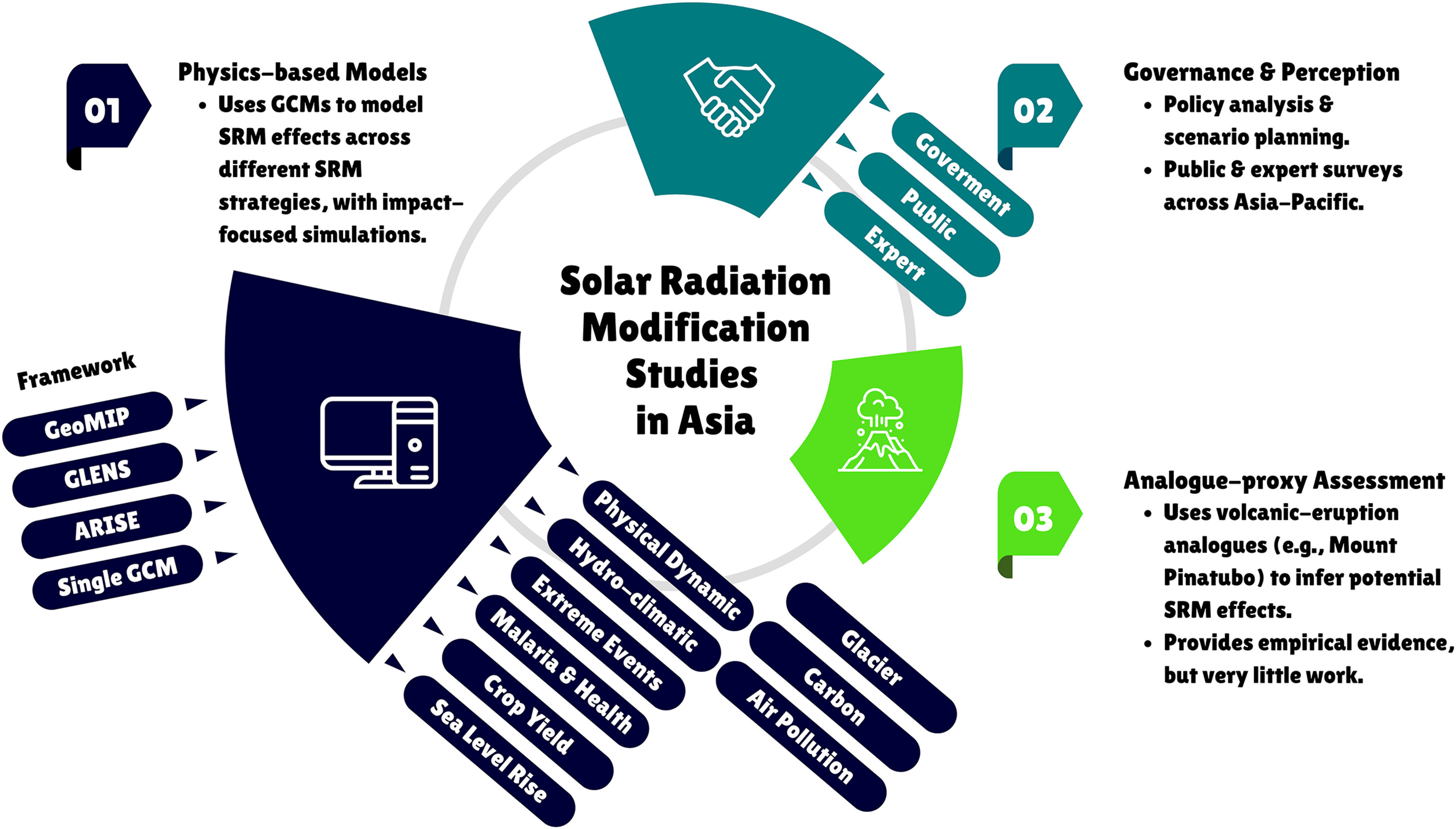
Solar radiation modification in Asia: Current progress, knowledge gaps and future priorities
Authors: Hai-Yuan TANG, Mou Leong TAN, Ze-Qian FENG, Xian-Li CHE, Fei ZHANG
Synopsis: A review of SRM research in Asia finds that, while the field has grown rapidly since 2023, major knowledge gaps remain. SRM could reduce temperatures but produce regionally varied impacts on rainfall, agriculture, health, sea level and climate systems. The authors identify key research, governance and capacity-building priorities to improve understanding of SRM risks and ensure stronger Asian representation in global research and policymaking.
Authors: Abolfazl Rezaei, John Moore, Simone Tilmes, Daniele Visioni
Synopsis: Using two versions of the Community Earth System Model, researchers found that SAI could largely prevent the warming-driven shift from precipitation- to temperature-controlled snowpack across much of the Northern Hemisphere. By maintaining cooler conditions, SAI preserved snowfall and seasonal runoff patterns, particularly in regions near the snow–rain transition, although runoff responses remained more variable across regions.
Authors: Puteri Nur Atiqah Bandira, Mou Leong Tan, Igor Gómez, Zaher Mundher Yaseen, Zhongli Chen, Ying Shao
Synopsis: This study assessed how SRM could affect streamflow in Malaysia’s Muda River Basin using a calibrated hydrological model and GeoMIP6 climate projections. While SRM moderated changes in mean streamflow compared with a high-emissions scenario, it did not consistently reduce flood and drought extremes. The results reveal spatially varied hydrological impacts, highlighting the need for further research on SRM deployment strategies and multi-hazard climate risks.
A stratospheric hose for solar radiation management
Authors: Roderick A. Hyde
Synopsis: A proposed engineering concept outlines a high-altitude hose supported by balloons to continuously deliver hydrogen sulfide (H₂S) to 20 km for stratospheric aerosol injection. Designed to inject 100,000 tonnes of sulfur annually, a single hose could enable small-scale SRM field tests, while multiple systems could provide larger-scale cooling. The paper also evaluates key engineering challenges, including wind, pressure requirements, hose design and balloon support.
The Impact of Aerosols on Climate Forcing and Cloud Microphysics
Authors: M. G. Abdullaha, S. Uba, I. Jibril, N. Y. Muhammad, M. A. Abubakar, M. B. Isa, M. Samaila, Y. O. Isiaq
Synopsis: By combining satellite observations, ground-based measurements and climate model simulations, this study examined how aerosols influence climate and cloud formation. Sulfate aerosols were found to produce a cooling effect, while black carbon caused warming. Higher aerosol concentrations reduced cloud droplet size, increased cloud reflectivity and suppressed rainfall, underscoring the importance of accurately representing aerosol–cloud interactions in climate models.
Bubbles, Droplets, Climate: Tellus’s Enduring Influence on Sea Spray Aerosol Research
Authors: Matthew E. Salter
Synopsis: This Perspective reviews the evolution of scientific understanding of sea spray aerosol (SSA), from early discoveries linking bubble bursting to particle formation through to modern insights into its physical, chemical and biological drivers. It highlights advances in field observations, laboratory techniques and wave-channel experiments, while identifying key research gaps in SSA emissions, climate impacts and marine cloud brightening, emphasizing SSA’s importance in air–sea interactions and climate science.
Authors: Rebecca L. Jackson, Matthew T. Woodhouse, et al.
Synopsis: Researchers developed ACCESS-EMS-GBR, a high-resolution regional atmosphere–ocean model for Australia's Great Barrier Reef that couples atmospheric, oceanic, biogeochemical and coral reef processes. Designed primarily to assess MCB, the model accurately reproduces observed aerosols, seawater temperatures and irradiance. It also improves sea-salt aerosol representation, enhancing simulations of MCB and supporting broader studies of marine aerosols, reef ecosystems and climate interactions.
Authors: Longrui Zhang, Taveen Singh Kapoor, Prabhav Upadhyay, and Rajan K. Chakrabarty
Synopsis: This study shows that scattering aerosols in the stratosphere, including those from SAI or spacecraft reentry, can produce unexpected positive shortwave radiative forcing over bright snow- and ice-covered surfaces. Radiative transfer simulations reveal that commonly used climate model approximations underestimate this effect. The findings suggest localized warming and snowmelt impacts from SAI and reentry-derived aerosols may be greater than previously estimated.
Exit ramps crucial for outdoor testing of stratospheric aerosol injection - Preprint
Authors: Gregory Nemet
Synopsis: An analysis of proposed SAI activities found a seven-order-of-magnitude gap between the largest planned experiments and early deployment scenarios. The authors argue that intermediate-scale tests could reduce scientific, technical and governance uncertainties while limiting risks. However, they caution that testing may increase the likelihood of deployment, emphasizing the need for robust “exit ramps” to prevent unjustified escalation.
THESES
Weather in a Geo-Engineered Climate: Extratropical Cyclones and Monsoon Dynamics - Thesis
Authors: Nooij, Meike de
Synopsis: This thesis examines how SAI affects extratropical cyclones and major monsoon systems using high-resolution climate simulations. SAI caused region-specific shifts in storm tracks, reduced cyclone-related winter precipitation compared with a high-emissions scenario, and altered monsoon timing and rainfall through changes in atmospheric circulation. The findings show that SAI creates distinct climate responses rather than simply reversing global warming impacts.
WEB POSTS
The Telegraph - The British boffins battling to dim the sun
The European Correspondent - Can we refreeze the Arctic?
The ARC: Thoughts on a safe climate future - The drivers of AMOC’s destabilization
DSG - Readiness Is Not a Destination: Lessons from a Cross-Sector Dialogue
The Economist - The rate at which Earth is absorbing energy is alarming scientists
Inevitable & Obvious - Why I Support Stabilization Research
Janos Pasztor - The China Sustainability Tribune interviewed me on a range of Climate Change Issues
The Economist - It’s too darn hot. Blame global dimming: Earth is absorbing a lot more sunshine
African Tech Futures Lab - A New Taxonomy of Climate Interventions
Ocean Visions - What Are Mixed-Phase Clouds, and Could They Help Save Arctic Sea Ice?
University of Cape Town - Geoengineering alone won’t save Africa from deadly heat, UCT study finds
Matthew Henry - What do climate models say about the impact of Stratospheric Aerosol Injection on the monsoons?
Mongabay - In the Canadian Arctic, an experiment aims to stabilize thinning sea ice
REPORTS
EESA - Satellite and Model Data to Inform Solar Radiation Modification Techniques
JOB OPPORTUNITIES
Staff Research Engineer at Climate Systems Engineering Research Initiatives | United States
“The Climate Systems Engineering initiative at the University of Chicago seeks an experienced Research Engineer to help bridge the gaps between academic modeling and factual engineering planning of SAI and open-system CDR.”
“Reflective is a global, non-profit research organization aiming to radically accelerate the pace of sunlight reflection research. We equip the world with the data and tools needed to make informed decisions about sunlight reflection, fast enough to matter.”
Director, Research and Origination, Fund Ecosystem at Renaissance Philanthropy & Senior Manager, Research and Origination, Fund Ecosystem at Renaissance Philanthropy
“Renaissance Philanthropy’s aim is to activate a virtuous loop of increasing ambition and impact between philanthropists and innovators: by identifying frontier experts both in science and in new ways of solving problems; by tapping into the growing number of emerging philanthropists; and by building multi-sector initiatives that can harness the power of philanthropy, markets, and governments.”
PODCASTS
Can we engineer ourselves out of a heatwave? | BBC Inside Science
“As the UK and Europe battles with extreme weather warnings, is it time for us to consider some more extreme tactics to tackle the heat? Tom Whipple is joined by Mark Maslin, Professor of Earth System Science at University College London, to explore if solar geoengineering can help.”
YOUTUBE VIDEOS
Live Discussion: The History of Solar Geoengineering | SRM360
“SRM360 hosted a live discussion on how the field of solar geoengineering originated and developed, and how it may evolve in the future.
Watch the recording to explore this topic with expert panellists David Keith, Sikina Jinnah, and Oliver Morton.”
“Dr Gene Fry presents his analysis of the growing role of albedo loss in global warming at a meeting of the Healthy Planet Action Coalition held on 20 February 2026.
Drawing on temperature records, Earth energy imbalance measurements, paleoclimate evidence and changes in clouds, aerosols, snow and sea ice, Dr Fry argues that greenhouse gases initiate warming while declining planetary reflectivity increasingly amplifies it.”
Offset Half the Warming: What Models Say | Climate Emergency Forum
“Herb Simmens of the Climate Emergency Forum speaks with climate scientist Dr. Ken Caldeira at the first Climate Systems Engineering Conference at the University of Chicago. Caldeira reflects on his pioneering role in solar geoengineering and recounts the unlikely bureaucratic origins of the now‑dominant term “solar radiation management.””
Laurie Laybourn - The Security Blind Spot: Climate Tipping Points | Healthy Planet Action Coalition
UPCOMING EVENTS
01 September | Online - Beyond the Headlines: Reporting on Solar Geoengineering by Solution Journalism Network
10-11 September | Washington, DC. - 2026 RFF and Harvard SRM Social Science Research Workshop
12-15 October | Malaysia - Global Tipping Points 2026 | Abstract Deadline: 15 May
7–11 December 2026 | San Francisco, CA - AGU26 Anuual Meeting | Abstract Submission Deadline: 05 August 2026
10-14 January 2027 | Denver, CO & Online | 19th Symposium on Aerosol–Cloud–Climate Interactions
08-09 April 2027 | United States - 2027 Solar Radiation Management Annual Meeting by Simons Foundation
Add our Solar Geoengineering Events Calendar to your default calendar in 2 ways:
Head to this link: https://teamup.com/ks64mmvtit583eitxx
Sync specific event: Click the event → menu (≡) → Share → choose your calendar → Save.
Or sync all events: Menu (≡) → Preferences → iCalendar Feeds → Copy URL → Add to your calendar settings → Subscribe.
Follow us on: Twitter | Bluesky | LinkedIn | Google Group | Podcast
Support us here:
While all content on Solar Geoengineering Updates is free for everyone, We urge those who can to become paid subscribers. Your support empowers this important work and helps us spread the message far and wide.