
Weekly Solar Geoengineering Updates (27 July - 02 August 2026)
Weekly SRM roundup of research papers, web posts, events, jobs, projects, podcasts, videos and much more.

JUMP TO SECTION
1. This Week’s Top SRM Updates
2. Research Papers
3. Theses
4. Web Posts
5. Job Opportunities
6. Upcoming Events
7. YouTube Videos

THIS WEEK’S TOP SRM HIGHLIGHTS
Research Paper: When are small-scale field experiments in solar geoengineering worth pursuing? (Springer Nature Link)
Thesis: Geoengineering as Defensive War: Why Climate Change Troubles the Waters of Just War Theory (ProQuest)
Web Post: The 3 levers that could stabilise the climate (Climate Uncovered)
Opinion: Heatwaves and wildfires highlight the urgent need for climate intervention (WaterLoo Region Record)
Job Opportunity: Program Officer – Climate Emergency and Climate Intervention Governance (CVF V20)
Upcoming Event: Global Risk and Stabilization Summit 2026 (ARC)
YouTube Video: Ground Rules for Geo-engineering (The Aspen Institute)
Read on to unpack more updates:
Solar geoengineering is one of the most important climate topics of our time.
We monitor hundreds of sources every week and deliver the most important SRM developments in one curated briefing. If these updates save you time each week, please consider becoming a paid subscriber to support the work.
RESEARCH PAPERS
Impact of Stratospheric Aerosol Injection on Rangeland Productivity and Animal Production in Africa
Authors: Ashleigh Ho, Babatunde Abiodun, Randall Boone, Lili Xia, Bosede Olagbegi, Gabriel Lekalakala, Azwihangwisi Edward Nesamvuni, Brilliant Mareme Petja
Synopsis: This study assesses how SAI could affect African rangelands under climate change. While SAI reduces warming, it also alters rainfall patterns, producing mixed ecological and livestock outcomes across regions. Livestock productivity improves in North, West, and East Africa but declines in Central and Southern Africa, with economic gains and losses varying accordingly. The findings suggest SAI could create uneven regional impacts, underscoring the need for region-specific adaptation and policy strategies.
Robust Solar Radiation Modification Strategy for Achieving Temperature Targets
Authors: Guo-Liang Zheng, Jian-Yu Wu, Tong Zhang, Hua Liao
Synopsis: Researchers develops a robust decision-making framework for SRM that accounts for uncertainties in cooling effectiveness, climate sensitivity, and SRM-related damages. Using a min-max regret approach within an integrated assessment model, the authors find that overly cautious deployment can prevent temperature-target failures but at significant welfare cost. The optimal strategy instead follows a two-phase pathway, with limited deployment before mid-century and faster scaling thereafter, balancing climate goals against the risks of over-deployment.
When are small-scale field experiments in solar geoengineering worth pursuing?
Authors: Ryan O’Loughlin & Daniele Visioni
Synopsis: This paper proposes five heuristics, scientific rigor, safety, usefulness, engagement, and transparency, to evaluate whether small-scale solar geoengineering field experiments are worth pursuing. Rather than fixed rules, the framework supports an adaptive assessment process that evolves with new evidence, ethical considerations, and governance needs. The authors argue such experiments should primarily improve climate models and reduce uncertainties, while emphasizing that strong research governance is a more credible justification for advancing solar geoengineering research than appeals to urgency alone.
The Potential Legal Issues, and Challenges of Utilising Geoengineering in Climate Change Mitigation
Authors: Mukhlish Mukhlish, Paul Atagamen Aidonojie, Muwaffiq Jufri, Mundu M Mustafa, Esther Chetachukwu Aidonojie
Synopsis: Geoengineering could help mitigate climate change through carbon dioxide removal and solar radiation management, but its deployment faces major legal, ethical, environmental, and socio-economic challenges. This review finds current international governance is inadequate, creating regulatory gaps, liability uncertainty, and cross-border concerns. It concludes that effective global legal frameworks, stronger oversight, and financial support for developing countries are essential to enable the responsible use of geoengineering in climate mitigation.
Authors: Dr. Daniele Visioni, Dr. Ben Kravitz, Prof. Douglas G MacMartin, Mr. Timofei Sukhodolov, Gabriel Chiodo, and Mr. Sandro Vattioni
Synopsis: Researchers propose a new framework separating SRM uncertainty into storyline uncertainty (scenarios, targets, deployment strategies) and physical uncertainty (climate and SRM model processes). Applying it to stratospheric aerosol injection (SAI), they find climate-model uncertainties exceed SAI-related uncertainties, while improving aerosol process modeling could reduce overall uncertainty by over 60%. Globally, deployment targets dominate uncertainty, whereas regionally, deployment strategies also play an important role.
Authors: Colleen Marie Golja, Marianna Linz, Ewa Monika Bednarz, Daniele Visioni, Ben Kravitz, John A. Dykema, Michelle E. Frazer, Anthony C. Jones, Isla R. Simpson, and Shingo Watanabe
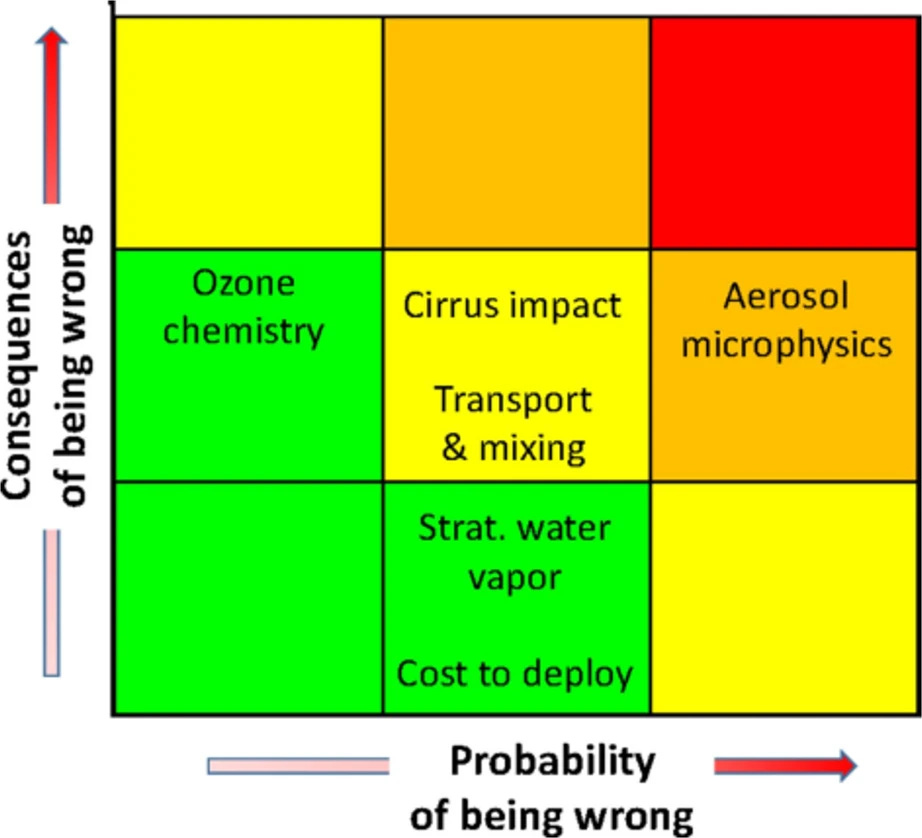
Synopsis: Using five climate models in the Stratospheric Heating Model Intercomparison Project (SHeatMIP), researchers examined how lower-stratospheric heating—an important consequence of SAI, affects climate. All models showed stronger polar jets, increased stratospheric temperatures and water vapor, and shifts in atmospheric circulation. However, substantial model differences remain, with stratospheric water vapor identified as a major source of uncertainty, suggesting observations could help identify the most reliable models for future SAI research.
THESES
Authors: Nguyen, Trung
Synopsis: This dissertation uses high-resolution climate modeling to improve projections of extreme rainfall in the U.S. Midwest and evaluate the regional impacts of SAI. It finds heavy precipitation intensifies under future warming, while SAI slightly reduces extreme rainfall by weakening mesoscale convective systems. The study highlights that convection-permitting models capture local climate impacts far better than coarse global models, providing more reliable information for infrastructure planning and regional assessment of climate intervention strategies.
Geoengineering as Defensive War: Why Climate Change Troubles the Waters of Just War Theory
Authors: Milgrim, Jonathan T.
Synopsis: This thesis argues that climate change can be understood as an unjust war because it threatens the sovereignty and even the existence of vulnerable nations. From this perspective, geoengineering may constitute a form of defensive action to protect affected states. The author explores how this framing challenges traditional just war theory, particularly around self-defense and proportionality, and examines how these ethical tensions might be addressed.
WEB POSTS
Politico - How a conspiracy-fueled campaign could turn Republicans against weather modification
ACIR Hub - What could climate intervention mean for Africa’s renewable energy future?
Peter’s Substack - The Climate Gap - Why cutting emissions alone will not cool a warming planet
The ARC: Thoughts on a Safe Climate Future - Observations from the climate stabilization field
Climate Uncovered - The 3 levers that could stabilise the climate
Inevitable & Obvious - What We Mean by Stabilization
Cape Breton Post - GWYNNE DYER: Climate: What to do now - Solar Radiation Management
WaterLoo Region Record - Heatwaves and wildfires highlight the urgent need for climate intervention
Clare Farrell - Termination Shock: The Faustian Bargain with our Lives
GitHub - Solar Geoengineering Research: India’s Scientific Contribution
SRM360 - Could SRM’s Greatest Risk Be That It Works?
The American Bazaar - Three Indian American researchers earn NASA awards for visionary technology concepts
The Economic Times - In 2011, UK scientists planned to pump water 1 km into the sky to test solar geoengineering equipment, but the balloon never launched
JOB OPPORTUNITIES
“The CVF-V20 seeks a Program Officer to lead delivery of its Climate Emergency and SRM program under the science and health work stream of the Climate Vulnerable Forum. The Program Officer will keep the 74 CVF-V20 member states informed on the evolving science of 1.5°C and the climate emergency, build technical and policy literacy on climate intervention options, including solar radiation management (SRM), marine cloud brightening (MCB), and sea-level-rise interventions, establish institutional mechanisms for informed deliberation on climate intervention governance, and strengthen Global South representation in emerging international discussions. The role provides balanced, evidence-based information and does not advocate for or against any specific intervention.”
UPCOMING EVENTS
19 August | Online - Solar Geoengineering and India – Heat, Pollution, and Politics by SRM360 (NEW)
01 September | Online - Beyond the Headlines: Reporting on Solar Geoengineering by Solution Journalism Network
10-11 September | Washington, DC. - 2026 RFF and Harvard SRM Social Science Research Workshop
12-13 October | Reykjavik, Iceland - Global Risk and Stabilization Summit 2026 by ARC (NEW)
12-15 October | Malaysia - Global Tipping Points 2026 | Abstract Deadline: 15 May
7–11 December 2026 | San Francisco, CA - AGU26 Anuual Meeting | Abstract Submission Deadline: 05 August 2026
10-14 January 2027 | Denver, CO & Online | 19th Symposium on Aerosol–Cloud–Climate Interactions
08-09 April 2027 | United States - 2027 Solar Radiation Management Annual Meeting by Simons Foundation
Add our Solar Geoengineering Events Calendar to your default calendar in 2 ways:
Head to this link: https://teamup.com/ks64mmvtit583eitxx
Sync specific event: Click the event → menu (≡) → Share → choose your calendar → Save.
Or sync all events: Menu (≡) → Preferences → iCalendar Feeds → Copy URL → Add to your calendar settings → Subscribe.
YOUTUBE VIDEOS
“In part 1, Tom will discuss climate change acceleration using the latest CERES data, looking in particular at the role of El Niños as ratchet moments creating jumps in global warming. The predictions for the ‘Goliath’ 2026 event have some worrying prognoses. He’ll discuss the fact that 90% of the accumulating energy goes into the oceans, but is not evenly distributed by depth. Ocean stratification in increasing with a number of impacts.
After this introductory Part 1, in Part 2, Jan Umsonst will dive deeper into some of the main signals inside the system that indicate that we are in the unquantifiable worst case scenario now. The presentation will be based on a sheet where he assembled the main aspects of the vicious feedback cycle between the upper oceans and atmosphere which we are in the process of triggering now.”
The Plan to Dim the Sun Is Already Being Tested | Nick Jackson
“An American startup called Make Sunsets is launching balloons filled with sulfur dioxide and selling cooling credits tied to those releases. The goal is solar geoengineering: place reflective particles in the stratosphere so less sunlight reaches Earth. The company has released far too little to change the global climate, but the physics behind the idea is real.
Mount Pinatubo showed why. After the volcano pushed millions of tons of sulfur dioxide into the stratosphere in 1991, reflective aerosols spread around the planet and global average temperatures fell by roughly half a degree Celsius for about a year or two. That makes stratospheric aerosol injection look like a fast, surprisingly cheap emergency brake.
It is also a mask, not a cure. It would not remove carbon dioxide, and models point to risks involving ozone, rainfall, and rapid rebound warming if a long-running program suddenly stopped. This documentary follows the science from Pinatubo to Make Sunsets, then asks the hardest question: if a company, wealthy individual, or country can alter the climate for everyone, who gets to decide?”
Aspen Ideas: Climate | Ground Rules for Geo-engineering | The Aspen Institute
“As the impacts of climate change grow more severe and global decarbonization goals seem increasingly out of reach, conversations about whether and how to directly intervene in the global atmosphere are growing more serious. As geoengineering moves from science fiction to potential reality, policymakers and the public will need to answer a series of increasingly urgent questions: who gets to decide whether, when, and how much to alter the Earth’s atmosphere?”
“As climate change continues to worsen, and fires rage across the planet, it’s time to ask, can we fix this? This video takes you through Stratospheric Aerosol Injection, how it works, the dangers and advantages.”
Follow us on: Twitter | Bluesky | LinkedIn | Google Group | Podcast
Support us here:
While all content on Solar Geoengineering Updates is free for everyone, We urge those who can to become paid subscribers. Your support empowers this important work and helps us spread the message far and wide.
Thanks for the double shout-out!
Yet another must read stack. Am not sure if to do so LIFO or FIFO. Alot of decent stuff from all in the pushin' and poppin'