
Weekly Solar Geoengineering Updates (06 July - 12 July 2026)
Weekly SRM roundup of research papers, web posts, events, jobs, projects, podcasts, videos and much more.

JUMP TO SECTION
1. This Week’s Top SRM Updates
2. Research Papers
3. Web Posts
4. Reports
5. Upcoming Events
6. YouTube Videos

THIS WEEK’S TOP SRM HIGHLIGHTS
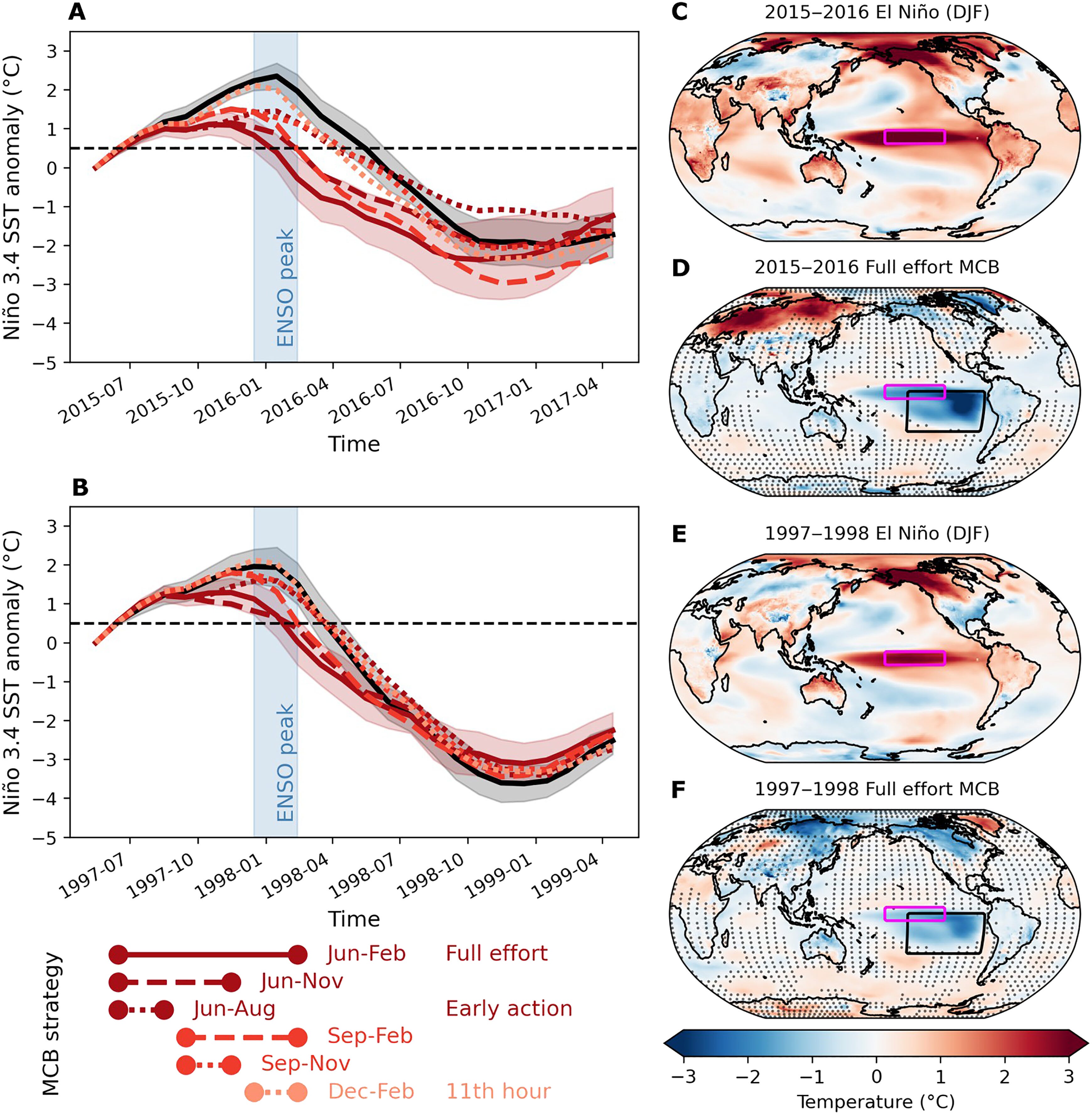
Research Paper: Targeted marine cloud brightening weakens subsequent El Niño (Science Advances)
Monthly News Brief: Monthly Solar Geoengineering Updates (June’2026) (Solar Geoengineering Updates)
Report: Governance of solar radiation modification research (UK Parliament)
Opinion Piece: Engage in the solar geoengineering debate: Why India must shape the rules before the sun goes dim (The Economic Times)
Upcoming Event: Beyond the Headlines: Reporting on Solar Geoengineering (Solution Journalism Network)
YouTube Video: What Happens to Our Food Supply When We Dim the Sun? with Brendan Clark (Climate Chat)
Read on to unpack more updates:
Solar geoengineering is one of the most important climate topics of our time.
If you value accessible, independent coverage of SRM research, governance, experiments, and policy developments, consider subscribing to Solar Geoengineering Updates.
Paid subscriptions directly support keeping this resource public, independent, and growing.
RESEARCH PAPERS
Marine cloud brightening of cumulus clouds: from the sprayer to the cloud
Authors: Johannes Kainz, Daniel P. Harrison, and Fabian Hoffmann
Synopsis: This study uses high-resolution large-eddy simulations with detailed cloud microphysics to evaluate how aerosol sprayer height affects the effectiveness of MCB over trade-wind cumulus clouds. The results show that near-surface sprayers are the most effective because they enhance aerosol dispersion within the boundary layer, increase the number of clouds influenced by the aerosols, and promote greater transport into developing clouds, leading to higher cloud droplet concentrations and improved cloud brightening.
Authors: Kenny T.C. Lim Kam Sian, Victor Ongoma, Temitope Samuel EGBEBIYI, Oualid Hakam, Walker Raymond LEE
Synopsis: Using CMIP6 and GeoMIP6 climate model simulations, this study examines how SRM influences temperature extremes across Northern Africa. While SRM reduces the intensification of extreme heat compared with a high-emissions scenario (SSP5-8.5), it does not replicate the pattern of temperature extremes under a mitigation pathway (SSP2-4.5), even at similar mean temperatures. Instead, SRM produces distinct changes in the frequency, distribution, and structure of temperature extremes, highlighting that cooling global temperatures does not fully restore regional climate extremes.
Climate Change Action and Climate Geoengineering Under Neorealism
Authors: Filipe Duarte Santos and Yvette Ramos
Synopsis: Examining climate politics through both liberal and neorealist international orders, this study explores how global power dynamics shape climate policy and geoengineering. It argues that a shift toward a US–China bipolar system could increase the likelihood of SRM deployment despite its risks, uncertainties, and lack of international governance. The analysis also suggests US climate policy is influenced more by fossil-fuel interests than by climate science, while emphasizing that SRM cannot replace emissions reductions.
Targeted marine cloud brightening weakens subsequent El Niño
Authors: Jessica S. Wan, John T. Fasullo, Nan Rosenbloom, Chih-Chieh Chen, and Katharine Ricke
Synopsis: Building on observations from the 2019–2020 Australian wildfires, this study investigates whether MCB could weaken El Niño events by targeting climate variability rather than long-term warming. Simulations show that early, sustained MCB in the southeast Pacific can disrupt the feedbacks that strengthen El Niño, potentially restoring neutral ENSO conditions and reducing teleconnections. However, the intervention may also trigger unintended consequences, including an earlier La Niña, highlighting the complexity and risks of using MCB to influence climate variability.
Authors: Long Cao and Yu Fang
Synopsis: This study investigates how climate feedbacks influence the effectiveness (forcing efficacy) of CO₂ and stratospheric sulfate aerosol forcing using the NCAR CAM4 climate model. Global aerosol forcing produced about 90% of the warming response of equivalent CO₂ forcing due to differences in albedo, water vapour, lapse rate, and cloud feedbacks. The results also show forcing location matters greatly: polar forcing was over three times more effective than global forcing, while tropical forcing was only about half as effective.
WEB POSTS
Solar Geoengineering Updates - Monthly Solar Geoengineering Updates (June’2026)
The Times - Bright sparks hope drones giving clouds a jolt can cool planet
Kentucky New Era - Legislators urge General Assembly to enforce geoengineering penalties
Peter Dynes - The Red Flags Are Everywhere. Why Are We Still Arguing About Whether Cooling Research Is Necessary?
The Cooler - Is geoengineering going to save us all? - Are we even ready to talk about it?
Issue Wire - Independent Author Explores Solar Geo-engineering, AI and Humanity’s Future in New Adventure Novel
Science News - Can geoengineering blunt El Niño’s fury?
CVNM - Conservation Voters New Mexico Statement of Principles Solar Radiation Modification
SRM360 - Different Takes: Reflections on Paul Crutzen’s SRM Paper, 20 Years On
The Economic Times - Engage in the solar geoengineering debate: Why India must shape the rules before the sun goes dim
Robbie Mallett - Sea ice geoengineering
University of Cambridge - Chasing cloudbows: student builds a drone to measure cloud droplets
New Scientist - Seeding clouds with seawater could prevent a super El Niño
The Economic Times - Not a risk worth taking: Solar Geoengineering could put India’s monsoon at risk
REPORTS
UK Parliament - Governance of solar radiation modification research
UPCOMING EVENTS
16 July | Online - Live Discussion: The History of Solar Geoengineering by SRM360
01 September | Online - Beyond the Headlines: Reporting on Solar Geoengineering by Solution Journalism Network (NEW)
10-11 September | Washington, DC. - 2026 RFF and Harvard SRM Social Science Research Workshop
12-15 October | Malaysia - Global Tipping Points 2026 | Abstract Deadline: 15 May
7–11 December 2026 | San Francisco, CA - AGU26 Anuual Meeting | Abstract Submission Deadline: 05 August 2026
10-14 January 2027 | Denver, CO & Online | 19th Symposium on Aerosol–Cloud–Climate Interactions
08-09 April 2027 | United States - 2027 Solar Radiation Management Annual Meeting by Simons Foundation
Add our Solar Geoengineering Events Calendar to your default calendar in 2 ways:
Head to this link: https://teamup.com/ks64mmvtit583eitxx
Sync specific event: Click the event → menu (≡) → Share → choose your calendar → Save.
Or sync all events: Menu (≡) → Preferences → iCalendar Feeds → Copy URL → Add to your calendar settings → Subscribe.
YOUTUBE VIDEOS
Changing the Climate: Is Solar Geoengineering Hope or Folly? | Plan C: For Civilization
“The PlanCForCivilization team gathered during London Climate Action Week for a private screening and workshop focused on these core questions. In a series of future forward exercises led by Foresight practitioner Tessa Finlev, participants were asked to imagine radical solutions to the climate crisis and the potential paths towards them.
Should solar-geoengineering be one lever we pull? What governance structures need to be in place to decide, collectively, the path forward? “
What Happens to Our Food Supply When We Dim the Sun? with Brendan Clark | Climate Chat
“In this Climate Chat episode, host Dan Miller interviews Cornell atmospheric climate scientist Brendan Clark about his research on how Sunlight Reflection Methods (SRM, a.k.a., solar geoengineering) will impact vegetation growth and agriculture. We will also discuss Brendan’s recent paper on how global warming induced changes to vapor pressure deficit (VPD) is slowing the growth of trees and reducing an important carbon sink.
Dr. Brendan Clark is an atmospheric scientist and Postdoctoral Research Associate at Cornell University who specializes in modeling climate intervention scenarios, specifically Stratospheric Aerosol Intervention (SAI). His research focuses on evaluating the regional trade-offs and agricultural impacts of solar geoengineering, simulating how altered temperature and sunlight patterns would affect global crop production, food security, and terrestrial ecosystems. A former graduate researcher at Rutgers University, he has authored prominent papers on these climate engineering variables, including a lead-author study in Nature Food examining how optimal climate intervention strategies vary by nation.”
IfM Buns Talk - Climate Repair: Can We Refreeze the Arctic? | Centre for Climate Repair
“Global warming is on target to exceed 2C by 2050. Arctic sea ice will almost certainly have vanished by then. The AMOC is weakening. Storms, floods and droughts are increasing in severity and frequency. What can we do? Emissions reductions alone are not sufficient, even when supplemented by carbon offsetting (Net Zero). We’re left with options to reflect sunlight, by emulating volcanic eruptions with stratospheric aerosols or increasing the reflectivity of clouds. There are even people talking about space reflectors. This talk will outline the activities of the Centre for Climate Repair and the options available to us. Time is running out!”
George Monbiot | The Most Important Technology You’ve Never Heard Of | Novara Media
“With Michael Walker and Guardian Columnist George Monbiot.
00:00 Intro
02:23 Farage Vs Binface
09:20 The Cost & Politics Of The Climate Crises
24:22 Blair Vs Humanity
29:13 Carbon Capture
39:22 Geo-Engineering
48:37 “Impossible” Begets “Inevitable”
55:55 Rewilding
1:00:04 “The most important environmental technologies ever developed!”
1:05:34 Will China Save Us?”
Follow us on: Twitter | Bluesky | LinkedIn | Google Group | Podcast
Support us here:
While all content on Solar Geoengineering Updates is free for everyone, We urge those who can to become paid subscribers. Your support empowers this important work and helps us spread the message far and wide.