
Weekly Solar Geoengineering Updates (25 May - 31 May 2026)
Weekly SRM roundup of research papers, web posts, events, jobs, projects, podcasts, videos and much more.

JUMP TO SECTION
1. This Week’s Top SRM Updates
2. Research Papers
3. Web Posts
4. Reports
5. Upcoming Events
6. Podcasts
7. YouTube Videos

THIS WEEK’S TOP SRM HIGHLIGHTS
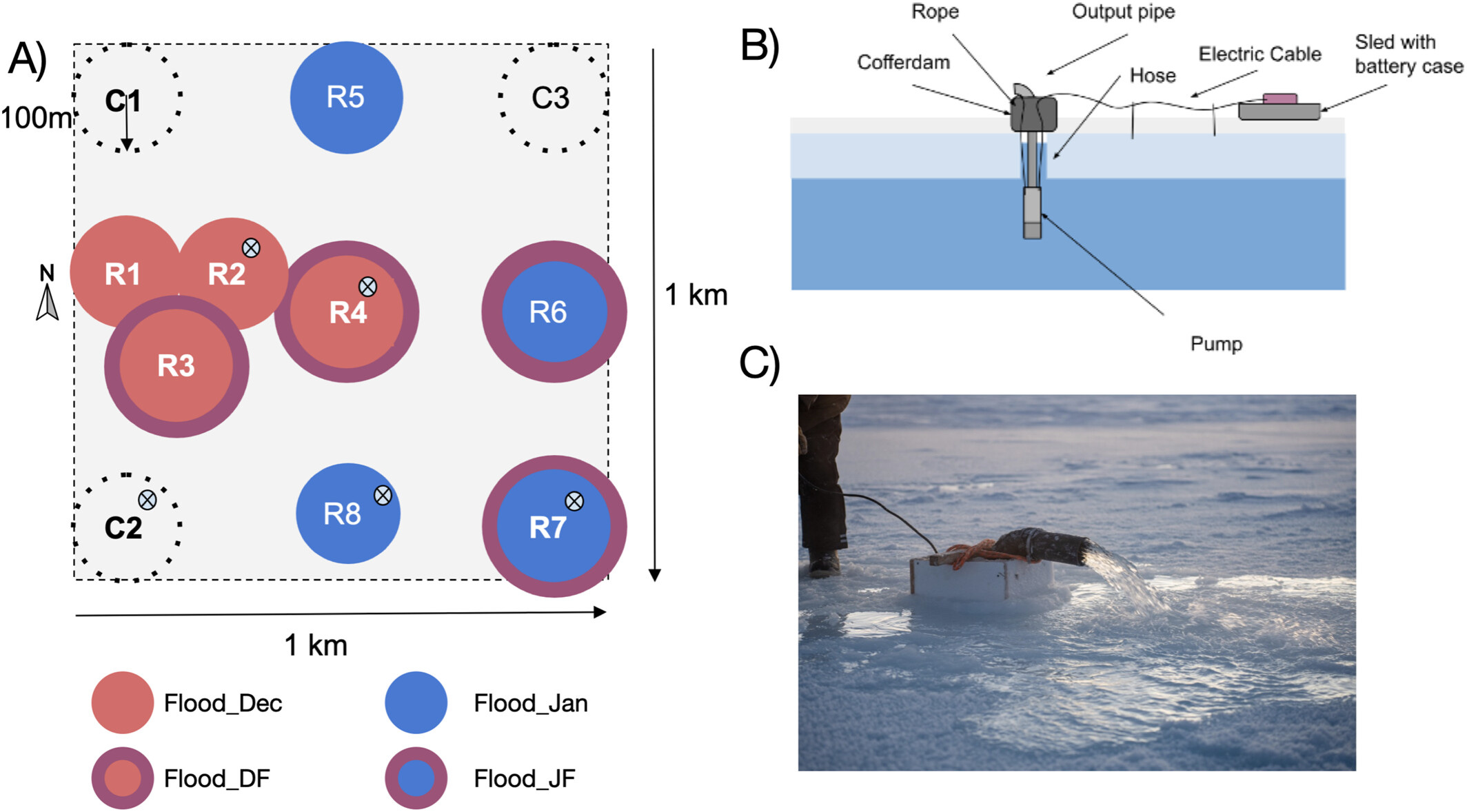
Research Paper: Artificial Flooding Leads to Thicker and Brighter Arctic Sea Ice (AGU)
Preprint: Estimating Twomey forcing sensitivity to aerosol plume spreading rates (EGUsphere)
Report: Options for the responsible governance of research on solar radiation modification (EU Parliament)
Survey: Dim the sun to tackle climate change? Fine by us, public suggests (The Times)
Podcast: How to Dim the Sun (How We Survive)
YouTube Playlist: 2026 Frontiers in Climate Systems Engineering (UChicago Climate Systems Engineering initiative)
Read on to unpack more updates:
Solar geoengineering is one of the most important climate topics of our time.
If you value accessible, independent coverage of SRM research, governance, experiments, and policy developments, consider subscribing to Solar Geoengineering Updates.
Paid subscriptions directly support keeping this resource public, independent, and growing.
RESEARCH PAPERS
Efficacy assessment of stratospheric aerosol scrubbing as a counter climate intervention strategy
Authors: Anthony C. Jones, James M. Haywood, Matthew Henry, and Alistair Duffey
Synopsis: Investigating whether SAI could itself be counteracted, this study evaluates “Stratospheric Aerosol Scrubbing” (SAS), where coarse calcite particles are injected to accelerate aerosol growth and removal. Model simulations suggest SAS can significantly reduce stratospheric aerosol loading and partially offset cooling effects, lowering radiative impacts by around 30% in sustained deployment scenarios. The findings indicate that deliberate interference with SAI may be technically feasible, introducing new considerations for geoengineering governance and potential climate intervention conflicts.
Earned Consent: Rethinking the Authority to Refuse Solar Geoengineering
Authors: Niñoval F. Pacaol & Mary Eimeren P. Tumulak
Synopsis: Amid escalating climate risks and slow mitigation progress, this paper examines whether consent should be considered an absolute requirement for solar geoengineering. The authors argue that while opposition often centers on obtaining consent from states and citizens, this principle may be overridden when those withholding consent are major contributors to emissions driving the crisis. The paper reframes solar geoengineering governance debates around responsibility, justice, and the limits of consent-based objections.
Authors: Edmund Reardon, Adam Boies, Jake Chapman, Daniel Harrison, Dante McGrath, Hugh Hunt, Shaun Fitzgerald
Synopsis: Exploring alternatives to existing MCB spray technologies, this study evaluates superheated atomisation as a method for generating sea salt aerosols. Experiments show the approach can produce narrow aerosol size distributions with most particles falling within the desired submicron range for MCB applications. While energy requirements were comparable to existing effervescent systems, most sprayed mass remained in larger particles, suggesting further optimization is needed before superheated atomisation can become a practical large-scale MCB technology.
Authors: Jie Jiang, Tianjun Zhou, Wenmin Man, Meng Zuo
Synopsis: Examining how SAI could alter rainfall patterns, this study finds that restoring warming to 1.5°C produces uneven hydrological responses across regions. Simulations suggest monsoon regions could experience reduced heavy rainfall alongside higher drought risk in more strongly cooled areas, while adjacent dry regions generally see more precipitation and fewer dry days. These contrasting responses, largely driven by atmospheric dynamics, highlight the possibility that SAI could create new regional hotspots of precipitation-related risks.
Artificial Flooding Leads to Thicker and Brighter Arctic Sea Ice
Authors: Edward Blanchard-Wrigglesworth, Andrea Ceccolini, et al.
Synopsis: Reporting results from the first field campaign to test winter flooding and meltwater drainage on Arctic sea ice across an entire growth and melt season, this study finds that artificially flooded sea ice became substantially thicker, brighter, and slower to melt than untreated areas. Flooded sites gained up to 32 cm of additional thickness, partially offsetting decades of historical thinning observed in the region. The findings suggest targeted ice thickening and surface modification techniques could influence seasonal sea ice evolution, though larger-scale assessments remain necessary.
Authors: Olumuyiwa Ayotunde Oloniyo, Babatunde J Abiodun, et al.
Synopsis: Investigating whether SAI could reduce heat stress across Africa, this study finds that while SAI substantially lowers temperature-driven heat hazards, it is much less effective at reducing overall risk because exposure and vulnerability remain dominant factors. Results suggest SAI only partially offsets future increases in heat stress and fails to restore most countries to baseline risk conditions. The findings emphasize that reducing heat stress requires broader adaptation and resilience strategies alongside any potential climate intervention measures.
Authors: Thejas Kallihosur and Govindasamy Bala
Synopsis: Exploring whether seasonal deployment strategies could reduce some unintended effects of stratospheric aerosol geoengineering, this study finds that restricting aerosol injections to the winter hemisphere can enhance tropical summer monsoon rainfall by shifting the ITCZ toward the summer hemisphere. While this approach increases summer monsoon precipitation and surface water availability across tropical land regions, it also introduces trade-offs, including altered winter precipitation patterns and changes to large-scale atmospheric circulation, highlighting the complexity of regionally targeted SAI strategies.
Authors: Tom Goren, Goutam Choudhury, and Graham Feingold
Synopsis: Researchers present a novel ternary diagram framework to classify marine stratocumulus cloud morphologies using cloud optical thickness categories. Analysis of satellite observations and simulations reveals that cloud evolution follows preferred morphological pathways and that cloud responses to droplet concentration changes differ substantially across cloud types. Results indicate marine cloud brightening outcomes depend strongly on cloud morphology, emphasizing the importance of morphology-specific assessments for climate intervention strategies.
Estimating Twomey forcing sensitivity to aerosol plume spreading rates - Preprint
Authors: Lucas A. McMichael, Ehsan Erfani, Robert Wood, and Knut von Salzen
Synopsis: This study examines how aerosol plume spreading influences the effectiveness of marine cloud brightening by combining realistic cloud simulations with particle dispersion modeling. While different meteorological regimes produced large differences in aerosol spreading rates, Twomey forcing remained relatively insensitive to these natural variations. Results suggest marine cloud brightening effectiveness depends more on aerosol lifetime and cloud responses than turbulence-driven spreading, though assuming unrealistically fast aerosol spreading in climate models could substantially overestimate cooling potential.
Authors: Yoav Lederer, Nahliel Wygoda, Dorri Halbertal, and Brian E. J. Rose
Synopsis: Rather than relying solely on computationally intensive climate models, this study introduces a new 2-D modeling framework to evaluate solid-particle options for stratospheric aerosol injection (SAI). Using silica and calcite as case studies, researchers examine how particle properties, aggregation behavior, and injection strategies affect cooling efficiency and stratospheric heating. Results show tropical injection maximizes cooling efficiency but increases heating penalties, while material choice strongly influences outcomes, with calcite producing substantially lower heating effects than silica.
Authors: ABDUL HASEEB TANOLI, Shams ul Arfeen
Synopsis: Addressing the trade-offs of conventional sulfate-based stratospheric aerosol injection, this study proposes a new core-shell mineral aerosol design, DoloSil-20, to tackle the competing goals of cooling efficiency, reduced heating, and ozone protection. Using a simplified aerosol model, the silica-coated dolomite particles showed stronger light-scattering performance and substantially lower modeled ozone impacts than sulfate while maintaining negligible heating effects. Although denser particles reduced atmospheric persistence, results suggest engineered mineral aerosols could offer promising alternatives for future SAI research.
Authors: Cameron Dong, James W. Hurrell, Elizabeth A. Barnes
Synopsis: Using deep learning-based diffusion downscaling, this study examines how SAI could influence future extreme precipitation across the contiguous United States at much finer spatial resolution than conventional climate models allow. Results suggest SAI could substantially reduce projected increases in extreme precipitation overall, cutting average increases in annual maximum rainfall by nearly half compared to non-SAI scenarios. However, regional differences remain significant, highlighting the importance of high-resolution assessments when evaluating SAI impacts.
WEB POSTS
The Times - Dim the sun to tackle climate change? Fine by us, public suggests
New Scientist - Geoengineering can thicken Arctic sea ice, but for how long?
Peter Dynes - The New Termination Shock
The DP - Penn Climate executive director discusses future of solar technology at Drexel film screening
Financial Times - Letter: Climate interventions also need their own governance
Chicago Business - UChicago forum examines the future of climate intervention
Inevitable & Obvious - The Case for a Planetary Sunshade
Atmos - With Geoengineering, a Fringe Climate Solution Moves Into the Mainstream
The University of Chicago - Second-Year Zilin Xiang Wins Inaugural CSEi Student Essay Contest
SRM360 - A Necessary Intervention: A Utilitarian Case for Governed SAI
SRM360 - The Cultural Architecture of SAI: Systems, Resource Extraction, and Climate Justice
Rebrighten - Draft Book: Sunlight Reflection - The Business Case for an Albedo Accord
REPORTS
EU Parliament - Options for the responsible governance of research on solar radiation modification
UKRI - Public dialogue explores solar radiation modification research
UPCOMING EVENTS
02 June | Philadelphia, United States - Plan C for Civilization: Screening & Discussion (SOUTH PHILLY)
02-04 June | Rwanda - The IAF Global Space Conference on Climate Change 2026 - Uniting Space and Earth for Climate Resilience
03 June | Online - Foundations of SRM Research & African Climate Implications by Emerging Climate Frontier
05 June | Philadelphia, United States - Plan C for Civilization: Screening & Discussion (NORTH PHILLY)
15 June | Online - SRM Research on a Rapidly Changing Planet: Earth System Tipping Points by Co-Create
20-21 June | United States - Bridging the Knowledge Gaps in Climate Engineering with Experiments, Models, and Observations by Gordon Research Seminar
21-26 June 2026 | United States - Gordon Research Conference - Bridging Observations, Models, and Impacts in Solar Radiation Modification Research
10-11 September | Washington, DC. - 2026 RFF and Harvard SRM Social Science Research Workshop
12-15 October | Malaysia - Global Tipping Points 2026 | Abstract Deadline: 15 May
Add our Solar Geoengineering Events Calendar to your default calendar in 2 ways:
Head to this link: https://teamup.com/ks64mmvtit583eitxx
Sync specific event: Click the event → menu (≡) → Share → choose your calendar → Save.
Or sync all events: Menu (≡) → Preferences → iCalendar Feeds → Copy URL → Add to your calendar settings → Subscribe.
PODCASTS
How to Dim the Sun | How We Survive
“Could dimming the sun be the key to cooling things down before the climate crisis worsens? Some scientists say yes, that we can cool the earth by launching tons of sulfur dioxide into the stratosphere. It’s a type of solar geoengineering that was once seen as preposterous, meant to exist only in the pages of a sci-fi novel. But now, it’s a reality.
To find out for ourselves, we travel to Northern California where two entrepreneurs are launching sulfur-filled balloons from the top of stacked shipping containers. Later, we talk with scientists on both sides of this issue to find out if solar geoengineering could help prevent catastrophic tipping points or introduce a whole new slew of cascading consequences.”
YOUTUBE VIDEOS
“Dr. Daniel Harrison is an Associate Professor in the Faculty of Science and Engineering at Southern Cross University in Australia. He is Chief Investigator for the Cooling and Shading Subprogram of the Reef Restoration and Adaptation Program (RRAP) and the Marine Cloud Brightening in a Complex World project through the UK’s Advanced Research and Invention Agency (ARIA).
In this recording describes his team’s research into the use of Marine Cloud Brightening to reduce coral bleaching. This project has a lead role in advancing the governance and technology of MCB.”
Solar radiation modification: a public dialogue | Sciencewise
“What does the UK public think about solar radiation modification (SRM) – proposed ways of cooling the planet by reflecting sunlight back into space?
In this film, participants, specialists and the team behind the dialogue share their experience of deliberating on one of the most complex questions in climate science – and what that process revealed about how the public weighs up the potential benefits, risks and ethics of SRM.
The dialogue, co-commissioned by UKRI’s Natural Environment Research Council (NERC) and Sciencewise, brought together 52 people from across the UK. Over more than 17 hours of workshops and online sessions between September and October 2025, they heard from 19 specialists and deliberated in depth on this complex and emerging area of climate science.
Their findings – including six principles they believe should guide SRM research – provide evidence that can inform how researchers, funders and policymakers think about SRM.”
“Video abstract for the third volume in the Cambridge Elements series on Public Engagement with Science. In this video abstract, authors Sikina Jinnah, Zachary Dove, and Shuchi Talati give an overview of their Element, Building Capacity for Public Engagement on Solar Geoengineering.”
“Exploring climate interventions at the science-policy interface” | World Climate Research Programme
“This webinar brings together leading voices to bridge the often fragmented dialogue between scientific research and policy implementation in climate intervention. Through three expert talks and an interactive discussion, participants explore how knowledge can be effectively exchanged across science, policy, and practice to support informed climate action.”
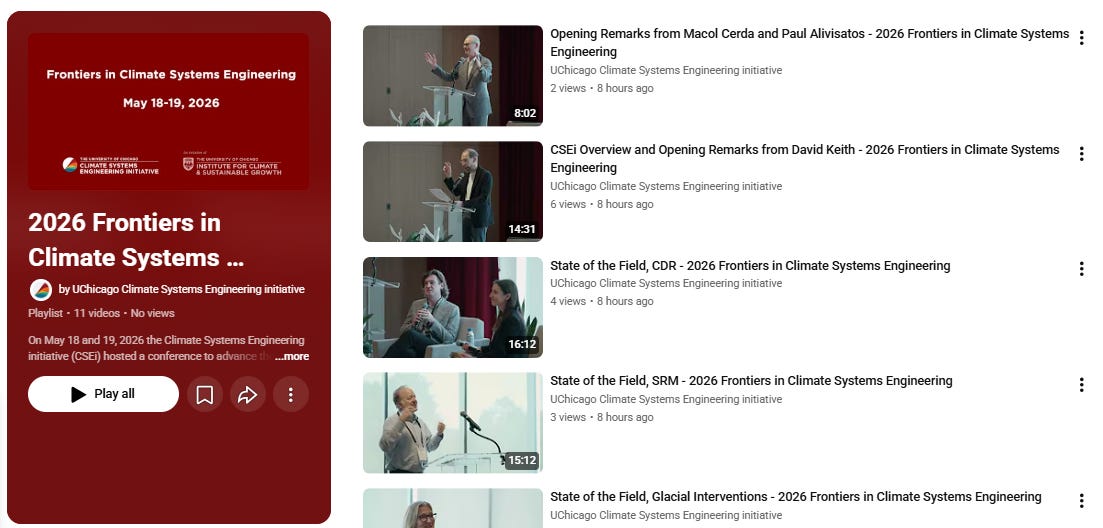
“On May 18 and 19, 2026 the Climate Systems Engineering initiative (CSEi) hosted a conference to advance the understanding of climate engineering through rigorous analysis and open debate.”
How could the first decade of solar geoengineering unfold? | SRM360
“Join SRM360 for a live discussion on what the first ten years of solar geoengineering could look like, and how it might unfold.
An expert panel featuring Holly Buck , Edward Parson, and Cynthia Scharf will discuss:
– Under what conditions might solar geoengineering be deployed – and how soon might that be?
– What risks and challenges could the world face in the early stages of deployment?
– What could governments and organisations do now to reduce those risks?”
“Climate change is worsening fast, and some researchers are exploring Solar Radiation Modification (SRM) as a possible way to temporarily cool the planet. With research funding from governments and philanthropies growing, commercial actors entering the space, and field experiments multiplying, this public panel offers an accessible introduction to SRM and the governance challenges this topic presents. A panel of interdisciplinary experts from across the Co-Create project will introduce the different dimensions of a responsible governance approach for SRM research, before opening up for audience questions. The session will touch on the science, societal viewpoints, international law, governance guidelines and ethics that will be explored in more detail throughout the rest of the conference.”
“Principles and Guidelines: what are they, and how do they support decision-making? Contributions from a research funder, lawmaker, researcher, and civil society.
Speakers:
• Matthias Honegger (Senior Research Consultant, Perspectives Climate Research)
• Lili Fuhr (Director – Fossil Economy Program, Center for International Environmental Law)
• Manon Simon (Lecturer, University of Tasmania)
• Shuchi Talati (Founder & Executive Director, The Alliance for Just Deliberation on Solar Geoengineering)
• Billy Williams (Executive Vice President – Ethics and Organizational Advancement, American Geophysical Union)”
[Co-CREATE Forum] Closing plenary: Visual Synthesis & Path Forward | Climate Strategies
“In this livestreamed session, will mark the close of the Co-CREATE Forum. Hosted by Matthias Honegger (Senior Research Consultant, Perspectives Climate Research), with the participation of conference participants.”
Plan C for Civilization: Film Screening and Panel | Columbia Business School
“Plan C for Civilization tackles the promise and peril of solar geoengineering with exclusive verite access to its protagonist David Keith and the SCoPEx project, as well as the rogue geoengineers of Make Sunsets. From Bangladesh to Nevada, solar geoengineering is emerging after more than 60 years in the shadows, and with it, a new chapter of the climate change saga. After the film screening, V. Faye McNeill (Chemical Engineering) and Gernot Wagner (Columbia Business School) had a discussion with the documentary filmmaker Ben Kalina (Mangrove Media LLC). This session was moderated by Vincent Sandow-Straesser, ’26CCS.”
Follow us on: Twitter | Bluesky | LinkedIn | Google Group | Podcast
Support us here:
While all content on Solar Geoengineering Updates is free for everyone, We urge those who can to become paid subscribers. Your support empowers this important work and helps us spread the message far and wide.