
Weekly Solar Geoengineering Updates (24 November - 30 November 2025)
Weekly SRM roundup of research papers, web posts, events, jobs, projects, podcasts, videos and much more.


1. This Week’s Top SRM Highlights
2. Research Papers
3. Web Posts
4. Job Opportunities
5. Upcoming Events
6. YouTube Videos
This newsletter provides SRM coverage free of charge & without advertising. We rely on donations from readers like you to keep our content accessible to everyone & pay our staff. If you value credible SRM coverage, please donate now to support our work.
RESEARCH PAPER: Social attitudes towards climate interventions: Are European publics uninformed about carbon removal and solar radiation management? (ScienceDirect)
PREPRINT: Strong Light Absorption by sp2 Hybridized Carbon Impurities in Diamond Dust (SSRN)
EXPLAINER: What’s the Difference Between Adaptation and Geoengineering? (Inevitable & Obvious)
NEWS: UK ‘not in favor’ of dimming the sun (Politico)
JOB OPPORTUNITY: Freezing Points: Ice Nucleation Experiments, Climate Intervention, and the Politics of the Sky (University of Leeds, School of Earth & Environment)
UPCOMING EVENT: Engineering and logistical concerns add practical limitations to stratospheric aerosol injection strategies by CSEi (University of Chicago)
VIDEO: Too late to cool? AMOC and Subpolar Gyre under delayed SAI - Claudia Wieners at Arctic Repair 2025 (Centre for Climate Repair)
Read on to unpack more updates:

Cloud fraction response to aerosol driven by nighttime processes
Authors: Geoffrey Pugsley, Edward Gryspeerdt, and Vishnu Nair
Synopsis: Stratocumulus cloud sensitivity to aerosols is dominated by nighttime processes. Using a Lagrangian framework, the study shows aerosols suppress precipitation most effectively at night, shaping next-day cloud fraction and radiative impact. Daytime clouds thin with aerosols, but nighttime processes partly offset this. Results underscore the need for nighttime observations and better diurnal-cycle modeling when evaluating aerosol forcing and MCB viability.
Authors: Benjamin K. Sovacool, Livia Fritz, Chad M. Baum, Lucilla Losi, Ramit Debnath, et al.
Synopsis: Surveys and focus groups across five European countries show diverse, often conflicting views on carbon removal and SRM. Attitudes are shaped by familiarity, trust, governance concerns, perceptions of “tampering with nature,” and personal climate experiences. Because support varies widely, no single policy approach fits all; inclusive engagement is essential to ensure fair, socially acceptable climate intervention strategies.
Authors: Michael S. Diamond and Lili F. Boss
Synopsis: Increased ship traffic rerouted around Africa after Houthi attacks revived detectable ship-track cloud effects in the SE Atlantic. Comparing pre- and post-2020 fuel sulfur limits shows that an ~80% cut in sulfur emissions produced a ~67% drop in cloud droplet enhancement per unit fuel burned. Despite lower per-ship brightening, higher 2024 traffic restored observable cloud perturbations linked to shipping pollution.
Potential impacts of climate interventions on marine ecosystems - Preprint
Authors: Kelsey E Roberts, Tyler Rohr, Morgan R Raven, Michael S Diamond,, Daniele Visioni, Ben Kravitz, et al.
Synopsis: As warming increasingly threatens marine ecosystems, interest in CDR and SRM is rising. This review outlines marine-focused intervention methods and highlights major uncertainties. While these approaches may reduce some warming-driven impacts, they could also disrupt food webs, biodiversity, and ecosystem function. Effects depend heavily on pathway, scale, and region, underscoring the need for detailed impact assessments to guide low-risk strategies and avoid harmful scenarios.
Strong Light Absorption by sp2 Hybridized Carbon Impurities in Diamond Dust - Preprint
Authors: Joshin Kumar, Gwan-Yeong Jung, Taveen S. Kapoor, Rohan Mishra, Rajan Chakrabarty
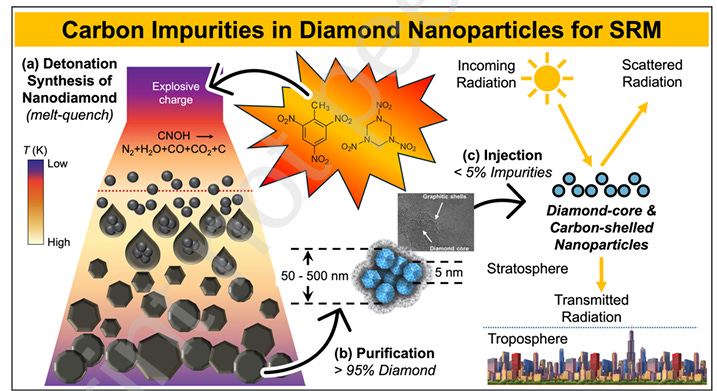
Synopsis: Diamond dust for SAI may absorb more sunlight than expected due to unavoidable sp² carbon impurities from detonation synthesis. Modeling shows even thin impurity shells can raise absorption to ~15% of black carbon and lower scattering efficiency, potentially shifting radiative forcing toward warming. Results suggest diamond’s suitability for SAI needs reevaluation.
Authors: lala kounta, Lifeng Luo, Gouri Anil, Daniel M. Hueholt, Cheryl Shannon Harrison, Daniele Visione, et al.
Synopsis: SAI can reduce future marine heatwave (MHW) intensity and duration compared with SSP2-4.5, but impacts are uneven. Model results show 25–76% of the ocean sees lower MHW intensity and 21–80% sees shorter events, with strongest benefits in coastal zones and the Tropical Atlantic, Indian, Arctic, and South Atlantic. Yet even under ARISE-SAI-1.0, ~25% of the ocean - especially the North Atlantic, Tropical Pacific, and parts of the Southern Ocean - still faces worsening MHWs.
Authors: Alex M. Mason, Matthew Henry, Haruki Hirasawa, Fiona M. O’Connor, and James Haywood
Synopsis: MCB uses sea-salt aerosol injections to brighten marine clouds, but climate effects vary by region. Using 42 UKESM1.0 simulations across 14 regions and three injection rates, this study designs optimized deployment strategies to restore the 2040s SSP2-4.5 climate to a 2014–2033 baseline. Multi-target optimization (temperature, precipitation, sea ice, SOI) shows combined regional MCB - especially including high latitudes - can improve sea-ice recovery and produce more balanced climate responses.
Marine Cloud Brightening of Cumulus Clouds: From the Sprayer to the Cloud - Preprint
Authors: Johannes Kainz, Daniel Patrick Harrison, and Fabian Hoffmann
Synopsis: Using large-eddy simulations with Lagrangian microphysics, this study evaluates how aerosol sprayer height influences MCB effectiveness in trade-wind cumulus clouds. Surface-level sprayers perform best, maximizing boundary-layer dispersion and aerosol entrainment into developing clouds, thereby increasing the fraction of clouds affected and boosting cloud droplet formation.
Authors: Alan Gadian
Synopsis: This paper discusses the initial development of Marine Cloud Brightening as a theoretical idea, from its inception as a cloud microphysics process in circe 1990 to the full-blown concept by 2015. It primarily focuses on the work of founders John Latham and Stephen Salter and their contributions. Recently the concept has been developed further, e.g. in the UK ARIA project, as a prospective method to ameliorate the Earths rapid warming.

Axios - Where Bill Gates draws the line on dimming the sun
Neil Hacker - There is no outside anymore
The ARC: Thoughts on a Safe Climate Future - The Climate Dashboard: Seeing the Whole System
Inevitable & Obvious - What’s the Difference Between Adaptation and Geoengineering?
SRM360 - When SRM Meets MAGA – Conspiracies, Politics, and Potential Profits
The Invading Sea - Reluctance to abandon fossil fuels has turned technology into a last resort
The Degrees Initiative - Researchers and policymakers team up in Bogotá to unpack the challenges of SRM
Associated Press of Pakistan - Experts urge Pakistan to declare climate change a National Health Emergency, call for SRM integration to protect million
Independent - Government ‘not in favour’ of controversial efforts to dim the sun
The Telegraph - Dimming the Sun to fight climate change is bad for planet, ministers fear
Politico - UK ‘not in favor’ of dimming the sun
DSG - Debates on Governing Solar Geoengineering Research
Quebec Science - The environmentalist who changes course
Sueddeutsche Zeitung - Saving humanity or taking an uncalculabe risk?
CDRA NET - Geoengineering’s image problem
Sustainability Magazine - Why Do Stardust & the UK Disagree on Sun Dimming Technology?

“Cirrus clouds have a significant impact on Earth’s climate, yet their formation—particularly the role of ice-nucleating particles (INPs)—remains poorly understood. The climate intervention strategy known as cirrus cloud thinning (CCT) aims to reduce warming by modifying these clouds, but it relies on uncertain science and raises complex political issues. This research area integrates laboratory studies of deposition-mode ice nucleation with critical analysis of how scientific knowledge is produced, interpreted, and used in policy and geopolitical contexts. By situating the researcher’s own scientific practice within these dynamics, the work will generate insights to inform decision-making around geoengineering proposals.”
Director, Research Development at Climate Systems Engineering initiative, University of Chicago
“The Climate Systems Engineering initiative (CSEi) is a new University-wide research effort seeded in the Physical Sciences Division (PSD) and part of a larger climate and energy focus at the University of Chicago, anchored in the Institute for Climate and Sustainable Growth. CSEi addresses the science, engineering, and policy of new technologies to reduce or reverse the harms from accumulated greenhouse gasses, including open-systems carbon removal, solar geoengineering, and local interventions to slow the melting of glaciers. The initiative spans engineering, physical and biological sciences, social sciences, humanistic approaches, behavioral science, law, policy and ethics, bringing together a collaborative group of faculty and researchers and leveraging the global network and partnerships of the University.”

14 - 30 November | Online - Documentary Plan C For Civilization World Premiere
01 December | Online & In-person (UK) - Good COP, Bad COP: First reflections on COP30 by Centre for Climate Repair
04 December | Online - Live Discussion: Are emissions cuts on track to avoid catastrophic impacts? by SRM360
09 December | Online - What is Global Cooling? by Sebastian Manhart
11 December - University of Chicago | Engineering and logistical concerns add practical limitations to stratospheric aerosol injection strategies by CSEi (NEW)
15-19 December | New Orleans, Louisiana - 2025 American Geophysical Union Meeting
9-13 March 2026 | Kyoto, Japan - CMIP Community Workshop (CMIP26)
21-26 June 2026 | United States - Gordon Research Conference - Bridging Observations, Models, and Impacts in Solar Radiation Modification Research
Add our Solar Geoengineering Events Calendar to your default calendar in 2 ways:
Head to this link: https://teamup.com/ks64mmvtit583eitxx
Sync specific event: Click the event → menu (≡) → Share → choose your calendar → Save.
Or sync all events: Menu (≡) → Preferences → iCalendar Feeds → Copy URL → Add to your calendar settings → Subscribe.

The Global Heating Emergency: What’s the Plan? | Negative Emissions Platform
“This event will elucidate the current dramatic acceleration of global temperatures, discuss the expected impacts on humanity and planetary ecosystems, the prospective roles of CDR, emissions reductions, and sunlight reflection in averting 2 degrees, and the practical next steps for the global community to mobilize around a new, comprehensive climate plan.”
“Stardust is making very rapid progress on Solar Geoengineering (SRM - Solar Radiation Management, or Solar Radiation Methods, solar climate engineering, solar reflection technologies, etc...). They reportedly have 25 engineers/scientists and seed funding of $75 million.
They are working on a full SRM deployment system using a white reflective powder to be deployed in the stratosphere to cool the planet, and their timeline is over the next decade or so. Very significant and very fast.”
“In this episode Charlie explains the recent measurement of accelerating atmospheric CO2 concentrations in the atmosphere as well as the announcement that coral bleaching has passed a tipping point, while Clare delves into the world of solar radiation management at a recent conference she attended with James Hansen.”
“Possibly the best- known SRM method so far is Stratospheric Aerosol Injection (SAI), which would work by injecting a reflective aerosol (e.g. sulphate) or a precursor gas (e.g. SO2) into the stratosphere.”
European Public Attitudes Toward Climate Intervention Technologies | Remove and Reflect Podcast
“This episode covers an academic article that presents an analysis of European public opinion regarding two sets of climate interventions: Carbon Dioxide Removal (CDR) and Solar Radiation Management (SRM). Researchers employed a mixed-methods approach, synthesizing results from five nationally representative surveys and ten focus groups spanning Austria, Germany, Italy, Norway, and the United Kingdom. The study finds a significant knowledge gap, with publics expressing widespread lack of familiarity with most technologies, particularly SRM, although conventional, nature-based CDR methods are better recognized. Attitudes across the countries reflect a pervasive aversion to tampering with nature, often counterbalanced by general worry about climate change impacts. Furthermore, when considering governance, respondents place the highest degree of confidence in universities and scientific institutes to oversee these technologies, while displaying comparatively low trust in national governments and industry. The findings suggest that effective governance requires context-sensitive policies and robust public engagement, rather than standardized solutions.”
“Ramit leads the Cambridge Collective Intelligence and Design Group. With a background in electrical engineering and computational social sciences, he designs collective intelligence approaches to provide a data-driven, complex system-level understanding of barriers to climate action, their interactions, and how these translate to leverage points for policy and behavioural interventions at scale. At CCR, Ramit uses computational social sciences, ML and AI to better understand the public awareness of emerging climate engineering technologies.”
“Agenda
Robert T – Albedo accord
Ron B – Open letter advocating immediate testing and deployment of SAI and other near-term cooling methods.
Chris V – Royal soc update on SRM – related to above.
Chris/Ron – Stardust – Politico piece
Clive E – Diter Helm lessons on COP-30”
Dimming the Sun for Climate Change is Back on the Table | Crossroads with Joshua Philipp
“The practice known as solar geoengineering, which has been discussed, and even experimented with as a way to fight alleged climate change, is back on the table.”
Follow us on:
Twitter | Bluesky | LinkedIn | Substack | Google Group | Podcast 1 | Podcast 2
Support us here:
While all content on Solar Geoengineering Updates is free for everyone, We urge those who can to become paid subscribers. Your support empowers this important work and helps us spread the message far and wide.
Great information.