
Weekly Solar Geoengineering Updates (22 June - 28 June 2026)
Weekly SRM roundup of research papers, web posts, events, jobs, projects, podcasts, videos and much more.

JUMP TO SECTION
1. This Week’s Top SRM Updates
2. Research Papers
3. Web Posts
4. Reports
5. Upcoming Events

THIS WEEK’S TOP SRM HIGHLIGHTS
Research Paper: Trade-Offs between Sulfuric Acid Aerosol Precursors for Stratospheric Aerosol Geoengineering (ACS Publications)
Preprint: A new Profiling Optical Particle Counter to study stratospheric aerosols (EGUSphere)
Opinion Column: Why sunblock in the Earth’s atmosphere is no longer a crazy idea (The Times)
Blog Post: In a week of extreme heat, can we talk about geo-engineering? (Clare Farrell)
Report: Tackling the Existential Threat of Climate Change - Collective action to manage, mitigate, and reduce climate risk (FP Analytics)
Upcoming Event: AGU26 Annual Meeting (AGU)
Read on to unpack more updates:
Solar geoengineering is one of the most important climate topics of our time.
If you value accessible, independent coverage of SRM research, governance, experiments, and policy developments, consider subscribing to Solar Geoengineering Updates.
Paid subscriptions directly support keeping this resource public, independent, and growing.
RESEARCH PAPERS
Authors: Ya Gao, Lili Xia, Juan Wang, Chaochao Gao
Synopsis: This study examines how ocean latent heat flux responds to sustained stratospheric aerosol geoengineering compared with the 1815 Tambora volcanic eruption. While LH compensates for aerosol-induced cooling in both cases, continuous aerosol intervention weakens the ocean's ability to buffer radiative changes due to reduced stored ocean heat. The findings show that volcanic eruptions are imperfect analogues for sustained stratospheric aerosol injection, particularly when assessing regional hydroclimatic impacts.
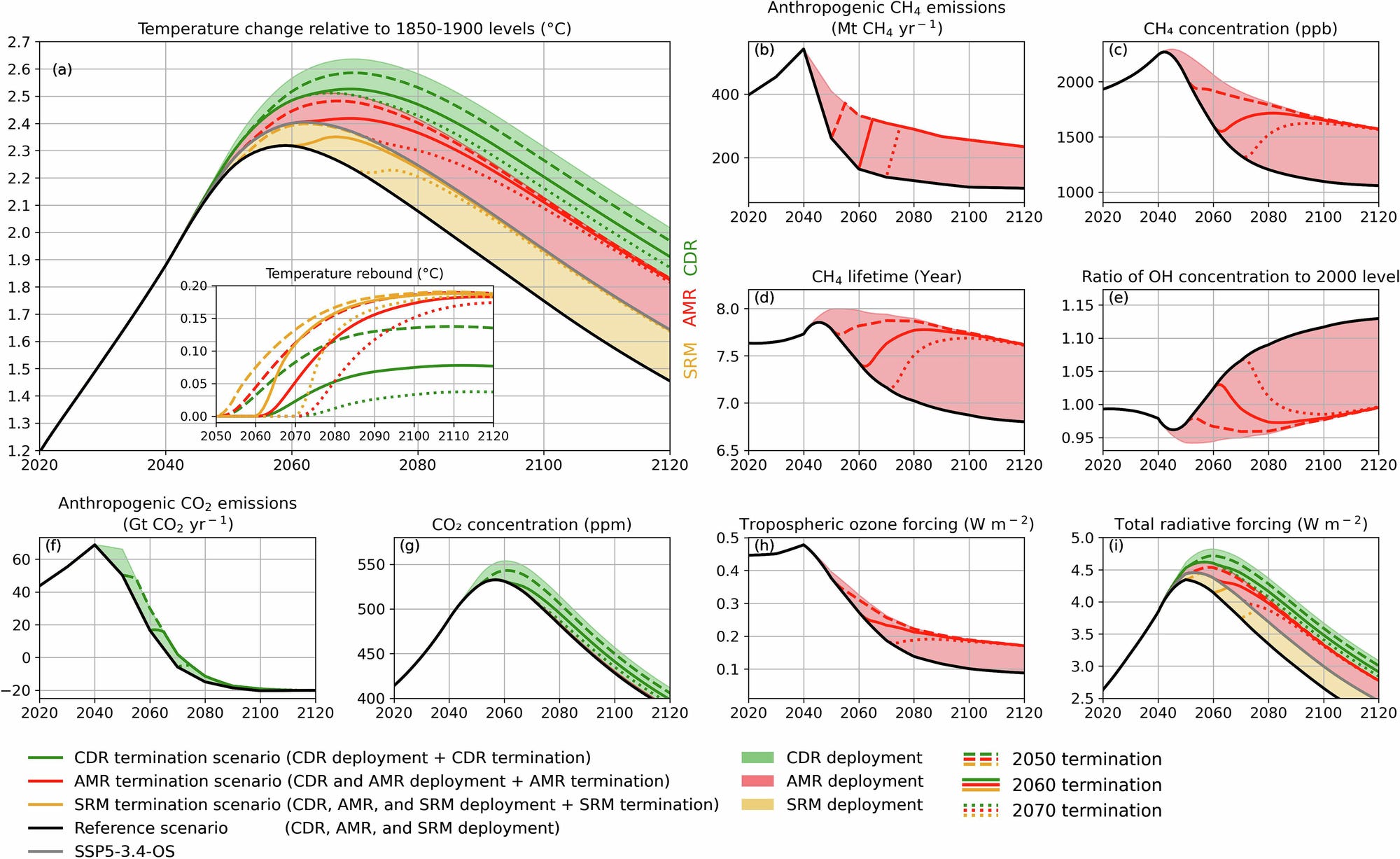
Authors: Katsumasa Tanaka, Weiwei Xiong, Didier A. Hauglustaine, et al.
Synopsis: This study examines Atmospheric Methane Removal (AMR) as a third climate intervention approach alongside CDR and SRM. It finds that AMR reduces warming, but its benefits are not long-lasting because methane has a short atmospheric lifetime. Unlike SRM, AMR produces a more gradual temperature rebound after termination, while its effects on tropospheric ozone depend on background air pollution levels.
Geoengineering: Infrastructures for a Global Climate?
Authors: Simon Dalby
Synopsis: As climate change intensifies, interest is growing in climate intervention technologies such as carbon dioxide removal CDR and SRM. If deployed, these approaches could become critical climate management infrastructure. This paper examines the governance challenges surrounding their implementation, arguing that the absence of robust international frameworks could either enable global cooperation or fuel geopolitical disputes over who controls climate intervention and how it should be governed.
Trade-Offs between Sulfuric Acid Aerosol Precursors for Stratospheric Aerosol Geoengineering
Authors: James Franke, Wake Smith, Angela Slavens, Frank N. Keutsch, Fangqun Yu, David Keith
Synopsis: This study compares six sulfur compounds as potential materials for SAI. Hydrogen sulfide (H₂S) could reduce lofting costs by about half compared with SO₂, though it introduces flammability risks and uncertain production costs. Elemental sulfur (S₈) is safer but requires undeveloped combustion technology, while sulfur trioxide (SO₃) and sulfuric acid (H₂SO₄) are more expensive but may improve control over aerosol size and reduce some side effects of SAI.
A new Profiling Optical Particle Counter to study stratospheric aerosols - Preprint
Authors: Jean-Paul Vernier, Nicolas Dumelie, Amit Kumar Pandit, et al.
Synopsis: Researchers have adapted the lightweight, low-cost Profiling Optical Particle Counter (POPC) for weather balloon missions, enabling detailed measurements of stratospheric aerosol size distributions. The latest 500 g, 30-channel version provides observations comparable to established instruments and has successfully detected volcanic and wildfire aerosol plumes. With 87 flights since 2018, POPC now supports the international BalNeO network, providing publicly available data to improve understanding of stratospheric aerosols relevant to climate, atmospheric chemistry, satellite validation, and potential solar radiation management research.
Geoengineering, moral hazard, and disrespect - Preprint
Authors: Alice Baderin, Maxime Lepoutre
Synopsis: Scientists and policymakers are increasingly considering solar geoengineering to address climate change, but ethical concerns remain. This paper argues that the influential “moral hazard” objection, claiming geoengineering research weakens emissions reductions, faces a dilemma: restricting research is either unnecessary or reflects disrespect for public agency. The analysis challenges the objection, identifies the empirical evidence needed to support it, and offers broader insights into respecting individual agency in public policy design.
WEB POSTS
DSG - SRM as a Tool for Climate Security: Competitive Framing and its (Geo)Political Implications
Green European Journal - A Feminist Approach to Solar Geoengineering
The Times - Why sunblock in the Earth’s atmosphere is no longer a crazy idea
Inevitable & Obvious - Stabilization Needs a State That Works
MSU - Cooling strategy not a panacea for marine heat waves
ABC Net - Private companies want to geoengineer the sky. The rain billions of people depend on could be disrupted
CPG - Scientists Plan to Release Air Bubbles Underwater to Protect Antarctica’s “Doomsday Glacier” from Melting
C.F.G - What Europeans think about solar radiation modification
Clare Farrell - In a week of extreme heat, can we talk about geo-engineering?
EPFL - The hidden atmospheric cost of Arctic shipping
SRM360 - What Do People in Bangladesh Think About SRM?
REPORTS
FP Analytics - Tackling the Existential Threat of Climate Change - Collective action to manage, mitigate, and reduce climate risk
UPCOMING EVENTS
30 June | Online - How Should Solar Geoengineering Research Be Governed? by SRM360
02 July | New York - Plan C for Civilization (Close Up w/ dir. Ben Kalina) (NEW)
10 July | University of Cambridge, UK - Climate Repair: Can we Refreeze the Arctic? by Centre for Climate Repair
10-11 September | Washington, DC. - 2026 RFF and Harvard SRM Social Science Research Workshop
12-15 October | Malaysia - Global Tipping Points 2026 | Abstract Deadline: 15 May
7–11 December 2026 | San Francisco, CA - AGU26 Anuual Meeting | Abstract Submission Deadline: 05 August 2026 (NEW)
10-14 January 2027 | Denver, CO & Online | 19th Symposium on Aerosol–Cloud–Climate Interactions
08-09 April 2027 | United States - 2027 Solar Radiation Management Annual Meeting by Simons Foundation
Add our Solar Geoengineering Events Calendar to your default calendar in 2 ways:
Head to this link: https://teamup.com/ks64mmvtit583eitxx
Sync specific event: Click the event → menu (≡) → Share → choose your calendar → Save.
Or sync all events: Menu (≡) → Preferences → iCalendar Feeds → Copy URL → Add to your calendar settings → Subscribe.
Follow us on: Twitter | Bluesky | LinkedIn | Google Group | Podcast
Support us here:
While all content on Solar Geoengineering Updates is free for everyone, We urge those who can to become paid subscribers. Your support empowers this important work and helps us spread the message far and wide.