
Weekly Solar Geoengineering Updates (18 May - 24 May 2026)
Weekly SRM roundup of research papers, web posts, events, jobs, projects, podcasts, videos and much more.

JUMP TO SECTION
1. This Week’s Top SRM Updates
2. Research Papers
3. Thesis
4. Web Posts
5. Job Opportunity
6. Upcoming Events
7. Podcasts
8. YouTube Videos

THIS WEEK’S TOP SRM HIGHLIGHTS
Research Paper: On the detectability by uninvolved parties of covert stratospheric aerosol injection programs producing transboundary impacts (IOP Science)
Research Paper: Differentiating Solar Radiation Modification Field Experiments: Scale, Technical Characteristics, and Governance Implications (Earth’s Future)
Thesis: Tropical Agriculture Responses to Stratospheric Aerosol Intervention (ProQuest)
Request for Information: Babin, McCormick Request NOAA Briefing on Marine Cloud Brightening and Geoengineering Oversight (Committee on Science, Space, and Technology)
News Piece: Could microscopic spheres of silica help cool the planet? (Economist)
Job Opportunity: Arctic Initiative Project Director (Harvard University)
Upcoming Event: SRM Research on a Rapidly Changing Planet: Earth System Tipping Points (Co-Create)
Podcast: Plan C for Civilization — Ben Kalina | SRM Is Coming Faster Than You Think — Ben Kalina on 15 Years Filming Climate’s Most Controversial Idea (Inevitable & Obvious)
YouTube Video: SGRP Lunch Talk: Thinking Well About Solar Geoengineering (The Salata Institute at Harvard University)
Read on to unpack more updates:
This newsletter is free to read, but not free to produce. Please consider a paid subscription to support our independent reporting.
RESEARCH PAPERS
AMOC weakening in response to global and regional reductions in aerosol emissions
Authors: Robert J Allen, Timothy Carson, Wei Liu, Laura J Wilcox, et al.
Synopsis: Reductions in anthropogenic aerosol emissions aimed at improving air quality may contribute to weakening of the Atlantic Meridional Overturning Circulation (AMOC) by mid-century. Using climate model simulations, the study finds that aerosol reductions increase warming and surface shortwave radiation in the North Atlantic, reducing ocean buoyancy and weakening circulation strength. Emissions cuts in North America and Europe produce the strongest effects, highlighting how regional air quality policies can influence large-scale ocean circulation and climate dynamics.
Authors: Heri Kuswanto, Hakan Ahmad Fatahillah, Candra R. W. S. W. Utomo, Tintrim Dwi Ary Widhianingsih and Kartika Fithriasari
Synopsis: Evaluation of the Geoengineering Large Ensemble (GLENS) over Southeast Asia finds that the model ensemble systematically underestimates uncertainty in daily precipitation and temperature projections during 2020–2025. Comparisons with ERA5 observations reveal poor prediction interval coverage and strong underdispersion across ensemble members. Because these issues stem from the ensemble system itself rather than SAI forcing, the study argues that statistical post-processing is necessary before GLENS projections are used for regional Stratospheric Aerosol Injection (SAI) impact assessments.
Authors: I. Hernandez-Galindo, A. Määttänen, B. H. Redmond Roche, O. Boucher, P. J. Irvine, J. C. Moore
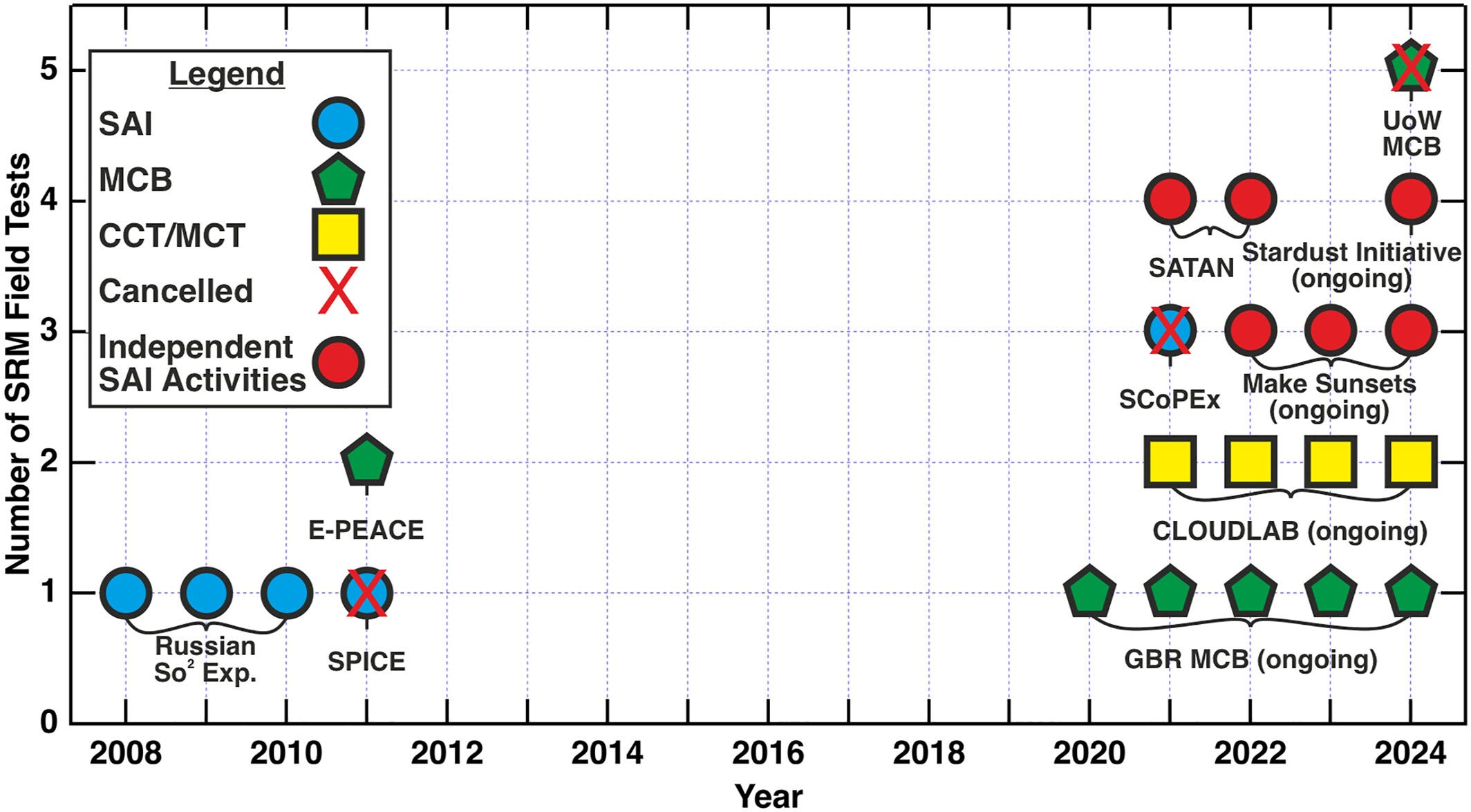
Synopsis: This review examines past SRM and SRM-relevant field experiments across Stratospheric Aerosol Injection (SAI), Marine Cloud Brightening (MCB), and Cirrus/Mixed-Phase Cloud Thinning (CCT/MCT). Analyzing projects such as SPICE, SCoPEx, E-PEACE, and Great Barrier Reef MCB trials, the study evaluates experiments using six parameters, including feasibility, monitorability, reversibility, and exit ramps. It finds that while small-scale trials demonstrated technical potential, inconsistent governance practices, public opposition, ethical concerns, and limited transparency contributed to the cancellation of several projects, underscoring the need for stronger governance frameworks for future SRM research.
Authors: B. H. Redmond Roche, I. Hernandez-Galindo, A. Määttänen, et al.
Synopsis: This study develops a phase-based typology of plausible SRM field experiments across SAI, MCB, and CCT/MCT. Moving beyond simplistic “small- vs large-scale” distinctions, it identifies near-, intermediate-, and distant-phase experiments with varying scientific aims, scales, and governance implications. The paper highlights regulatory gray zones, governance gaps, transparency needs, and stakeholder legitimacy challenges, particularly within existing EU legal frameworks.
Authors: Wake Smith, Matias Alberola, Jasper Boers, Karen Rosenlof and Daniele Visioni
Synopsis: This study examines whether SAI could be deployed covertly to manipulate climate without other states detecting it. The authors argue that while small-scale experiments with negligible impacts could remain hidden, any deployment large enough to produce transboundary climatic effects would be detectable well in advance. They identify two reliable detection methods already available to civilian actors: satellite monitoring of sulfate precursor plumes and observation of the aircraft fleets required for high-altitude aerosol injection.
Energy management strategies for mitigating Arctic amplification using a solar chimney
Authors: Yang Liu, Li Zhou, Chong Peng, Tingzhen Ming, Mohammad Hossein Ahmadi, et al.
Synopsis: This paper reviews proposed SRM approaches for reducing Arctic amplification and introduces a localized alternative aimed at lowering environmental risks. The proposed system uses a solar chimney-driven spray ice-enhancing mechanism to increase Arctic sea ice coverage and thickness while transferring heat above the temperature inversion layer. By weakening surface albedo and lapse rate feedbacks, the approach seeks to slow Arctic warming. The study also examines operational challenges, environmental considerations, and preliminary designs for an experimental prototype.
Assessing retrieval biases in ship tracks - Preprint
Authors: Iarla Boyce, Alice Cicirello, and Edward Gryspeerdt
Synopsis: Satellite retrieval assumptions about cloud droplet size distributions may bias estimates of aerosol-cloud interactions in ship tracks, which are widely used as natural laboratories for studying cloud responses to pollution. The study finds that neglecting the narrowing of droplet size distributions in polluted marine clouds can significantly overestimate cloud droplet number concentrations, potentially exaggerating the Twomey effect and overstating the apparent effectiveness of climate interventions such as MCB.
Authors: Abdul Haseeb Tanoli, Shams ul Arfeen, Zeeshan Anwar, Yasir Abbas
Synopsis: A nationwide survey conducted by the PIEAS SAI Research Initiative highlights widespread public concern over climate change impacts in Pakistan, including disrupted rainfall, extreme heat, agricultural stress, floods, and smog. Drawing on 1,149 responses across all major administrative regions, the report finds high levels of climate awareness and significant reported household damage from climate-related events. While respondents prioritized afforestation and water management, the study also situates these findings within broader research into SAI as a potential temporary supplement — not substitute — to emissions reductions and conventional climate adaptation measures.
Authors: Jaylynn M Brunelli and Prof. Michael Steven Diamond
Synopsis: This study assesses how SAI could influence global climate-zone shifts and associated “adaptation burdens” under future warming scenarios. Using a modified Köppen-Trewartha climate classification system, the authors find that climate changes under an SAI scenario resemble those under a medium-emissions pathway and are substantially less severe than under high greenhouse gas emissions alone. However, significant uncertainties remain regarding the regional distribution and magnitude of impacts, reflecting differences in climate model responses to aerosol forcing.
Delaware Corporate Law as Geoengineering Regulation
Authors: Luis Armando Martínez
Synopsis: This article argues that Delaware corporate governance law may become a key legal framework shaping private-sector SAI activities in the United States. Focusing on fiduciary duties and corporate oversight obligations under cases such as Caremark and Marchand, the study examines how corporate law could encourage both responsible risk monitoring and opportunistic behavior among SAI firms. It highlights the growing importance of private law in governing emerging climate intervention technologies amid the absence of dedicated SAI regulation.
Authors: Iris Hilbrich
Synopsis: Researchers’ perspectives on geoengineering differ significantly across regions, reflecting unequal experiences of climate risk and global power dynamics. Drawing on interviews with German and South African scientists, this study shows how geoengineering debates are shaped by spatial inequalities, with vulnerable Global South countries often marginalized in decision-making. The chapter argues that governance and technology assessment for high-risk climate interventions must account for regional justice, neocolonial continuities, and differing imaginaries of risk.
THESIS
Tropical Agriculture Responses to Stratospheric Aerosol Intervention
Authors: Nina Grant
Synopsis: This dissertation explores how SAI could affect tropical agriculture under climate change. Using process-based crop models, the study finds that SAI may improve yields for rainfed rice and wheat in India, particularly rainfed wheat, while having limited effects on irrigated crops. For coffee and cocoa, yields are projected to decline under future warming scenarios, with SAI providing modest improvements but not restoring production to historical levels. The research also highlights that conventional adaptation measures, such as adjusting planting dates, could partially reduce agricultural climate stress even without SAI.
WEB POSTS
American Academy of Arts & Sciences - Solar Radiation Modification (SRM) Primer
Peter’s Substack - The Stardust Problem
SRM360 - SAI: How Low Can You Go?
Financial Times - Can geoengineering avert a climate catastrophe?
E&E News by Politico - GOP lawmakers question federal oversight of sunlight-blocking tech
Economist - Could microscopic spheres of silica help cool the planet?
City of Erice - Collection of signatures for a popular initiative bill entitled “Blue Skies - Ban on Modifying Weather Conditions (Geoengineering)”
APP - Experts discuss climate innovation at COMSATS University
Committee on Science, Space, and Technology - Babin, McCormick Request NOAA Briefing on Marine Cloud Brightening and Geoengineering Oversight
SRM360 - Stardust Reveals Its Particles for Climate Cooling
The Atmospheric Crucible - Unilateral Solar Geoengineering and the Limits of International Human Rights Law
JOB OPPORTUNITIES
Arctic Initiative Project Director at Harvard University | Cambridge
“The Project Director will conceptualize, organize, and convene the Arctic Initiative’s core activities aimed at advancing an understanding of the Arctic region, its opportunities and challenges. The Arctic Initiative Project Director will act as senior leadership of the program providing oversight and strategic guidance to all aspects of the Arctic Initiative project.”
UPCOMING EVENTS
26 May | Philadelphia, United States - Plan C for Civilization: Screening & Panel Discussion (WEST PHILLY)
26 May | Online - How Could the First Decade of Solar Geoengineering Unfold? by SRM360
26-29 May | Tórshavn, Faroe Islands - Healthy Humans and Oceans in the Arctic
28 May | Arena 2 Plenum - Building and Sharing Knowledge of Climate Interventions by UArctic Congress
27-29 May | Belgium - International Forum on Solar Radiation Modification Research Governance by Co-Create
01 June | Online - CSAR lecture: Beyond Net Zero: Can We Repair The Climate? by University of Cambridge
02 June | Philadelphia, United States - Plan C for Civilization: Screening & Discussion (SOUTH PHILLY)
02-04 June | Rwanda - The IAF Global Space Conference on Climate Change 2026 - Uniting Space and Earth for Climate Resilience
03 June | Online - Foundations of SRM Research & African Climate Implications by Emerging Climate Frontier
05 June | Philadelphia, United States - Plan C for Civilization: Screening & Discussion (NORTH PHILLY)
15 June | Online - SRM Research on a Rapidly Changing Planet: Earth System Tipping Points by Co-Create (NEW)
20-21 June | United States - Bridging the Knowledge Gaps in Climate Engineering with Experiments, Models, and Observations by Gordon Research Seminar
21-26 June 2026 | United States - Gordon Research Conference - Bridging Observations, Models, and Impacts in Solar Radiation Modification Research
10-11 September | Washington, DC. - 2026 RFF and Harvard SRM Social Science Research Workshop
12-15 October | Malaysia - Global Tipping Points 2026 | Abstract Deadline: 15 May
Add our Solar Geoengineering Events Calendar to your default calendar in 2 ways:
Head to this link: https://teamup.com/ks64mmvtit583eitxx
Sync specific event: Click the event → menu (≡) → Share → choose your calendar → Save.
Or sync all events: Menu (≡) → Preferences → iCalendar Feeds → Copy URL → Add to your calendar settings → Subscribe.
PODCASTS
“Sunlight reflection has spent decades as an idea scientists batted around at academic conferences. Now venture-backed companies are racing to build deployment systems, state legislatures are passing bans on weather modification research, and the public still mostly thinks the contrails overhead are a government plot. Ben Kalina has been pointing a camera at this entire evolution for fifteen years. Plan C for Civilization, his documentary on the field’s emergence as serious research, is the closest thing we have to a real historical record of how this is unfolding. We talked about what changed Ben’s mind about the timeline, why average audiences leave his film more curious not less, the strange dynamics of venture capital entering a space that runs on trust, and what of the Stardust Solutions optics problem can and cannot be engineered away.”
YOUTUBE VIDEOS
“Debates about solar geoengineering often move quickly to questions about whether the technology should be researched or eventually deployed. But those questions cannot be answered adequately if they are poorly framed. In this talk, Britta Clark, a Postdoctoral Research Fellow with the Harvard Solar Geoengineering Research Program, examines several recurring errors in public and academic discussions of solar geoengineering. By bringing these errors into view, she aims to clear the way for a more precise, productive, and honest debate over the role of solar geoengineering in the energy transition.”
“In this Climate Chat episode, host Dan Miller interviews Planetary Sunshade Institute’s Board Member and former Executive Director, Ross Centers, on the science, risks, and reality of using giant space-based sunshades located between the Sun and the Earth to reduce global warming.”
Follow us on: Twitter | Bluesky | LinkedIn | Google Group | Podcast
Support us here:
While all content on Solar Geoengineering Updates is free for everyone, We urge those who can to become paid subscribers. Your support empowers this important work and helps us spread the message far and wide.