
Weekly Solar Geoengineering Updates (05 January - 11 January 2026)
Weekly SRM roundup of research papers, web posts, events, jobs, projects, podcasts, videos and much more.


1. This Week’s Top SRM Highlights
2. Research Papers
3. Thesis
4. Web Posts
5. Projects
6. Podcasts
7. YouTube Videos
8. Upcoming Events
Subscribe to stay informed on solar geoengineering tech and support our independent reporting through a paid subscription.
Follow us on:
Twitter | Bluesky | LinkedIn | Google Group | Podcast


Research Paper: Design of Hydrogen Powered High Altitude Conventional Tube-Wing Aircraft for Aerosol Injection in Stratosphere (WashU)
Research Paper: Design of Hydrogen Powered High Altitude Canard-Wing Aircraft for Aerosol Injection into the Stratosphere (WashU)
Thesis: Studying Climate Intervention Scenarios With Data Science Methods (ProQuest)
Opinion Series: It’s time to talk about geoengineering (The Guardian)
Podcast: Malaria Trends and SRM - Hussain (Reviewer 2 does geoengineering)
Opinion Piece: Impacts of the US withdrawal from the UNFCCC and the IPCC (Janos Pasztor)
Video: Let's Brighten Some Clouds (ToSaveTheWorld)
Read on to unpack more updates:

Authors: Thomas S. Richardson, Matthew Watson, Duncan Hine et al.
Synopsis: Monitoring Aerosol Climate Engineering (MACE) is a UK project developing an autonomous uncrewed aerial system to measure aerosol and cloud microphysics in hazardous volcanic plumes as natural analogues for SRM. Using high-altitude, zero-emission aircraft with AI-guided plume interception, MACE will study aerosol injection, dispersion, chemistry, and radiative effects relevant to SAI and MCB through field campaigns at active volcanoes.
Economic assessment of SRM under socio-political and geophysical tipping dynamics
Authors: Francisco Estrada, Bernardo Adolfo Bastien-Olvera, et al.
Synopsis: As SRM gains policy attention, its feasibility depends on avoiding abrupt termination that could trigger severe warming. This study introduces a coupled socio-political–geophysical tipping point framework and a novel damage function sensitive to warming rates and catastrophic risks. Modeling shows SRM only reduces global risk under strict conditions: strong mitigation, extremely low failure probability, and gradual phase-out—conditions that conflict with current political realities.
Authors: Raymond J. Hogea
Synopsis: This study presents the conceptual design and performance analysis of a hydrogen-powered, high-altitude aircraft for long-endurance aerosol dispersion. Using Raymer-based sizing, hybrid weight estimation, and RDSwin simulations, the aircraft achieves sustained flight at 65,000 ft with a 3.5-hour cruise while carrying a 50,000 lb payload. Results confirm the feasibility of a hydrogen-powered tube-wing configuration for efficient, high-altitude, long-duration missions.
Authors: Edward N. Hogea
Synopsis: This paper outlines the conceptual design and initial performance assessment of a hydrogen-powered, high-altitude canard-wing aircraft for stratospheric aerosol injection. Designed to deliver a 50,000 lb payload at 65,000 ft with zero CO₂ emissions, the aircraft uses liquid hydrogen turbofans and a swept canard configuration. Mission analysis shows sustained cruise near performance limits, demonstrating technical feasibility for high-altitude aerosol delivery.
Geoengineering Revisited in the Shadow of Climate Crisis and Technocratic Control
Authors: Radu Simion
Synopsis: Revisiting geoengineering ethics a decade on, this paper argues that climate intervention has become normalized in policy without sufficient public debate or ethical scrutiny. It critiques technocratic framings of SRM that privilege control and preparedness over legitimacy, justice, and plural knowledge systems. The author calls for an alternative ethical framework grounded in epistemic humility, intergenerational justice, inclusive governance, and deeper reflection on the planetary futures geoengineering implies.
Authors: Anna Lange, Ulrike Niemeier, Alexei Rozanov, and Christian von Savigny
Synopsis: This study examines limits of satellite solar occultation measurements under large-scale stratospheric aerosol injection scenarios. Simulating continuous SO₂ injections (30 Tg S/yr) with MAECHAM5-HAM and SCIATRAN, it shows that high aerosol loads cause “zero transmission” at some latitudes and wavelengths. Results identify latitude-dependent minimum wavelengths needed for reliable aerosol extinction retrievals, demonstrating occultation remains viable, especially at longer wavelengths, with relevance for both SRM and volcanic eruptions.
Deployment Strategy Shapes the Polar Climate Response to Marine Cloud Brightening - Preprint
Authors: Erin J. Emme, Chih-Chieh Chen, Hannah Horowitz
Synopsis: Using nine CESM2 simulations, this study examines how Marine Cloud Brightening deployment location and seasonality affect polar climate and sea ice while restoring global temperatures to 1.5 °C. Results show MCB is most effective when deployed in the same hemisphere and during local summer, enhancing sea ice area and thickness. Bilateral hemispheric deployment improves polar outcomes, especially in Antarctica, without major climate disruptions.
Authors: Tom Goren, Goutam Choudhury, and Graham Feingold
Synopsis: This study introduces a ternary-diagram framework to classify marine stratocumulus cloud morphologies using cloud optical thickness. Applied to satellite data and large-eddy simulations, it reveals preferred evolutionary paths and explains observed morphology distributions. Results show morphology-dependent cloud responses to droplet number changes, with liquid water path and albedo effects often canceling, highlighting the need for morphology-aware assessments of marine cloud brightening.
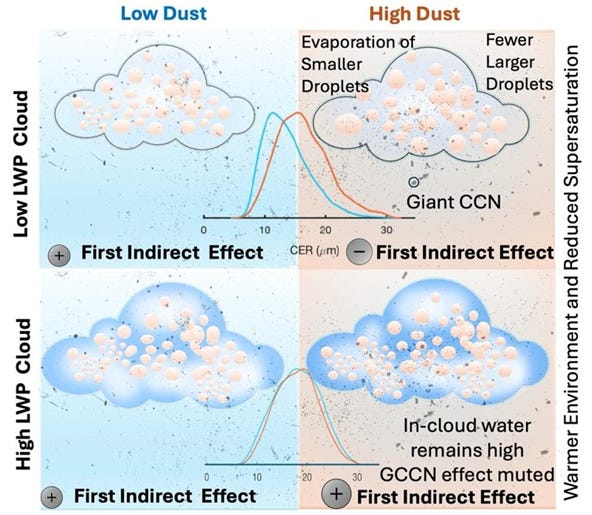
Authors: Satyendra Pandey, Adeyemi Adebiyi, Yang Lian, V Vinoj, Xue Zheng
Synopsis: Mineral dust strongly alters aerosol–cloud interactions in warm marine clouds, but its role remains uncertain. Using satellite and reanalysis data (2003–2024), this study shows Saharan dust increases cloud effective radius by ~9% and weakens the first indirect effect by ~1.25×, even reversing its sign for thin clouds. Coarse dust acting as giant CCN and dust-driven radiative warming drive this response, yielding a net positive top-of-atmosphere forcing of 0.38 W m⁻².

Studying Climate Intervention Scenarios With Data Science Methods
Authors: Connolly, Charlotte
Synopsis: This dissertation examines how Stratospheric Aerosol Injection (SAI) scenarios are designed and analyzed, focusing on both coordinated global deployment and single-actor interventions. It evaluates atmospheric responses, sensitivity to internal variability, and risks of counter-deployment. The work introduces an interpretable machine-learning emulator trained on CESM2 simulations to support scenario design, highlighting overlooked assumptions and the need for broader, more critical exploration of SAI futures.

E&E News by Politico – Republican introduces bill to study only negative effects of geoengineering
Janos Pasztor – Impacts of the US withdrawal from the UNFCCC and the IPCC
The Guardian – It’s time to talk about geoengineering
The Guardian – We can safely experiment with reflecting sunlight away from Earth. Here’s how | Dakota Gruener and Daniele Visioni
The Guardian – We study glaciers. ‘Artificial glaciers’ and other tech may halt their total collapse | Brent Minchew and Colin Meyer
The Guardian – If geoengineering is ever deployed in a climate emergency, transparency is key | Ines Camilloni
UChicago Magazine – To the skies
Financial Times – Letter: Climate priority is to curb near-term temperatures
InsightAI – The $60 Million Race to “Shade the Sun” Responsibly
Jacobin – Capitalists Want You to Stop Worrying About Climate Change

ARIA - Re-thickening Arctic Sea Ice (RASI)
Led by Shaun Fitzgerald at the Centre for Climate Repair (University of Cambridge), the RASI project is supported by a £9.9m grant over 42 months. The consortium unites specialised field teams — Real Ice and Arctic Reflections — with a global network of research partners including the University of Manchester, UCL, the University of Washington, and NERSC, to combine rigorous scientific modelling with real-world Arctic experimentation.
Two separate sub-teams of researchers (Real Ice, Arctic Reflections) will conduct controlled, small-scale experiments in two locations in Canada. These experiments have been designed in close collaboration with local communities and in compliance with ARIA’s stringent governance framework. The goal is to gather essential real-world data to rigorously assess if this intervention warrants further consideration.

Malaria Trends and SRM - Hussain | Reviewer 2 does geoengineering
In this episode, @geoengineering1 interviews Athar Hussain, physicist and professor of atmospheric science at COMSATS University, Pakistan, about his recent study examining how SAI could influence malaria transmission across South Asia. Using the VECTRI malaria model, the research compares an unmitigated high-emissions pathway (RCP8.5) with the GLENS-SAI scenario, which stabilizes global temperatures at 2020 levels, across seven countries: Afghanistan, Bangladesh, Bhutan, Iran, India, Nepal, and Pakistan.
The discussion highlights that while SAI could reduce overall malaria transmission intensity across much of the region by lowering vector density, entomological inoculation rates (EIR), and case numbers, its effects are spatially uneven, with localized increases projected in parts of Pakistan, Afghanistan, Iran, and Nepal. The conversation also explores the public-health implications of these shifts, the potential risks and trade-offs of solar geoengineering, and the importance of region-specific strategies, local expertise, and international collaboration in addressing climate-related health risks.
Paper: Hussain, A., Shoaib, M., & Latif, M. (2025). Malaria transmission dynamics under climate change and solar geoengineering in South Asia: a GLENS-based assessment. Malaria Journal, 24(1), 439. https://doi.org/10.1186/s12936-025-05666-2”

What is Global Cooling? - with Paul Gambill | Sebastian Manhart
“In this conversation, Sebastian Manhart and Paul Gambill delve into the pressing topic of global cooling and solar geoengineering.
They discuss the urgency of addressing climate change, the transition from carbon removal to geoengineering, and the moral hazards associated with these technologies.
The conversation also touches on the challenges of governance, the role of the private sector, and the importance of cultural engagement in shaping public perception.
Ultimately, they emphasize the need for open discussions and a shift in societal attitudes towards these critical issues.”
MEERTalk with Paul Gambill | MEER SRM
“The only permanent solution to Earth’s energy imbalance is removing over 1.5 trillion tonnes of excess CO2 from the atmosphere. In less than a decade, an industry has emerged from nothing: 700+ companies, billions invested, and real technology proving out. And yet for all that progress, we remain orders of magnitude behind the pace required to lower global temperatures before crossing catastrophic tipping points. If carbon removal can’t arrive in time—and the math suggests it can’t—what fills the gap? In this talk Paul makes the case that cooling interventions aren’t Plan B—they’re what makes Plan A possible.”
“Dr. Lili Xia (Rutgers University, USA) : “Agriculture responses to Solar Radiation Modification: Connecting Broader Impact Studies”
Dr. Pat Keys (Colorado State University, USA): “Designing Scenarios for Exploring Unilateral Climate Intervention”“
“Miranda Hack (Columbia University, USA): “Engineering and logistical concerns add practical limitations to stratospheric aerosol injection strategies”.
Morgan Goodwin & Jeff Overbeek (Planetary Sunshade Foundation, USA): “Reflecting Sunlight from Space: Unique Capabilities for Climate Intervention”“
Let’s Brighten Some Clouds | ToSaveTheWorld
“Alan Gadian shares some memories of early Marine Cloud Brightening research by John Latham and Stephen Salter. Robert Tulip and Peter Wadhams have been major innovators in the field too.”
“Essentially, we are experiencing “Global Brightening”. Over time, the amount of the incoming solar energy (shortwave radiation) from the Sun that reaches the Earth surface is rapidly increasing. The effect of reduction of aerosols (air pollution and sulfates) means that is less direct scattering and there are fewer low level clouds and thus more warming due to indirect effects, namely fewer cloud condensation nuclei. Essentially, the “Global Dimming” effect has been replaced now with “Global Brightening”.”

30 January | Online - Could solar geoengineering help protect coral reefs? by SRM360
9-13 March 2026 | Kyoto, Japan - CMIP Community Workshop (CMIP26)
03-08 May | Vienna, Austria & Online - EGU26
13-15 May | University of Nottingham - IAA Planetary Sunshade Workshop by Planetary Sunshade Foundation
17-19 March | Tokyo, Japan - Sixteenth GeoMIP 2026 Meeting by Alan Robock and Daniele Visioni
28 – 29 May | Belgium - International Forum on Solar Radiation Modification Research Governance by Co-Create
02-04 June | Rwanda - The IAF Global Space Conference on Climate Change 2026 - Uniting Space and Earth for Climate Resilience (NEW)
20-21 June | United States - Bridging the Knowledge Gaps in Climate Engineering with Experiments, Models, and Observations by Gordon Research Seminar
21-26 June 2026 | United States - Gordon Research Conference - Bridging Observations, Models, and Impacts in Solar Radiation Modification Research
Add our Solar Geoengineering Events Calendar to your default calendar in 2 ways:
Head to this link: https://teamup.com/ks64mmvtit583eitxx
Sync specific event: Click the event → menu (≡) → Share → choose your calendar → Save.
Or sync all events: Menu (≡) → Preferences → iCalendar Feeds → Copy URL → Add to your calendar settings → Subscribe.
Follow us on:
Twitter | Bluesky | LinkedIn | Substack | Google Group | Podcast 1 | Podcast 2
Support us here:
While all content on Solar Geoengineering Updates is free for everyone, We urge those who can to become paid subscribers. Your support empowers this important work and helps us spread the message far and wide.
Fantastic roundup, especially the morphology-conditioned cloud study. The ternary diagram approach for classifying cloud optical thickness is clever, but the finding that liquid water path and albedo effects cancel out is kinda sobering for MCB potential. I've been following the marine strat ocumulus work and this morphology dependence piece explains alot of the previous inconsistencies. Really curious how this plays into the deployment strategies now.